Wednesday, September 15, 2021

ARTSPACE OPEN SOURCE EXHIBITION, OCTOBER 2021

In the year since Artspace’s Open Studios 2020 (see my contribution here), I’ve continued my work on the Tarot panels and on the series called “renderings.” My work on this year's website can be found here (when the Artspace link goes live October 15).

First up, one of the latter. This painting, which I worked on in May and October 2020, is based on a photograph I took of my wife Mary and our newborn daughter in Philadelphia in summer 1981. Apart from its considerable personal meaning for me, as an image and as a souvenir of a particular time and place, I’ve always felt the image had a great potency. The protective abandon of the maternal figure, the way the child in sleep is still in the posture of nursing, but also looks as if she’s trying to “take in” the mother. The mother’s T-shirt and cutoffs certainly conjure fond memories for me, but are also great fun to paint, set against all the pillows and sheets, as are the flesh tones. It’s probably the first painting I’ve done where painting for the sake of painting is involved. I hope there will be more.

In this series there are three other works in progress that are too in flux for me to want to post their images. All three are intended as gifts anyway so I don’t mind keeping them under wraps for now.

And now, onto the Tarot panels.

Last year, I had finished the first 3 panels of the “Ethos” section. Now I can present them together with the last two to comprise what should be a quincunx of paintings, like this:

Individually, here they are:


“Ethos 1: O The Fool” (April-May, 2020): The image of The Fool is of a man stepping off a cliff because he’s not paying attention.

 “Ethos 2: XIX The Sun” (May-July, 2020): The Sun is depicted as a naked cherub looking at his own reflection, above a desert.

“Ethos 3: I The Magus” (June-September, 2020): On a stage which might also be a church, the Magus kneels on one knee, lifts a microphone and an illuminating finger.

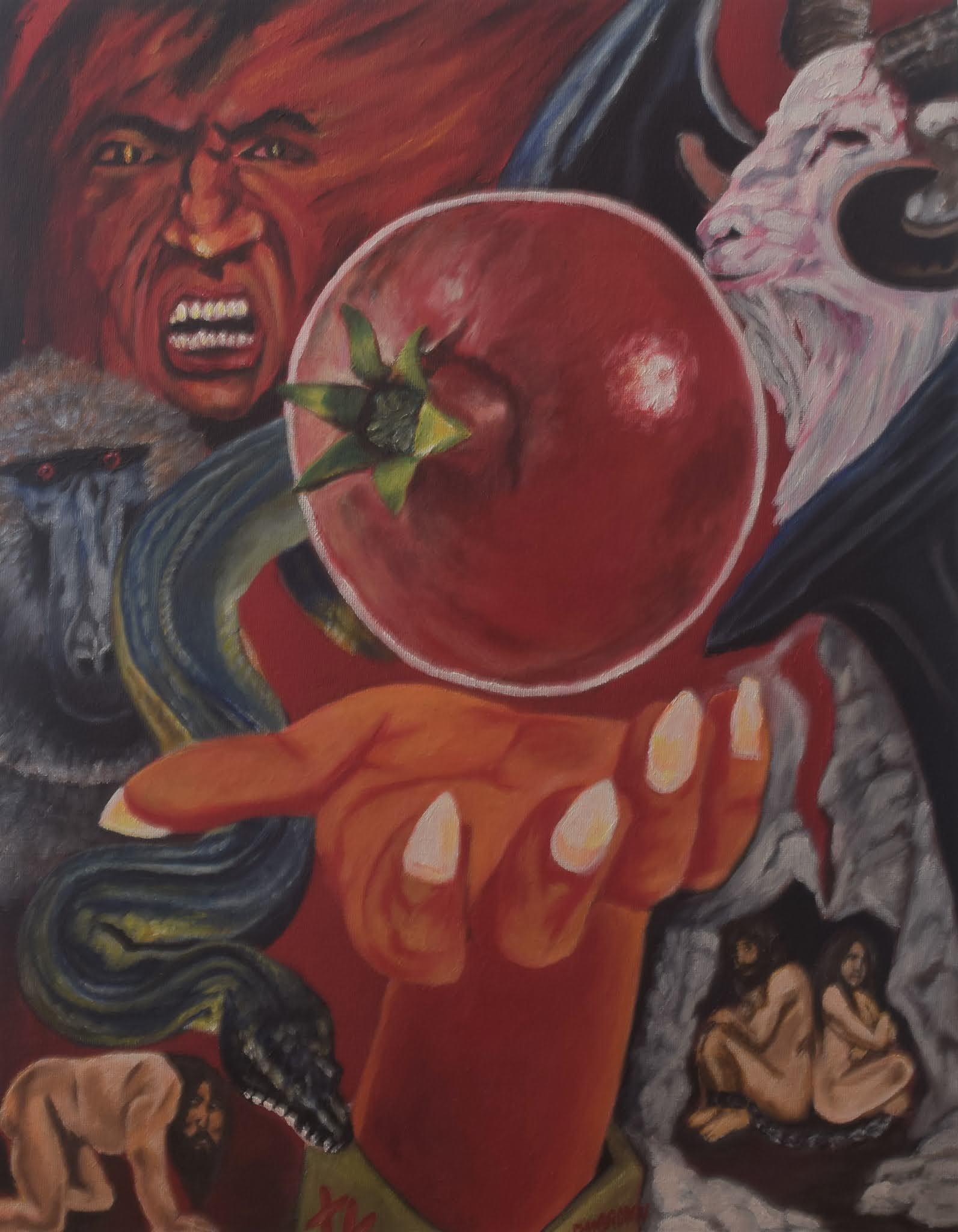
“Ethos 4: XV The Devil” (August-October, 2020): A collage of images for “the great deceiver,” including a pomegranate (as the fruit of temptation), a goat, a baboon, a serpent, a snarling face and images borrowed from William Blake.

“Ethos 5: IX The Hermit” (October-November, 2020): A single figure, derived from an Egyptian statue of a scribe, in an empty room, prepares to write his visions.

The latter painting was mostly painted last November. No matter how much I might like to be a hermit and withdraw from the world to paint and write and read and so forth, November, you may recall, was a particularly fraught time with the contested election and a host of unsettling events that culminated in the assault on the Capitol before the inauguration in January. It’s a fact anyway that I didn’t do much painting, if at all, after Thanksgiving weekend until the inauguration. That month I got started on Eros, the second segment in the Tarot series. And here are the first three. Again, these are meant to be seen as a group of five with VI The Lovers in the center, XVII The Star above, and III The Empress to the left of center; XIV Temperance, the panel below, is mostly completed but not yet signed or numbered, and VIII Strength, the righthand panel, was begun in August but hasn’t had much progress due to work on those three other “rendering” paintings.


“Eros 1: VI The Lovers” (January-March, 2021): Derived from an image for alchemical transformation, two winged figures, male and female, couple in a pond beneath a tree, a lyre nearby; the composition alludes to Chagall’s “Daphnis and Chloe.”

“Eros 2: XVII The Star” (March-June, 2021): A nude woman pours water from a vase into a pool in which she stands while gazing at the viewer, elements of her features and figure borrowed from friends, Dürer’s Eve, and a Waterhouse nymph.

“Eros 3: III The Empress” (April-July, 2021): A woman on a throne in nature, her figure and clothes derived from a statue of Parvati, the wife of Shiva and a Hindu goddess of fertility.

We're allowed nine images on the site, so that’s it for me, this year. Maybe around Christmas I’ll get those other three “Renderings” up. I’ve got quite a number of those planned, and should also be starting the panel for “X The Wheel of Fortune” which is the first “outcome” card—one at the halfway point, the other at the end. Thus I’m almost at the halfway point in the panels, but at least two to four months away.


Saturday, September 4, 2021

WHATCHA READIN'? (2)

Elizabeth Hardwick’s Herman Melville (2000)  Another book picked up by chance at Gray Matters, to complement earlier readings this month of Jean Giono’s Melville and Hardwick’s own Sleepless Nights.

Here, Hardwick as usual writes well, conveying some of the excitement of reading Moby-Dick, but ultimately I’m not impressed, as she has no particular sense of Melville. It’s a belletristic performance in the bad sense. I’d say EH has no insight into Melville because she can’t fathom how completely bizarre he is. How sui generis. (Which is odd, given that she was intimate with the rather bizarre and sui generis Robert Lowell.) But EH, one of the founders of the New York Review of Books, commits the sin of the lit. journal: to describe others by your sense of judgment . . . and let’s be clear: that’s what book reviewing is. Publications such as NYRB promote work within the terms of their sense of judgment, and the implied idea is that everyone writes “in order to be judged” by them. It’s the grand conceit of lit crit: that its judgment trumps the object. Whatever the artist creates, what she or he achieves is determined by critical judgment. So all art asks/waits to be judged. Critics love to quote bad judgments so they can find an opening for their own judgment—but the self-congratulatory rhetoric is that such-and-such has “waited until now” to have its true or real judgment. No such thing. The judgment machine rolls on and other horrible workers will come (to paraphrase Rimbaud).

As something like the NYRB judgment on Melville, EH’s take is rather lacking in depth, though not a bad read. She likes to visit those “homoerotic moments” in Melville’s writing as if the fact that men can be attracted to men and be rather sanguine about that feeling is new or surprising (just how sheltered are intellectuals?), but has so little to say about Pierre (I’ve begun it, taking it slowly) which is rife with stunning oddity, a fantasy of psychosexual proportions that EH is not interested in at all. I suspect that Pierre will make me a Melvillean much as FW made me a Joycean—thought not as whole hog, perhaps, but convinced, again, of the writer’s unmannerly pursuit of “necessity.” EH can only shake her head, wondering why someone who flopped with Moby-Dick would next write Pierre. And there you have that judgment by market forces and by “critical judgment.” No one grasped what he was doing, the readership avoided it, so he should try to rectify that and write what the public want. Rather than what he wants to write. But Melville has that at least, the courage to write what he wants to write, and because there’s no “excuse” for it, otherwise, that makes him worth reading, to me. His manner is engaging, his ideas odd.

Jerome McGann’s The Romantic Ideology. A Critical Investigation (1983) Also part of the Gray Matters’ haul, this was a very gratifying find, a book I probably skimmed back there in Princeton but was surprised to learn was published in 1983 (I took it for a late ‘80s or early ‘90s book). My sense, reading it now, is that McGann’s sense of the English Romantics is clear, both in what they are and what they aren’t, and what he’s particularly good at is sifting the criticism of Romanticism, an area that, if more entrenched even than modernist criticism, can also boast better readers. The notion of “ideology” which he brings to the discussion, after Marx’s The German Ideology, helps to open the question of what—if anything—one tries to “teach” via literature. It’s a question I’ve never been satisfied about and was quite disillusioned with the forms it had taken by the time I tried to sign on (forms that, I note, McGann was already criticizing in 1983—when I was blithely indifferent to academia and following my own fantasy). He sees the too-easy assumptions of an over-arching period consciousness in which students learn the checklist of Romantic attributes and then look to see them evenly applied throughout the works of the period, while the so-called early and late Romantics are quite temperamentally distinct. Even critics and scholars who should know better take up positions that are aimed to explode ideas that no one who seriously reads the Romantics (rather than the synthesizers of the critics) would ever have.

What I miss in McGann is any very developed sense of romantic irony (he prefers the “romantic agony” approach—even with or especially with his man Byron); McGann, tinged by the claims made for artforms by the likes of Althusser and his epigones, has to do battle with the notions of “escape” and “transcend.” What McGann can’t seem to grasp (seems deaf to, as a kind of tone-deafness) is the ironic emphasis of most Romantic utterance. The romantic poet, to use Dylan Thomas’ phrase, “sings in his chains like the sea.” The irony is that is the best one can do. Romantic poetry is a soliloquy in a drama that one cannot “escape” in a world one can barely alter and never master. And yet one sings. And, while that situation might inspire “agony,” to me it was one of a more notable irony—as found in Shakespeare’s tragic heroes who, for all the tragic dimensions of their situations, can speak with a sense of irony that “the wheel has come full circle, I am here.” It is a question of tone, at last.

McGann is very good at stressing how poems are created in their own particular times with those kind of temporal assumptions that Bakhtin theorized as “the chronotope.” So much so that it might behoove me to consider, not only the extent to which “the Romantic ideology” has played its part in my formation but also “the Romantic chronotope”—both, I feel, are important to the scene or space of utterance in “Mobil Limbo” (which has gotten some significant tweaks this summer). Its flights of imagination always land, we could say, back into that space/time. The “chains” are very real but the way they can be imagined, the way one can imagine breaking them or shedding them—there’s that “escape” and “transcend” again—is what keeps the game in play. Byron: “And mine’s a bubble not blown up for praise / But just to play with, as an infant plays.” As for all that, McGann did send me back to the poems of Coleridge headed “Limbo,” and I expect I will revisit “Childe Harold” and “Manfred” and would like to finally get through “Don Juan” (I’ve just acquired McGann’s texts of Byron in the Oxford edition, to that end). He also tipped me to Galvano Della Volpe’s Critique of Taste which I managed to acquire in a Verso summer sale (just arrived today—I’d already forgotten I ordered it). More anon.

Friday, September 3, 2021

WHATCHA READIN'?

Stanislaus Joyce’s My Brother’s Keeper. James Joyce’s Early Years (1957) Picked up a nice used copy by chance in Gray Matters mid-August. I don’t believe I’ve read it cover to cover, more like skimmed it in a library. It was a big revelation for Joyceans in the late '50s/early '60s, but by the time I got into JJ studies, mid-80s, it had been thoroughly picked clean in other studies, notably Ellmann’s biography which I first read in 1981 or 82. And anyway, MBK mainly seemed of use for the old “spot the reference to JJ’s own experience” approach, which I was frankly dismissive of, as a scholarly bent. Stanislaus is all about their shared experiences. In a represented discussion with JJ, Stanislaus dismisses the ending of a juvenile play JJ wrote because the ending has no basis in Joyce’s own experience (i.e., JJ had no lady love in his life at the time) so SJ is criticizing his brother for inventing a woman wholesale. It’s pretty feeble as criticism but, as no one but SJ and William Archer read the play, maybe it was a feeble scene (though Archer, a publisher, found that scene to be best). It’s not to besmirch SJ that I note this but mainly to say that his rendering of JJ is steeped in “what I know about him”—which is always going to miss the big picture. But here is what SJ says much to the point: “He [JJ] maintained that art had no purpose; that all fixed purposes falsify it, but that it had a cause, namely, necessity, the imperative inward necessity for the imagination to recreate from life its own ordered synthesis. He spoke of the importance of the artist in the community, and insisted on his right to develop his personality freely in accordance with his own artistic conscience, and without being drawn into movements or making himself the mouthpiece of others. The artist inherits difficulties enough to struggle with in his own soul” (p. 129).

Reading this, I can say that that attitude is one I had in youth, that was much like my driving ideal. Since I knew little of Joyce until the end of high school, the common ground for that view might well have been Ibsen. I had an Ibsen phase around 15—though nothing like JJ’s infatuation with Ibsen as a living artist he actually corresponded with! Probably the main source is Nietzsche which SJ doesn’t speak of much except to note the part he played in creating, in Duffy of “A Painful Case,” a character somewhat based on SJ. In any case, that sense of the artist as his own criteria was clear to me and was my “test” in evaluating artworks: was the creator his own person, working from that sense of “necessity”? It’s what I embraced in Dylan whenever he turned away from what was expected of him in search of whatever he felt most compelled to do. It’s what, eventually, made me a defender/explicator of Finnegans Wake. For I believed fully in JJ’s reasons for writing it, though I never insisted that a “general reader” had any reason to read it. And that’s my view of art anyway: when it comes to “community” I don’t recognize one. Though I suppose that it is how one gets from the inward imaginative necessity to a commodity for sale in a marketplace. It must pass through “a community,” the “win friends and influence his uncle” phase. I still see writing the way I see art works: unique. Certainly, as with prints and other mechanically arrived at works you can make as many copies as you like but the notion of “supplying a market” only makes sense if there is a market—and is a market ever “a community”?  This is shown in JJ’s own career. I always loved the story of how Ulysses was published: it was done by a community; only when it went forth into the international marketplace did it have to deal with being suppressed and pirated and all that mess. Certainly I’m glad there were commercial versions of it available by my lifetime, as I am that Dylan got a contract with a major label, after winning over the “folk city community” of NYC, but how those things came about is always murky to me. In other words, how the artist gets the interest of the money-men, out to make money off his “inner necessity” by means of consumers rather than a community.

I have to say it’s a shame Stanislaus didn’t get to the Trieste years. His pointing out sources for the Dubliners stories (often from something SJ witnessed) makes me want to read them again (it’s been ages).

Wednesday, June 30, 2021

SUMMER CITADEL

It’s summertime for real, right now. Here in the northeast US there are heat advisories and warnings and there is some noticeable discomfort if, like me, you live a life without air-conditioning—and work at home. But it’s the work that distracts from the heat—if you let it.

Today, making breakfast, I recalled the song by The Rolling Stones—from their 1967 psychedelic LP Their Satanic Majesties Request—called “Citadel.” Like many a psychedelic paean to the joys of the Inner Man, “Citadel” takes up an exotic theme (citadel as a castle with classical or biblical overtones because the word finds use in many such texts, whereas “castle” seems more deliberately medieval and European) as a metaphor for the “trip” mentality. The fantasy in the lyrics, initially, is of crusaders “armed with bibles,” then we get glimpses of flags and dollar bills (the U.S. market, of course), then “peasants” crawling (the fans, the press, etc.) to hear their numbers called, and finally the “woods of steel and glass” of a busy urban scene—all the things these citadel-dwellers are avoiding by staying in their indwelling universe, fixing a hole where the rain gets in, and all that. And always that child’s rhyme chorus: “Candy and Taffy, hope you both are well / Please come see me in the citadel,” where Candy—a playful plaything’s name at the time—gets stretched into confection by palling around with Taffy (these girls are sweet!) and both are invited to the citadel, where no doubt our singer reclines in utter decadence, plump grapes poised upon plump lips.*

Well! My sense of a working citadel is nothing like that! More like what I imagine Keef might be up to in the studio with Brian, layering all those sounds onto tape. For me, it’s layering colors and I’m concluding The Empress and a few days into Temperance. But the song was suggested by my subconscious (or something), due no doubt to a fleeting thought that painting while listening to my many mixtapes compiled in the summers (starting in 1978 and reaching to the present—I made the tape side for Temperance just last week) is about as withdrawn as I can be from the world at large.

Left to my own devices in the house of Eros on my painting tour of the 22 cards of the Major Arcana of the Tarot. The section Eros, as just became definite to me early in June before my visit to the shore in Maryland for two weeks, consists of: VI The Lovers (center), XVII The Star (above), III The Empress (left), XIV Temperance (below), XIII Strength (right). This configuration is pleasing as a departure from what I had considered the sequence to be, up to that point. I had thought I would be moving on to do The Emperor after The Empress. The change came about because, in searching for images to composite into the Emperor, I was struck by the pathos of the figure. And so that card will be the third panel in Pathos, corresponding to the place The Empress holds in Eros. And that’s fitting because The Empress represents the fully empowered female—mother, queen, the ruler of the roost, both sexual and maternal, all that. Whereas The Emperor—following the old idea that the son, come to manhood, is the king/father’s replacement—is a figure for decline, for the old that is passing away. Pathos, in other words.

In the four overlays, the center panels have been definite for some time: The Fool for Ethos, The Lovers for Eros, and Justice for Logos (all obvious to me). The first major change came in shifting The Wheel of Fortune from the center of Pathos (a good figure for all the changes that cause our sense of time passing toward the grave) to its place as the outcome of the first series, thus matching perfectly with The World (the idea of the eternal that supersedes that transient wheel) as the outcome of the second series. Which is a way of noting that Ethos (the Bildung) and Eros (the reign of desire) bring us to a sense of the Wheel (how all things do change and love fades and mentors die and nothing lasts) which must be endured through Pathos (the struggle to assert something that lasts at least a generation or two), aided by Logos (the idea of the eternal, as suggested by religion—for some—art, for others, and, well, at least by the systems of signs by which we make sense of the world as something to be made intelligible, for ever and ever anon). The new center figure for Pathos is The Hanged Man, a figure for the suffering body itself, and of “the sacrifice for the sake of”—wisdom (Odin), the sins of man (Christ) and so forth. So then, The Fool (my spirit guide, let’s say), The Lovers (my youthful ideal, late teens through twenties), The Hanged Man (upon the rood of time), Justice (you decide if he was wise). The circling we’re into now, around those lovers, takes in The Star—as a figure for the ingenue, the sweet thing (Candy and Taffy), but also all those forbidding maidens never manned, à la Cohen’s “Came So Far For Beauty”—The Empress (see above, here figured as an Empress of India who is in fact Indian), and, now, Temperance as the Angel who mixes duality into unity while also, like a horse of many colors, radiates all we project upon them (the Angel, being neither male nor female, is a perfect instance of the need for a “multi” pronoun as designation—particularly as, in a sense, any Angel is every angel, no?). Anyway, I’m having a wonderful time on this one just now.

But then, I have a wonderful time on each of them—the panels, that is—until I reach the limits of my ability and wish I could do something different. In any case, they are what they are, cartoon approximations of concepts that have to take the form of pictures since words don’t really convey what they are either. There are only tales told, rhymes rhymed, songs sung, and abstruse and recondite interpretations to approximate what these figures actually figure. The wonderful time, for me, is seeing what the paint does while I engage in that slippery pursuit of Image. A word I’ve always viewed with a certain awe as I understand it to be vision arrested by the mind—which some call “a vision” but which I’d rather call “an Image.” Keeping alive the relation to ‘imagine/imagination’ as well as recalling hoary old usages such as “made in his own image” and “the very image of a modern major general.” And maybe it’s just fanciful on my part to relate “Image” to “i mage, or I magus,” with “Magus,” card number I.

I guess this has gone on long enough. And what I really meant to talk about was the experience of listening to all those summer tapes. I arrange them by month—June, July, August—and, where possible, by the day I made them, rather than by year. So I’m not moving chronologically through the years in this trip through time, but through the months, after a fashion. June dropped away because I was away and I’m making it up as best I can. May found me listening through the series of May tapes my daughter Kajsa and I made. It became a tradition to make them at the end of each school year, beginning with the end of twelfth grade, and stretched into a few years after she graduated college. The summer tapes, though, make me tour through a variety of times. There is at least one summer tape for every year up through 1999 (when I turned 40). After that, tape-making for myself falls off, but, generally, a tape in summer and in fall continues for another decade give or take (I’ll have to tabulate them some time).

Are they all relevant to Eros? More or less, I’d say, though some are more tinged by Pathos than others, doubtless. And that’s fitting because we’re in the “bottom” of Eros, with one last turn to go. And I hope that I'll be through the circle—with at least a start on that Wheel—ere this summer is past.


*: note: In Andy Warhol's Popism, which I just finished reading, 7/3/22, Andy says that Candy is Candy Darling the person who Andy respects as the most successful drag queen he ever knew, and Taffy is one of Candy's drag friends, and that once, while the song was playing, Candy pointed out the lyrics to Andy as Mick inviting the girls to visit and mentions the hotel the Stones were staying in which becomes, by that reckoning, the citadel. According to Andy, though, Candy was a bit embarrassed because she could never tell the Stones apart and wasn't sure "which one is Mick."


Sunday, April 11, 2021

POP GOES THE WEASEL


A note, dated 6/21/14, I wrote in ink in the back of my copy of Hal Foster’s The First Pop Age (2012, Princeton UP) says: 

What I’m after: abstract photographs or photographs as abstract paintings. I think Richter [of the five artists Foster examines: Richard Hamilton, Roy Lichtenstein, Andy Warhol, Gerhard Richter, Ed Ruscha] is the most germane for my immediate idea (from oceanscape or cityscape photos) but could see the possibility of figures, portraits, ‘iconic images’ (of friends, influences, celebrities) being used the same way.

It’s been done, I know—but the interest is still in the use of fields, lines, planes for form.

Am I ready to become a pop formalist?

Today, having finished the chapter on Richter (back in 2014 I apparently stalled in the Warhol chapter), I can see that I was right. (Not surprising as I’d seen Richter’s “40 Years of Painting” exhibition at MoMA in 2002. I’m thinking that it’s possible I bought Foster’s book at MoMA’s bookstore after viewing the Sigmar Polke exhibit that ran April-August 2014. Both shows gave me much food for thought where making images is concerned.)

Foster strikes me as much more in tune with Warhol and that mechanical aspect of Pop as in thrall to the productiveness of commodity culture. Products for the sake of production rather than production for the sake of product. The very notion of “product” as somehow synonymous with “object” takes its impetus from that conflation, a conflation that, it seems, art in my lifetime (since the end of the Fifties) can do nothing to avoid, can at best exploit.

What Richter—whom Foster quotes a lot with a certain hands-thrown-up gesture—gets at, it seems to me, is the spanner that someone who actually cares about painting throws into the works. Because Warhol doesn’t care, nor does Foster, really. The conceptual force of art is all he can work up any attention to, even if it means that a dizzying level of production on Richter’s part meets with points like: “They [an entire body of “blurred” paintings in gray paint] suggest how our very sensorium, memory, and unconscious have become, at least in part, ‘photogenic,’ that is to say, not only affected by photography and film but also somehow adjusted to them—suited, even designed, to be photographed or filmed, created with such light in mind, along the lines suggested by Kracauer in 1927” (196). So that numerous paintings were created, in the mid-1960s, simply to illustrate a condition that Siegfried Kracauer was onto in the late Twenties. It’s a common feature of Foster: the thesis, uncontroversial as it might be, is supported by the art. No need to really look at it after that.

But the quotations from Richter start to steal the show. “Something has to be shown and simultaneously not shown in order perhaps to say something else again, a third thing” (196—the quotation apparently comes from Richter’s Writings, pg 272, but is not dated explicitly in Foster). “’Illusion—or rather appearance, semblance—is the theme of my life’ Richter also commented in 1989” (215 in Richter; 198, Foster). Foster tries to develop this question of “semblance” to serve his theme of the “photogenic” as an element of Richter’s painting: “semblance is not the resemblance produced in representation any more than it is the negation of this resemblance produced in abstraction. Semblance comprehends both modalities because it concerns the very consistency of appearance—it is what allows the world before us, natural or mediated, or natural as mediated, to cohere—and this concerns Richter above all else: “'Appearance,’ that is to me a phenomenon” (405).” Then Foster cites Richter “in the 1989 statement” saying “All that is, seems, and is visible to us because we perceive it by the reflected light of semblance,” and sums up that “according to Richter, the painter must ‘repeat’ [the semblance of the world] or, more exactly, ‘fabricate’ it” (199, Foster). It would be nice to read Richter’s entire statement but even in this cherry-picked version I like the way Richter suggests that we live in a world that is not simply already viewed through media, as Pop (in Foster’s version) belabors endlessly, but in which “appearance” or “semblance” is a condition of recognizing anything, or having, as it were, visual relations with the world and the things and people in it. His fabrication of that, as what an artist’s act amounts to, puts the burden on the viewer I suppose to determine what relation one of his paintings has to the other elements of the visual world that we recognize. Where do these fabricated semblances fit in in our universe of semblances?

To me, the fascination with what Richter achieves, as a painter, is tied up with my own burgeoning fascination with painting. I can’t say I ever had the fascination with painting as activity that sustained so many careers. I generally wanted the paint to do something I was trying to do, to strike the eye a certain way, and that’s that. The fascination of the painted was something to be found in the hands of masters, or at least in very gifted students. Nowadays I’d say I’m fascinated by the question of what I call “rendering.” And what gets rendered, to some extent, is what Richter is calling “semblance” or “appearance.” Foster insists this has nothing to do with the resemblance between the photograph and its subject and or between the painting and the photograph (the paintings by Richter being discussed all derive from photographic sources). And it’s true that “resemblance” is a lower order quality, one that Richter, as a painter, is too gifted to be bothered by. But it is, to me, a part of the concern of rendering: if I want the image to “look like” the person the picture is of, though not a stenciled version of the image. In other words, the photographic image, or the reproduction, I’m working from is indeed a semblance—of someone or something—but I want to render my relation to that semblance, which is not contained by that image nor exhausted by it, nor by my rendering of it. All the rendering does is perform that relation.

This is something Foster eventually gets to: Richter’s painting “is neither a progressive form of critical art nor a cynical kind of posthistorical pastiche. It does not resolve its contradictions so much as it performs them, and in this performance, it sometimes suspends them as well” (207). It’s not that Foster really sees painting as performance, and yet his formulation, once we get past his usual binary choices about what art can be (critical/cynical, progressive/posthistorical), almost articulates what is at work there. The art of painting as performance. What the whole “performance art” aspect of our contemporary art world [recently watched The Artist is Present] stresses is that the audience wants to be a part of the act/art. Fine. But the Old School approach was about coming to see the finished product/object—all the performance had already taken place, in the studio. Still my preference. And that’s because what happens, in the witnessing/observing/perceiving, is like what happens in reading/listening. I can’t see with another’s eyes nor hear with another’s ears nor read with another’s mind. I bring my own gear wherever I go. I want the artist to show me the semblance arrived at for the sake of my seeing. I'll take it from there. To be “in the scene”—like taking a selfie next to a masterpiece—is to underscore the historical dimension of art. You are there, it’s in your space and time. So what?

But in making art I have no such escape valve. I mean it is in my space and time because I am the one there making it. And there’s no sense of audience, only a sense of when I’m done, if only because I’m tired of “seeing what I can do.” I hit the limits of my ability or of my patience and so it’s time to move on. Otherwise, the rendering is its own agenda, to play with paint for the sake of form. What used to stymy me wasn’t just my lack of skill, but my lack of conviction that there should be something rather than nothing. Not nihilism so much as no commitment to an enduring image. The Pop culture that Foster is keen to elucidate struck me as not worth the candle. Tedious enough in each encounter, why proliferate Campbell soup cans to underscore the tedium? At the same time, there were fabricated images that fascinated—including even fully commercial products like album covers and book jackets, to say nothing of magazine ads. Meanwhile, any canvas no matter how grandly sublime could become an icon in a textbook, a thumbnail. An image, not a painting. The victory of Pop in the sense that seeing the actual “one and only” artwork could seem redundant. Though it’s really not if you really are looking/seeing and not simply conceptualizing as you wander through.

So maybe art isn’t exhausted by the tedium of making things but by the tedium of explicating, of fitting the object into the syllabus, of analyzing for the sake of an activity that, unlike art itself, seems to need no justification. If only because it has academic pedigree.

 All of which is simply a way to further render my note at the back of the book, a way of saying that I could see, in 2014, a détente with Pop, which I otherwise fault with being the a la mode from my childhood onward that seems impossible to outdistance, outlive, escape, or fully accept. And I say, as I did then, that Richter does help me see the way to that end. It’s in the performance of rendering semblance. What anyone other than me sees in that semblance? What the fuck do I care? As SD sez: “unsheath your dagger definitions.” Call it something, if it suits. As all these Pop guys know so well, it must be addressed by the critical—I won’t say “community”—apparatus (apparatchiks?) in order to really exist. But that’s just saying that any semblance one renders as an object must be given its wraithlike existence in the permanent embalming fluid of history or else . . .  we might as well, as Christopher Fry once put it, sculpt in snow.

 Yeah, but I like paint.

Wednesday, December 2, 2020

SOME THOUGHTS FROM LAST YEAR, 2 (toward a start)

3/12/19

So, if I turn my attention to the major myths as foundations to my readings in a variety of media, the failing to guard against is that every instance simply becomes another example of the same concept. The specificity of the relationship between myth/instance/receiver has to be analyzed. If I play off of Barthes’s tripartite breakdowns where the signified finds a signifier that gets encoded in a sign and the sign (word/work/object) becomes a signifier for the signified (myth) which is decoded in the sign of the mythologist’s analysis, then there’s also a further trio (of allegory) that takes the mythologist’s reading as “signifier” matched to a signified (the cultural work of the sign) that finds its sign in the lyrical history of reception, which is to say that the sign is the coming to consciousness of the formation fantasies and that realizing them, in writing, is the entire goal.

With this approach in mind I have to begin with the mythic sign and move toward the allegory of becoming. This process is personal and individual (hence, the idiosyncrasy) but it is also social/collective because it assumes the general presence and reception of the myth; as critique of the myth the analysis serves a proleptic purpose—a conduit between the past, where the myth was received, the present, where its effects are analyzed, and the future where a possible benefit accrues, not as revolutionary gesture but more as an existential truth, a Sisyphean perpetuation of the burden of knowledge, of the framing of the idea of an emancipatory act. “No exit,” indeed, but that is not a cause for despair if, a good jester, one accepts the joke is on oneself.

Playing with these ideas in my mind at the moment, I see that—to recall my four-part fantasia—ethos would be the comic, the jester’s wit, the ability to laugh at absurdity and to see the cosmic joke in human affairs (how to take people seriously?); pathos would be the heroic, which moves from superheroes to tragic heroes—Christ, Faust, Shakespearean—to antiheroes, Dostoevskyian, in film and fiction; eros would be the poetic—the lyrical—finding its image in woman/the feminine, and having to recognize its presence in oneself: a self involved in rendering the sensual mental sphere which is what I basically find in poetry or at least my poetic heroes; finally, logos would be the narrative principle—uniting novelist and certain film-makers as controllers of the narration/diegesis. It will be seen at once that this change in emphasis, to the theoretical or categorical, lessens the attention to the diachronic, historical approach—the point of autobiographical criticism—but not if I can help it.

My sense of art history, as a sequence of styles and their attendant myths, should keep me focused on the passage of time as an element in reception/conception. (Note: I’m sitting here, now, in the Blue State Coffee Shop on York Street in New Haven, which used to be, when I first moved here, in 1994, a Willoughby’s Coffee Shop—the view out the window on York Street on the rear of Yale’s Sterling Library hasn’t changed much (though there was construction on the outside of the library for many years). I can’t sit here and not remember writing one of the poems I worked on for “At Large,” the poem called “Backseat Driver.”) My point—in that parenthesis—being that the time that has passed from the day of that poem to this—which is to say from the doctorate to now—is not lost but part of the perspective. Time must be contained in the views of the myths, in the allegory of their reception, or I have learned nothing. These thoughts, about the years at Princeton, come from re-reading that Barthes essay, which takes me back to starting at Princeton and the idea that exercised my mind at the time, to unpack the transition from the realist novel to something more subjective, based on an aesthetic response, to see how—again—the impact of history plays into aesthetic experience (a concept I might now see as ‘myth’) as a thematic element of every narrative—which is to say an indication of the author’s choices/assumptions about the “state of the art” and the position of the probable reader/receiver. What kept me from fully embracing Barthes et al. at the time was the sense that semiology was ultimately not concerned with art qua art. In other words, it did not consider the ‘usage’ of the strategies of art—in poetry, in literature—as substantially different from any other form of discourse or media. My “aesthetic experience” claim sought to foreground that particular use value which can only be found in art. With the eclipse of most of my artistic assumptions in the name of ubiquitous media, it’s no surprise that those ideas didn’t garner much support.

The concession, at this remove, occurs on several fronts. First, the situatedness of the critic. The objectivity of theory and history has always bothered me. The claims I make, as a critic, are to some degree performative—which is where both autobiography and lyrical self come into play, as they must, or there is no point in me writing this. My failings in the profession come primarily from trying to write as others do, to appropriate an appropriate voice/stance. If I am to “free my hand” then I’ve got to own the stance entirely, which means “owning up” to the particular idiosyncrasies of the critical gesture. Second: that situatedness has a political dimension because of our surrounding context which interrogates privilege, racial placement, gendered identity and all aspects of the social mimesis. That critical tendency became prevalent as I was finishing at Princeton and was the marked position of the academy at the time—the university as a white male dominated space of intellectual colonialism, an oppression by other means. Because of the steady chipping away at that monolith, any work that arrives as the intervention of a hetero white male with Ivy League antecedents is going to be suspect if not irrelevant. That I can’t help, but I can accept, jester-like, the use of irony. “Hide, fox, and all after” has long been my motto, with all due acknowledgment of its source. The placement of critical pressure on historical accident, the stress on trivial identification factors (whom one’s ancestors were and whom one has sex with and how) as determinant of “position,” is a way of recognizing that the social uses of art, more—its value for social recognition and identification—is all that matters in this period.

The “driven to abstraction” nature of my earliest incarnations take root there as there is no access to that mode of thought by means of those trivial factors. So this—belated—recognition of the social importance—for critical purposes—of that ground is something that the criticism must register. The work on “Between Days” has made that aspect of my past—now told by a self-styled narrator—more accessible and even relevant, particularly where the “myth” of the author/artist is concerned. No doubt a part of that analysis will be of the trajectory of that concept as it plays through my earliest identifications and into the state it now occupies in all its situated banality. What kept me away from biographical/historical analysis of the artist/author before was my sense that such work was essentially gossip writ large. I still believe that, but there is some merit in meeting that view with a grasp of the self-deprecating humor necessary to the form (“who’s he when he’s at home?”). If one can’t countenance the continuity between text and being, between the authority of the author and the triviality of the person, then one becomes a worshipper, an idolater. That I am not.

Third: aesthetic experience as but one factor (even if a “supreme fiction”) in the reception of the everyday fiction of mediated existence. Some version of that argument was contained—at what lengths!—in the transition from modernism to postmodernism and it could be said that my perspective is still a postmodern, “Baby Boom” perspective on the era that I lived through, but, if so, it’s one that has been shaped both by my elders (those born in the ‘30s and ’40s), my contemporaries (born in the ‘50s and ‘60s), and my juniors (born in the ‘70s and ‘80s). The elders come to me through literature, film and rock; the contemporaries share those fields. The juniors—as my stepson’s and my daughter’s generation—inherit them and have their own emphases. The subsequent generation (‘90s and ‘00s) is the student population that may or may not receive the lesson. My locus in that tripartite division is key to my outlook, and it will be key to the historical situatedness of the account. Which is a way of saying that the context—supplied by those who lived through World War 2—is distorted by the elders, moving into the counter-cultural emphases of those born in the ‘40s (who are now our elder statespersons), received—with all due irony and apathy—by those born in the ‘50s and ‘60s (a kind of “lost generation” of its own, but finding—for me—some ready heroes, particularly in rock, less so in the fine arts), moving on to the generation now approaching its fulcrum of middle-age (forty, fifty years old). The true juniors—in their twenties and thirties—are so readily identified with the twenty-first century and its technologies of (so far) benign surveillance and its failing environments and embattled borders as to be largely indifferent to these arguments. So, granted, the target audience is still “my students”—those who were grad students and undergrads in the 2000s. As we move into the 2020s I can only gesture toward what deluge awaits, seeing 2022—100 years after Ulysses—as the place where the record of modernist myth must reach a kind of end-stop. So, then, the myths . . . [Note: I’ve projected spring of 2022 as the completion of the Tarot panels, 12/2/20]

A simple schema would yield ethos as comedy, pathos as tragedy, eros as lyric (whether poetry or song), logos as narrative (in film and fiction). But, while that might work at the schematic level, I don’t think it works in practice. The “comic” as an ethos could be a factor in any genre, as such it’s part of the perspective. Yet I see this as significant, an aspect of my outlook that I may have neglected. The point, then, is to establish the originary myths. The pathos of the hero and the antic comic hero—the value of irony. One would be the hero as redeemed by suffering, another would be the hero whose insouciance carries the day. Another would be the femme fatale of drama and of song; the muse; the model; the artist-hero; the creative ego; the demiurge; the daemon; the various myths of the rock-bard, like the movie star, are deeply invested with a specular identity, but that also serves the scholar-star, the creative genius, the unprecedented talent, the romantic hero; then there’s the trickster, the jester, the fool. The narrator-hero, the observer, the chronicler, the historian, the critic—these are all positions, entities, but the task is to extract the ideology and poetics of these subject positions. And since most of them mark the reception of and identification with the works of lit, music, film, the analysis should take us into the basis of intrinsic conceptions. What I’ve mainly been thinking of, in terms of explication, is my own formation as a critic-subject, a developmental account, but this newer conception puts the critique at the forefront.

Thus, the development is of a series of myths that prolong the ideology of art (as alternative to culture) and invite the poetics of the self-formation that leads to the critique. The end result is not an artwork, nor an artist’s creative ego, but a critical engagement with the perspective made possible by certain interactions and experiences—aesthetic, yes, but requiring an account of what that entails. It’s likely that at any given stage in this diachronic account there will be dominant figures, the unavoidable “new figure” that encapsulates and challenges, that creates the expectation of a further satisfaction. Of course, the line I was considering previously—derived from Stevens’ “Supreme Fiction”—was the abstraction (ethos), change (pathos), pleasure (eros) trio, which still pertains, but at a more meta level. And that level (allegory or supreme fiction) is the vantage point that may be “beyond critique” or “beyond interpretation” as some would have it. It’s the passion for the task that undoes the performance of it. The untamed, untutored essence of need. Abstraction, as I said earlier today, was the necessary lie against bleak reality, recognizing the lack within the particular—so a supplement for the sake of a “higher calling” (a myth in itself); change (pathos) has always been intimate to my vision—what found such fascination in Proust, the realization of time as the tension between “the eternal” (the analogue to an ethos of “the universal”) and the time-bound loss, the impossibility of a fixed value. And that leaves eros/pleasure as the temptation to linger in good feelings, the sustaining attention to sensual satisfactions—seeing, hearing, touching, consuming—where “the work” is a feast, a dance, a spectacle, a trance, a poem. Breaking the trance is the work of criticism, an inscription on a tomb.

I wait in anger and amusement
In my rehearsals for retirement

If I'd have known the end would end in laughter
Still I'd tell my daughter that it doesn't matter

Farewell, my own true love, farewell, my fancy
Are you still ownin' me, love, though you failed me?
But one last gesture for your pleasure
I'll paint your memory on the monument
In my rehearsals for retirement

--Phil Ochs, “Rehearsals for Retirement” (1969)

SOME THOUGHTS (BARTHES) FROM LAST YEAR

3/11/19

I was thinking this morning of how the type of account I want to write should begin with a statement of main themes, that it’s not enough—as I tend to do in lists—to enumerate proper names with maybe a tagline to indicate critical orientation. Then, having had a look-in yesterday at Baudrillard’s Conspiracy of Art, I picked up this morning Barthes’ “Myth Today,” which includes, as perhaps ultimate inspiration or challenge, the lines: “In a word, I do not yet see a synthesis between ideology and poetry.”—with the two seen as “two equally extreme methods”: “either to posit a reality which is entirely permeable to history, and ideologize; or, conversely, to posit a reality which is ultimately impenetrable, irreducible, and, in this case, poeticize.”

For me, the true poeticization is something like “Metro Lace” where language serves the purpose of asserting arbitrary relations to the subject and object—it is a bridge between two things, each with its own status, and the poem approximates moods only, making the capacities of language register presence—thus a sensual act because the writer is a locus of senses and sensory impressions in the act of operating language.

But a critical language needs history—which is biographical first because the utterance has to be placed in time and because the evaluation is retrospective. “Entirely permeable to history”—though—is more extreme than what I had been considering. And that’s where reading Barthes’s very lucid discussion may be crucial at this time. For I begin to see that what has hung me up all along is what I might call the particular vantage of my intervention. I’ve wanted it to be “autobiographical” or “lyrical” criticism, a story of becoming, à la Nietzsche’s “How One Becomes Who One Is,” but that is fraught with the difficulty of articulating who and where and what one is. The account creates its author, I don’t doubt, but that’s an intimidating prospect. As “lyrical,” the account allows for a love story, of sorts, and that might too easily become fan notes or the glib appreciations the internet is rife with. But Barthes’s concept of myth brings me to something I’ve been trying to suggest with such formulations as “exile,” “pursuit,” and “flight.” The point is that the perspective has to be one willing to excavate the myths built into the objects by their context (the historical imperative) and to witness the myths of becoming that each object bequeaths.

Here, then, we’re engaged in true critique, the type that would extract principles of becoming, not so absolute as an interrogation of essence by means of substance, or of form by accident—since I don’t think I will uncover Platonism at the heart of the endeavor, nor phenomenology, but rather a Nietzschean or possibly romantic irony, a gesture, in other words, toward art/poetry by other means. But if I am attentive to the myths built into, or incorporated by, the reception of the object, and how that reception creates or stimulates a certain subject—the subject as receptor/receiver/reader/viewer—then the point of the writer in the equation (what Barthes calls the mythologist) is to delineate the ideology at work each step of the way because, in Barthes’s terms, revolution does not occur. The failure of revolution is the real failure, or the failure of the Real. The arts are, at best, a gesture toward emancipation, but that impetus only exists to end up in art. So that even a “revolution of the word” or a revolution of ways and means within the artform still stops short of eradicating the art world and the history of art. This particular confrontation, compromise and concession has to be acknowledged within the objects, but also within the spectator—as observer, not actant. We are always watching a pageant go by, that’s the nature of the condition. What Barthes points us to is acknowledgment of the degree to which we take the “nature” or naturalness of our condition from the bourgeois world that dominates all critique and tables each intervention. As such, protest is always theater and acting out, unless one sets aside representation and manifests overthrow; that, at times, is the context by which the object is informed, but that gesture becomes encoded into its subsequent reception, into its status as a historic break or defeat.

See Barthes: “Bourgeois ideology continuously transforms the products of history into essential types . . . . So it cannot rest until it has obscured the ceaseless making of the world, fixed this world into an object which can be forever possessed, catalogued its riches, embalmed it, and injected into reality some purifying essence which will stop its transformation, its flight toward other forms of existence. And these riches, thus fixated and frozen, will at least become computable: bourgeois morality will essentially be a weighing operation, the essences will be placed in scales of which bourgeois man will remain the motionless beam. For the very end of myths is to immobilize the world: they must suggest and mimic a universal order which has fixated once and for all the hierarchy of possessions. Thus, every day and everywhere, man is stopped by myths, referred by them to this motionless prototype which lives in his place, stifles him in the manner of a huge internal parasite, and assigns to his activity the narrow limits within which he is allowed to suffer without upsetting the world: bourgeois pseudophysis is in the fullest sense a prohibition for man against inventing himself. Myths are nothing but this ceaseless, untiring solicitation, this insidious and inflexible demand that all men recognize themselves in this image, eternal yet bearing a date, which was built of them one day as if for all time. For Nature, in which they are locked up under the pretext of being eternalized, is nothing but a Usage. And it is this Usage, however lofty, that they must take in hand and transform.”

It’s clear to me, from the above, that for too long I’ve entertained the idea of enumeration, the weighing in the scales—this is more significant than that—for the purpose of creating “the universal order of the hierarchy of possessions”—to create that eternal analogue of my former life, the life I lived within the objects as “worlds” to explore. But I see in Barthes the challenge to objectify the myths of the things themselves, to write as a means to “take in hand and transform the Usage”—where the “usage” is the values gained from the museum, the library, the archive, the collection, the syllabus, the news bulletin, the ad, the prospectus, and the transformation has to come from the twin actions of ideologizing and poeticizing—where history is the autobiography (a life in time) and lyric is the acquired language/taste of a life lived in art.


Monday, September 21, 2020

Paintings, City Wide Open Studios, New Haven, October 2020

The following introduces the images I’m sharing in this year’s City-Wide Open Studios in New Haven, CT (here’s a link to the site at Artspace).

1. “Now & Then: Self Portrait with Photos” (January 1983, and August/September 2020; 24" x 30")


I'm feeling more Proustian than usual, thanks to this inter-temporal slam. Back in the winter of 1983, I was 23 and worked in security at the Pennsylvania Academy of the Fine Arts, and spent a lot of time hanging out with current and former students there, as well as a number of Philadelphia poets and artists. I painted a self-portrait that featured, on the right-hand side, my image in the bathroom mirror (the boards through the plaster showed renovation work that was halted when we moved in), and, on the left, a painting in black and white based on a photo of me in March, 1982, around the time of my daughter’s first birthday. In between were pasted three reproductions of a photo of me at 20 (my first winter in Philly) which I painted upon. The lower left showed a sunrise on the ocean when we stayed in Ocean City, MD, in June of 1981, and the upper left showed a view of Bar Harbor, ME, from Cadillac Mountain, from a visit in October the same year. The idea was to preserve me at that moment (the start of the end of the Philly era, as it turned out), set beside some images from the recent past that informed that period.

In 2020, the Kehler-Liddell Gallery in Westville put out a call for artists to contribute to a show called “I Am”: “How do you see yourself? How do others see you? What makes you, you? From selfies to personal branding to the complexities of identity politics, our carefully crafted personas are routinely broadcast to the world via the internet. The modern world revels in the revelation of a semblance of self, allowing us to conceal as much as we reveal. In this age of unprecedented exposure, how can an artist offer some fresh statement of self?” (Here’s a link to Brian Slattery’s coverage of the exhibit for the New Haven Independent.) I didn’t submit anything but the question made me think of my youthful self-portrait, which I wouldn’t have submitted as is because I was never quite satisfied with it. That got me thinking about painting-in a new, contemporary, twenty-first-century face.

Initially I thought I might use a very good photograph my wife Mary took of me for a class she was taking around 2017. But that already was a little dated. I turned 60 in 2019 and it made sense that the picture should be from the new decade in my life—the 60s!—and from the new decade we’ve begun—the Twenties! Shortly after my sixty-first birthday in August, with “Covid hair” in evidence, I took a selfie with my Surface and that’s what the new face on the left is based on. Further work was done on the “me” of 1983 as well, and the ocean (which was the part most fun to paint and which looks forward to a series of seascapes I hope to get started on soon).

While working on the painting, I played cassette tapes I still have from 1983 as well as an iTunes playlist featuring only LPs from 1980-83 that I owned at the time. Who says you can’t go home again?

In response to the K-L Gallery query: The activity of painting recalls someone I have been at various times in my life, and am trying to be again. For it’s not simply an action—painting—it’s an assertion of identity. One becomes the maker of this particular thing, and of another, and another . . . But there is no resting within that identity because it’s predicated on activity, an activity that changes with each new attempt. The task of painting what one sees becomes at once a reflection upon how perception changes day to day. There’s no enduring gaze, there are only the discrete moments of looking. Even a static image changes. And that fact, which used to defeat me and make me despair of ever “getting it right,” now keeps me in the game, given over to the effort to paint the way I see at the moment. And—here music contributes in subtle ways—the way I feel from moment to moment, or song to song. Part of the process of trial and error means relearning how to paint, or of learning how I paint now. “I Am” both painter and painted, and, in the painting, both 23 and 61.


2. “Baby Mommy” (September-December, 2019; 14" x 18")


The return to painting after a twenty-year lay-off started a year ago with this painting. The photograph shows my mother—who died in 2011 at age 82—at three or four, and so dates from around 1932. She is dressed for her portrait in a white, billowy dress adorned with embroidery across the shoulders and neckline, with puffy short sleeves and a cape, discernible off to her left side. Dress shoes—one is visible as she sits with one leg beneath her, the other foot is out of the frame. She leans forward slightly, eyes gazing at something, or simply intent upon not blinking. The face is a bit tense but also—I sense—greatly impressed at the fuss it must have taken to appear so perfect. Her hair is carefully combed, and she wears a bracelet on her right arm and a pendant around her neck. There she sits, Elaine May Taylor, third child and third daughter of Mr. and Mrs. James Patrick Taylor of Wilmington, Delaware, at her best. Understood even then, I suspect, as an icon of the ephemeral beauty of childhood.

The activity of painting involves what’s called “muscle memory”—indeed, that’s one of its great attractions, as some might feel for cooking or running or playing an instrument or any of dozens of physical activities. Which may include dancing or making love. And the latter is the act I find most akin to painting because it is a labor of love, this effort to render an image. Working from a photograph presents certain immediate frustrations—you can only see what the camera shows. And what the camera shows has been frozen in a lifelike but non-living image. To put life into it—my life—is the task, certainly. But, more importantly, the effort means putting my mother’s life into the image. Day after day I painted and watched her face change—watched as I changed her face—letting me glimpse my older brother, Tom, or Joan Walters, a cousin my age (who then died in April), or my mother’s father—recalling his resemblance to my younger brother, Jerry—or our sister Kathy, or even my daughter Kajsa, whose face I drew many times for a collage of images from photographs of her, newborn to age ten, back in the mid-90s. To find those other faces lurking in my mother’s child-face as I painted and repainted it was to see again our interrelations, while the face that emerged in the painting was not my mother as a child, or not only. The look in her eyes—in the eyes I fashioned for her—was a look I had seen, it was the stare not of the child in the photo, who would become my mother, but of my mother as I knew her. That double vision—was it only in my eyes, looking at what I had done, or was it there more tangibly? My deceased mother’s living gaze brought back to me as an object to be regarded, as a “thing” that had been, that had—in a sense—never gone away. The painting I created was not my mother as a little girl, but a little girl as my mother, a baby mommy.


3. “Not Yet Dad” (January-April, 2020; 14" x 18")


Here the idea was to do a quick study from a photograph of my father, Fred Earl Brown, 1927-1996. The picture was taken in a photo booth with my mother around the time, I believe, they became engaged in 1949. They married in August of that year and my dad turned 22 in October. I liked the way my father engaged the camera in this photo, ready to start his life with the woman at his side. He had been in the service as a Marine, but he was not yet a dad. Their first child would not be born until March 1952, when my father was 24. The fact that I was a dad before my 22nd birthday gave me a certain pleasurable feeling of priority over that young dude. The photo is black and white so I had considerable leeway in choosing colors, and the expectation that I would paint this one quickly soon faded away. I had thought, because my mother’s photo was such a fine studio affair, that it would be the more difficult to render, but the flash-bulb-lighting on my father was the kind of distortion that is foolish to render as is, in paint. So it took some time before I got a tonality and balance I could live with.

There’s the old canard of the poet Paul Valéry saying that, for amateurs, a poem is never finished, only abandoned. A comment I’ve often applied self-consciously, with an ironic smirk, to my own efforts. Valéry, a certain kind of perfectionist, wouldn’t undertake any work unless he knew what “the end” was, what it was he wanted to achieve and why. Well, we all can’t be Valéry, and many of us simply blunder along, trying things, eventually saying “I give up.” In fact, the only thing that made me stop work on this painting was the fact that I needed to move on, to begin the series that comprises the rest of the images in this inventory. And because any further work would only distort what I’d already achieved, and I didn’t want to find out where such distortion would take me. Not with this. The photograph, unprofessional as it is, has a charm I wanted to maintain and that has to do with walking a line between simply sentimental evocation—which I don’t at all disparage, at this point in my life, whatever I might’ve felt about such motivations as a younger man—and something more elusive. That “something” kept me involved because (whatever it is), it entails a search within myself for a reason to do anything so de trop, so superfluous, as making a thing. A photograph can be scanned, made into a digital facsimile, photoshopped, and shared. What can be the purpose of rendering that image as a separate object, if not the experience that occurs in the fashioning? And that’s the very thing—my skepticism says—not likely to be present to other eyes or at least not as a particular experience. The question of particularity—this particular image at this particular time—is apt to be meaningless to anyone but me. Even my siblings or my father’s grandchildren, familiar or not with this image of his youth, aren’t likely to relive their relation to him simply because I made this painting. And yet something like that is my goal: to live the hours spent making the image as a kind of homage—to my father’s past, to the beam in his eye, and to my past indebted to him and to whatever aspect of our connection still lives. While painting “Baby Mommy” I thought of my father once saying—watching me paint as a teenager still living at home—“I’m gonna have to chain you to the easel.” He meant, quite rightly, that I was very lazy about painting, even back then when I was doing Frank Frazetta copies for spending money, and I wasted a lot of time not making any effort and a lot of effort not putting in the time. So, on this one, I put in a lot of time.


The Tarot Panels

This is not the place to go into the history of my interest in the 22 cards called the “Major Arcana” in the Tarot deck. Suffice to say the curiosity dates from around 1980 and that I wrote a poem for each of the 22 cards between 1988 and 1992, which I gave a public reading of while in grad school at Princeton. A few efforts to publish them as a chapbook went nowhere and my interest drifted to other things. When I moved to Hamden in 2016, I hoped the extra room would give me a place to paint and one of the ideas was to do an “illustrated Arcana” in some fashion. When the COVID lockdown occurred in March, I got immersed in texts and notes to see how I’d approach that. Developing a logic I’ll maybe go into on some other post, I broke up the 22 cards into four groups of five, with two leftover, one as transition and the other as outcome. The four groups were titled—following on ideas about literary interpretation I spent some post-doc years developing—“Ethos,” “Pathos,” “Eros,” “Logos.” I considered doing a very big painting for each group with the two extras as stand-alone images. But that didn’t feel right. And I don’t really want to work so big in my spare room home studio anyway. The two paintings of my parents both happened to be 14” x 18” and that seemed a good size for the Tarot panels. Panels because canvas stretched on board to feel and look a bit more like playing cards. So it should be possible to hang all five on a wall at once, and to even rotate them through the seasons and so forth…

Initially, my plan to join the City-Wide Open Studios was to garner a wall to hang the first group of five on—“Ethos”—which should be in a quincunx with #1 in the center, #2 above, #3 to the left, #4 below, #5 to the right. My hope was to do one a month and have all five done by September. It didn’t happen and COVID meant no wall anyway. So, here are the three I consider “done” as of now. #4, “XV The Devil” is begun and #5, “IX The Hermit,” may be by the end of October? In any case, I’ll add them as they come along.


4. Tarot Panel 1: “0 The Fool” (April-May, 2020; 14" x 18")


The standard image—borrowed from the Golden Dawn Tarot pack developed by A.E. Waite and Pamela Colman Smith—is of an aesthete-looking guy stepping off a cliff while brandishing a flower and carrying a knapsack. I didn’t ponder too long over this card because I’ve drawn a couple different adaptations of it, in different contexts, over the years. The main change was to depart from motley for the Fool—I liked the association with the Fool in King Lear, one of my favorite Shakespeare characters in one of my favorite Shakespeare plays. But this time I wanted a contemporary fool, and the act of checking his phone while stepping into the abyss struck me as irresistible. His clothes came from a google search of hip threads of the times, while the figure’s stance came from Rodin’s statue “John the Baptist preaching.” I needed a naturalistic space, I felt, so the fact of his imminent plunge would be clear. I selected the Cliffs of Moher in Ireland, well-known as “the Cliffs of Insanity” in The Princess Bride. And the Fool’s features are meant to recall those of the young Hermann Hesse (around the time he wrote Knulp, a novella about a free-spirit who wanders about without any ties to person or place) whose works helped me, as a teen, get into Nietzsche’s Thus Spoke Zarathustra, which I associate with the spirit of The Fool, in its more philosophical inspirations. (For more synopsis, via a song playlist, go here.)

5. Tarot Panel 2: “XIX The Sun” (May-September, 2020; 14" x 18")


Unlike the Fool, which has a story of sorts, the Sun is mostly just a symbol, or else it’s the heavenly body itself. To paint a picture of the sun is not an easy thing to do, and what should its foreground or background be? All along I knew—drawing again on the Waite-Smith deck—that there would be a young nude male in the image. He should be an embodiment of the Sun. A Sun-child. The Sun god. The search went out for cherubs and cupids and a number were found that might suffice. In the end I came to rely, mostly, on the figure of Cupid that stands, mini-me style, on a first-century statue of Augustus Caesar from Prima Porta. Except that my Cupid-Sun figure would be holding a glass up to see his own countenance. To get the look on his face was a long bout of trial and error—at one point I had a face that was quite lyrical and dreamy, then a self-satisfied look that reminded me of the young Marlon Brando, and a couple others. The face that finally emerged owes something to an image of a Renaissance putti a facebook friend happened to post. The idea is that The Sun is personified as a nude man-child looking raptly at himself in a kind of “sun bubble” that flourishes with sunflowers and corn, to symbolize summer in my part of the world, while below all is desolate sunbaked wasteland, recalling two famous poetic lines: “a gaze blank and pitiless as the sun” (from Yeats’ “The Second Coming”) and “boundless and bare / The lone and level sands stretch far away” (from Shelley’s “Ozymandias”). (For more synopsis, via a song playlist, go here.)

6. Tarot Panel 3: “I The Magus” (July-September, 2020; 14" x 18")


The figure of the Magus, or Magician, should be potent. Initially, my conception of the figure I wanted to portray drew on Jimi Hendrix, a magician of the guitar whose playing first held me rapt around age 10 (when Hendrix was still alive). Some subsequent thought made me think of merging Hendrix with Prince, a musical figure from my own generation to whom he could be compared in creating a unique niche in rock music as a black artist. The image would be a charismatic performer, maybe with a guitar maybe not, kneeling on a stage singing into a microphone, his clothes a flamboyant mash-up of Jimi and Prince. For further inspiration I compiled a tape alternating songs by the two performers. Then came the protests for the ruthless murder of George Floyd in Minneapolis (Prince’s hometown) and my Magus would have to be seen taking a knee. He would hold his microphone aloft to invite the voices of the crowd, his raised finger showering sparks—perhaps incendiary, perhaps illuminating. His hat I borrowed from a photo of Lamont Steptoe, a black poet-friend of mine from Philadelphia, while the rainbow sash recalls Hendrix’s Rainbow Bridge and the alchemy of colors in “Bold as Love,” as well as the rainbow of LGBTQ awareness. The plaque in the background copies an ancient Egyptian relief of the god Thoth, a kind of analogue to the Greek god Hermes, known for his magical knowledge and for having given humanity writing, and often associated with The Magus card. The Ankh symbol on the hat I used to wear on a chain around my neck, in high school, and is generally interpreted as a symbol for eternal life.


Monday, July 17, 2017

RETRO READING: CAMUS


Re-read Camus’ The Fall, probably the first time since the 1980s. I read it first around 1974, I think, and it was part of the background I draw on when I recall my high school reading. The formative stuff. My recollection of it—the bar, the quays, the bridge—played a part in the initial “Axis and the Fallen Angel” composition of around ’76 or so. Reading The Fall now, I see in it the seeds of my conviction, fully ignited by reading Nietzsche in those days, that the purpose of life was a kind of mental clarity about one’s state—I suppose I would’ve accepted “spiritual state” as a good enough phrase for what I had in mind. Key to that intention was a need to do away with the teachings of the Catholic church in the name of something else.

In The Fall, the speaker’s insistence on judgment—to give it and to escape it—plays into that need. One could accept that one would be judged “sinful” by the arbiters of that law one was raised with, but the effort was to free oneself of that view, to find another way. The greatest risk was that one had wasted one’s time, one had squandered one’s gifts—and life, with whatever talents and intelligence one possessed, was the chief gift. One was indebted, from the start, but how to repay that debt? For the artist, the way was clear, in a sense: use one’s talents to the best of one’s ability. But there one encounters a question: how do we determine “best use,” how do we understand—or even perceive or conceive—what “talent” compels? It becomes “a blessing and a curse,” as the song says; it becomes a test of one’s mettle all along the way. One reason I want to go back to the scene of starting out is because I want to see again where I went wrong—but, even more so, I want to reshape the past for the sake of the present and possibly for a different future.

Returning to The Fall interests me because I know that the speaker’s insistence that “we need slavery” is something I grasped at some basic level back then—in two senses. One was with Rimbaud’s “we are slaves, let us not curse life.” A complex statement that says our slavery is built into the system we serve. We have our assigned tasks and we let them determine our identities, to a large extent. We are given money for this and so we cease to call it slavery—we are “free,” we say, to choose. But if we are honest, we know how little choice we have. Somewhere in that notion, as I received it, was Nietzsche’s “What, a great man? I see rather the play-actor of his own ideal.” That line, to me, undermined even the unique life of the artist or leader. Such figures were still slaves to an ideal, an intention, that governed them. We might wade through the biographies of everyone whom talent or wealth or wisdom supposedly freed until we come at the moment when they are ruled by something—call it love, call it God, call it need, call it—maybe even—justice. It doesn’t matter. It’s an ideal that shapes that person’s acts, making them, at best, an actor—pretending they “have it,” the ideal—at worst, a puppet, an automaton compelled by the ideal to—and here’s where Camus comes in—make excuses. For we all fail our ideal. And so must own up to it, or take it out on others. “No excuses ever, for anyone; that’s my principle at the outset. I deny the good intention, the respectable mistake, the indiscretion, the extenuating circumstance. With me there is no giving of absolution or blessing . . . .  In philosophy as in politics, I am for any theory that refuses to grant man innocence and for any practice that treats him as guilty. You see, in me, très cher, an enlightened advocate of slavery.”

So we come to the other sense of slavery—as the state of those who require masters, or a master. In other words, the Hegelian master/slave dichotomy. To me, coming from Catholicism, God was the ultimate master and we his slaves because he owned us—having created us for his own reasons. The Christian sense of this debt was simply that we should love Him, worship Him, do His bidding to the extent we could perceive it. But if that master is removed, then mastery itself becomes the task: to master oneself, to make of oneself a master to be loved. To the master who achieves this, perhaps, the mass of mankind would willingly be a slave. But the master? What kind of freedom is his? It’s the kind of freedom (from masters) that Camus’ Clamence calls “a chore . . . a long-distance race, quite solitary and very exhausting.” The master enslaved to his mastery.

This is not only the artist enslaved to his own ideal of mastery—of, perhaps, preaching a message to the masses via art—but also the task which Camus will imagine as the rock of Sisyphus. Pushing the rock up the slope, Sisyphus masters gravity; letting it roll to the bottom and pursuing it, he masters himself. But he is eternally enslaved to that struggle. There’s no freedom through tasks. Freedom from all tasks—that, I suppose, was the tact I took. The freedom simply to Be. To be, not only as “finale of Seem,” but Be as the only acceptable slavery. For one must exist. Camus also argues for the acte gratuit of suicide, as a gesture of mastery of the moment, and over life itself—which some find, no doubt, in the taking of other lives. But it should be clear that in the philosopher’s oubliette—or what Camus’ speaker calls “the little-ease” (a medieval torture confinement)—we are only concerned with the life we were given. (If one lets oneself become an executioner of the life of others one is indeed defined by the task, by the fact of lives one can end until someone or something ends one’s own life. Needless to say, all such acts are distractions—as is sex and appetite—from the existential emptiness at the heart of the endeavor, any endeavor.)

Granted, art or war—or maybe the art of war—are alike in their valuing a skill set that must prove itself again and again. At some level, the exercise of these skills may be an end in itself, but don’t we—the spectators of the world historical cases these exercises establish—want something more? Some like to speak of edification, but that’s a mighty abstract idea. Don’t we want, really, a rooting interest? A sense that there are stakes and that our hero-warrior or hero-artist or hero-ruler may fail mightily or succeed greatly? But in what lies that success or failure? Renown? The eyes of the multitude upon the acts, and the judgment—always the judgment of someone from somewhere—that it was “worth the time,” “worth the candle,” worth—if it must come to it—the whole world. And into that “world” we place the crying babies of need, and the misused and abused women and men, and all those who have shackled their fortunes to the side that lost, and all those who danced in the streets with the side that won, and all those who never knew comfort and all those who squandered riches untold, and all those who struggled to improve their lot or the lot of others, and those who broke every rule and yet thrived, or who reviled their betters or abased themselves for preference, or who lived pious, quiet lives, exulting in God, or who threw all caution to the wind and gave themselves over to every sensual pleasure and pain. “All” are subsumed in this Battle Royale of one against the very principles of existence.

Thus existentialism chez Camus.