Sunday, September 30, 2007

MUSIC THROUGH THE YEARS, 15


25 years ago: Sept. 1982

The Dreaming was the first Kate Bush album I heard upon its release. A friend had recently -- winter of '82 -- convinced me to listen to her first three albums, albums which showed a clear growth and development from the airy pixie voice of that first album, The Kick Inside (1978, when Kate was 20), remarkable for its clarity, unusual phrasing, and -- in a tour de force like "Wuthering Heights" -- passionate declamation. The second album, Lionheart (1978) was largely more of the same, though featuring some of my favorites among her early songs -- the mysterious "Kashka from Baghdad," the erotic "In the Warm Room," the Shakespearean fantasy "O England, My Lionheart" (hard to believe this was released while The Clash were up-and-coming and The Sex Pistols were still nominally in existence) -- it also has more forgettable songs than the first album. Never Forever (1980) was clearly a leap ahead. Wherever she was headed, Kate would not find there many to compare her with, nor many followers. The closest analogy to what she was doing with the layered, textured sound she began to develop on the third album is to Peter Gabriel whose third solo album was also released in 1980. Certain songs from that album got a lot of airplay in the U.S., not so Kate's album, lamentably. Why we weren't hearing "Babooshka" as regularly as "Hit Me With Your Best Shot" or the latest hits by Blondie or (yes, here she comes) Madonna is just one of those matters that rock historians can try to make sense of -- Zeitgeist, hype, payola, giving the people what they want, etc. -- but it makes of Kate's career something of an esoteric occurrence in the States (whereas in Britain she's tabloid fare).

That's the pre-history, sorta, but none of that can really prepare your ears for The Dreaming. Everything that was nutty and not-to-be-believed in her harmonies and counter-harmonies before is here -- on drugs, as it were. Kate is self-producing the music in her own studio, I believe. And her music has become masterful mannerism -- New Wave Baroque? -- that plays with the listener's attention in ways that hadn't been attempted since the days of The Beatles big studio breakthroughs and the first Pink Floyd album (David Gilmour, who joined that band in 1968, discovered Kate it's said -- one of his more lasting contributions to music I would think). Just listen to the title song. Then keep listening till you get it all. Yes, kids, there was a time when music was movies for your mind. And that's not even the strangest song.

The sheer diversity of the sounds on offer comes from the fact that Kate's voice seems able to do anything she wants it to -- from little pipings that sound like munchkins on speed, to airy, ethereal murmurs that drift angelically in and out, to guttural bellows that are truly disturbing ("Houdini"), to screeching banshee shrieks, to lounge-singer croon, to her version of the rock goddess vocal, which is never simply down and dirty, but has taste, poise, intelligence, and as for "pop diva" stylings, they've never before been tied to such odd syncopation, to musical arrangements that are so brilliantly NOT what you've been hearing on the radio, but on this album she goes into terrain, via vocals, that just doesn't exist anywhere else.

For awhile there I was a little worried about letting the second side play to the end -- like "here be monsters" on those old maps of the world -- because where Kate goes in "Get Out of My House" is both so uniquely her (the use of the male voice in particular) and so idiosyncratically out of this world that I can't quite begin to suss what it's really all about. The song is harrowing, especially when she changes into the mule ("Eee-yore"), but most of the songs here are, each in its own way; even the likeable, even danceable "Suspended in Gaffa" has odd flights (if only the backroom voices demanding they want it all and the little murmurings voices that wouldn't be out of place in an asylum -- "I'm scared of the changes"), and the final delivery of "it all goes slow-mo" feels at the end of its tether. "All the Love," in its sound evocative of a mind not in our world (dead or mad), rivals anything in the Barrett catalog -- and the use of recorded voices of the answering machine (answering machines were new technology in the early '80s) -- is right out of Roger Waters' bag of tricks, and used just as effectively. There's a theme of heists -- "There Goes a Tenner" and the soaring, passionate "Night of the Swallow" -- of something other-worldly via "Houdini" and the sense, sounded in the first song "Sat in Your Lap" that this is all about some kind of quest, in this world, for intimations of another world. But the reach outward -- "Sat" and "The Dreaming" -- and the resolute turn inward -- "All the Love" and "Get Out of My House" -- both seem parts of the same agony. The end of side one "Leave It Open" seems more positive, but doesn't sound it (if only because of the oddly manic voices saying "Now I've started learning how" and the munchkins from hell at the end).

"Idiosyncratic" is a word that comes to mind a lot when describing this record. That root "idios" -- of one's own ... which becomes synonymous with "peculiar," having the meaning of "unique" and also "odd." To be totally unique is to be odd. And this album is as odd as they come. Kate produced some great and worthwhile work on subsequent albums, but this one is the definitive article. Peter Gabriel released Security the same month -- also a step forward in his career, but the album feels dated to me now -- a good album of the early '80s, fine. But The Dreaming, though I associate it with fall 1982 when Scudo came over and insisted we play it at once, doesn't reside in that time, probably because I'm still learning how to listen to it.

Now everybody --
"Bang goes another kanga on the bonnet of the van"

Thursday, September 27, 2007

2 FOR 2

Last Friday, my wife and I attended a WHC showing of Stanley Donen's Two for the Road (1967), starring Albert Finney and Audrey Hepburn. It's a movie best seen with someone you're married to. It features a series of continuous "presents" from the course of a long-standing marriage, all involving road travel in France, from the "cute meet" of Marcus and Joanna in their twenties, hitching (when they find "their" spot on the Mediterranean), to the "family trip" with Marc's old flame, her "anal" husband and recalcitrant brat of a daughter (full of amusing tensions, and the humor of the husband's Freud-speak), the "getaway" trip in the ailing MG (when Joanna announces she's pregnant and they encounter Maurice, the rich tycoon who becomes a kind of overbearing patron to young architect Marc), Marc's solo visit for Maurice where he has a quick fling with a blonde in a convertible, to the trip with their own daughter Caroline (where the stress of playing mommy and daddy is convincingly expressed in a few deft scenes), to the visit at "their spot," which has now become a resort thanks to Maurice, when Joanna encounters Philippe and has a brief affair, to the present where they ride together -- again to Maurice's -- more or less trying to determine the fate of the marriage. All these different visits are interspersed at will and jump-cut in a lively, enjoyable fashion from one to another.

The most affecting -- in the grand romantic comedy tradition of good-looking people having a good time -- are the "first encounter" tour and the MG trip: points when the romance is alive and well and they have all the world before them, so to speak. The film does a good job of keeping all its balls in the air -- in each visit there is something at stake, so each plays a part in our view of how this couple develops as a couple -- and Finney and Hepburn do a great job of maintaining "the chemistry" that is the heart and soul of any long-term relationship, even when flagrant infidelity "just happens." Probably the first time I saw this film I was more critical of how it maintains such a sunny mood, for the most part, not really going into the wedded doldrums that are de rigueur for most restless spouse set-ups (as in the "let's talk it to death" manner of some Woody Allen movies -- Two is closest to Annie Hall for sheer fun). Marc and Jo do talk it out, but mainly in the latter-day car ride, and they do argue, but what the film is more concerned with showing is how they click and how that "click" keeps coming back, no matter what.

It's a good marriage movie for that reason. Most romantic comedies are about the getting together while overcoming hilarious obstacles, or about the "new romance" that threatens the old, until everyone manages to shrug it off in some scene that is the cinematic equivalent of roses and chocolates. This film is about the marriage, the long durée, and anyone who's been in some version of one can find echoes, memories, occasions to cram into the interstices of the scenes on the screen -- though mine, speaking personally, were poorer for want of a French countryside to play out against. It's also my favorite Hepburn role and my favorite young Finney movie: Hepburn's eyes were never used to better effect, nor Finney's irrepressibly winning smile. It ends with a kiss and the tender endearments "Bitch." "Bastard." See it with someone you've loved for decades.

Monday, September 24, 2007

A CHOICE OF NIGHTMARES

"My hour of favour was over; I found myself lumped along with Kurtz as a partisan of methods for which the time was not ripe: I was unsound! Ah! but it was something to have at least a choice of nightmares."--Joseph Conrad, Heart of Darkness

Last week the text for discussion was Conrad's Heart of Darkness(1899), that powerful and slippery novella that, each time I read it, seems harder and harder to fathom. Some works of art are like that: the earlier you encounter them, the easier they are. Make up your mind about them quickly and move on. But then there are those milestones -- those works that are perennially "assigned," so that, in a sense, one is never "done" with them: The Great Gatsby . . . The Waste Land . . . Ulysses . . . Moby Dick. I guess most of Shakespeare's major plays fall into that category too, but there one can always lean upon the facts of the period. But what are the facts of the modern period, "our" period? Which are incontestable? Which are useful? What is the context that matters?

Heart of Darkness can be an adventure yarn, and a pretty good one it is, if a bit anticlimactic; it can be proto-modernism -- its symbolism if at times obvious is extremely deft and, more importantly, evocative, and it satisfies that literary need of using familiar tropes from "the tradition" to add density and suggestion in a modern setting; it can be an exemplar of impressionistic narrative, of the unreliable narrator, of ironically posed and articulated tale-telling; it can be a mini epic of colonialist exploitation; it can be a severe questioning of the late Victorian sense of propriety and "the white man's burden"; it can be a racist tale with liberal underpinnings (à la Achebe) that is ultimately culpable in treating Africans as impossible others, animalistic and unintelligible; it can be an odyssey into a wilderness that undermines the resources -- moral, intellectual, psychological, material -- that make such exploration possible; it can even be -- thanks to Coppola's messy if ambitious film -- "analogous" to the American experience in Vietnam in which "the enemy is us."

Reading it this time, I was mainly interested in what Marlow thinks he means when he says he has "a choice of nightmares" and that he chooses Kurtz's nightmare, rather than the nightmare of the Belgian operation from which Kurtz is a renegade. In other words, on the one side -- the rejected nightmare -- is the organization men, the self-satisfied, unquestioning exploiters who see an opportunity and seize it, no exceptions, no questions asked, no quarter given or requested. But the other nightmare isn't so easy to assess. Kurtz's "unsound method" is deemed by Marlow "no method at all." But if that's because "method" gives way to "nightmare," we still must wonder what it means to choose that nightmare, that "unsound method," and be "loyal" to it as Marlow insists he has been.

In a sense, that loyalty is the "method" of telling the story, perhaps, the "sunken Buddha" pose from which Marlow's voice emanates, becoming a voice as Kurtz became a voice. Kurtz, Marlow insists, "had something to say. He said it. . . . He had summed up - he had judged. 'The horror!'" But these reflections occur after Kurtz's death; the sense of choosing Kurtz's "nightmare" occurs while Kurtz is still alive, though clearly doomed. The point is: Kurtz hasn't yet "summed up" when Marlow first speaks his allegiance. So the moment that seems definitive for me, is when Marlow states: "I had to deal with a being to whom I could not appeal in the name of anything high or low. I had, even like the niggers, to invoke him -- himself -- his own exalted and incredible degradation. There was nothing either above or below him, and I knew it. He had kicked himself loose of the earth. Confound the man! he had kicked the very earth to pieces. He was alone, and I before him did not know whether I stood on the ground or floated in the air."

Here we have the Nietzschean conception of Kurtz. Kurtz an artist of life, a will to power, a fatality -- as Nietzsche would say. No method at all. Some might find this moment hyperbolic -- what in fact has Kurtz achieved? What has he accomplished? Not much, surely, in world historical terms. But that is precisely the greatness of Conrad's conception: how to give a sense of a completely new understanding of the world, a shattering of every conviction about what man is, a loss of any standards, practices, sources, meanings, images that can be appealed to. One might as well say here is the moment -- here a being -- "beyond good and evil," because those terms simply can't be applied in any conventional -- which is to say acceptable, determinate -- sense. A nightmare, certainly, if you would like to turn this into method, into a specific act to be praised or blamed. It's a moment when Marlow -- and possibly Conrad -- is willing to be "of Lucifer's part" as Milton couldn't help being in Paradise Lost. To choose: the most seductive phantom, the most baleful ghost, the most cunning demon, the most errant knave, the most impossible claim. In a manner of speaking, Kurtz's "method" is the "method" of Une saison en enfer. Rimbaud, Nietzsche, Heart of Darkness effectively end the nineteenth century in the name of something "Unsound!"

Thursday, September 20, 2007

DOUBLE FEATURE, 2

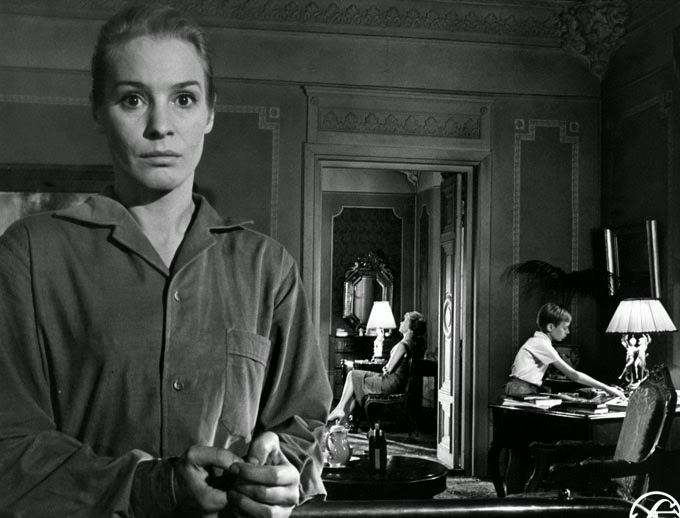
The other recent double feature I attended at WHC was the pairing of Antonioni's Il Grido (1957), The Outcry, and Bergman's Tystnaden (1963), The Silence, in honor of the directors' deaths at the end of July within hours of each other. I have to say that other pairings could have given the films more to say to each other. It seems the films were paired only in so far as they both manifested how relentlessly each director pursued his particular aesthetic. The films had little in common, though I suppose "silence" and "outcry," as titles and situations, do have a certain resonance.

Watching them, it became clearer to me (not that I didn't know it already) that Antonioni's aesthetic is the one I prefer. The power of his images is comprised entirely of compositional elements. Nothing is shown that isn't in a sense realism, but everything is shown in an artistically achieved way. I would almost say "in a contrived manner" -- except I'm afraid "contrived" would be taken as disparaging. It's not intended that way. What inspires my fascinated viewing is that each shot is "set up," the way the perspective of a painting is "contrived." In fact, I think that what Antonioni gives to film, that has disappeared from most work in cinema, is the sense of each shot as composed the way a painting is composed. There are moments in the film that are nothing -- as story, action, symbolism -- but which look like meditations on gray tones, on figures against a ground, on views between exterior and interior, on the use and meaning of perspective. It seems to me that only an audience that has spent some time "reading" representational paintings can get the most out of an Antonioni film of this period.

The story itself was more "heart-felt" than the typical Antonioni movie, mostly because of Steve Cochran's very vulnerable performance as the lead character, Aldo. But to place the meaning of the film under those clichés of "alienation" and "lack of communication" strikes me as a bit ironic. In other words, those "big words that make us so unhappy" (to borrow Stephen's phrase) are also a failure to communicate. What I was struck by more, because I commented on Robinson's Housekeeping recently, was how Aldo's story is also the story of a drifter -- in this case expelled into movement by his mate's refusal to marry him, by her preference for someone else -- who can find no settled life. Which is to say, that it shows how loss can make someone a loser, not simply in the sense of "failure," but in the sense of one who loses things -- like affective ties, like a purpose or a goal, even as his old town is eventually given a purpose: to be bought and knocked down for airplane manufacture.

The Silence presents, I suppose, another loser in that sense, though we watch the film with little sense of what constituted the ailing elder sister's existence before she arrived at the hotel with Anna, her younger sister, and Anna's son Johan, except that the sisters were "close," probably even lovers. That Ester's in a bad way is clear enough, that she's a translator is made much of, that she is a lesbian is established and then given a forceful statement at the film's close. The contrived nature of Bergman's world, though, is different from Antonioni's and I will use the term disparagingly. The fact of the sisters staying in a town where they can't speak the language is odd, one of those "inability to communicate" situations made literal -- achieving comic effects at moments having to do with the old, loose and baggy concierge who eventually comes to seem a ministering angel to Ester -- but feeling enigmatic for the sake of enigma. The young boy, through whom a good part of the action is focalized, put me in mind of Alexander in Fanny and Alexander, though his adventures are more a kind of comic relief from the tensions between the sisters rather than an odyssey of discovery as in that later film.

As to the images themselves: I generally watch Sven Nykvist's cinematography with rapt enthusiasm, but this film is so claustrophobic -- despite the long halls of the elegant hotel where the boy wanders -- so caught up in a language of facial closeups and closeups of glasses, pillows, headboards -- that it becomes oppressive (deliberately). Hard to watch after all those long, low flat horizons in Il Grido. The image from The Silence that stays with me is Ester leaning, exhausted and short of breath, on the door of the room where her sister has shacked up with a male lover from the street, as the troop of dwarves performing at the hotel parade by in costume. The last two -- a harlequin with a drum and a black-draped, white-faced death figure -- seem to stay longest on screen as they pass, hanging for a moment as, it seems, the only ones that register with Ester. It's a comic moment, but also cruel and so memorable. Rare enough are the moments in the film where I can say an image gives pleasure, rather than expressing the oppression of desire, the uselessness of language, the need for physical contact. The rest is silence.

Tuesday, September 18, 2007

DOUBLE FEATURE

Last Friday night, WHC showed two films based on works by Arthur Schnitzler. I went to see La Ronde (1950) because I've never seen a Max Ophuls film before, but I also stayed for Stanley Kubrick's Eyes Wide Shut (1999) even though I've seen it on-screen at least three times before. Somehow I just couldn't not watch it again.

La Ronde was gorgeous to look at, which is what I've always heard about Ophuls, and the tone of the film was decidedly drôle, as the French say. The "master of ceremonies" who linked the action was arch and likeable, très amusant, très charmant, but his corny little French songs gave the whole a kind of mawkishness -- a way of poking fun without really poking fun too much. The "ronde" of a series of erotic encounters was diverting enough, but all the characters were deliberately types, deliberately playing out familiar roles, and, while there was some poignancy in the married woman's search for passion outside marriage, and in the street-walker's ready made insouciance, there was little in the way of friction against our comfortable appraisals of these types, all made fools by l'amour. C'est la vie. Olympian laughter at the nonsense that desire leads us into is all well and good, but I like my send-ups with a bit more bite.

Maybe that's why I had to stay for the showing of Kubrick's final film. Based on Schnitzler's Traumnovelle, which is much more engaged by the grip of passion -- in this case jealousy -- than the wry spoofing of La Ronde could manifest. I'll admit when I first saw Eyes, I was a bit disbelieving toward its central problem: that a man should be surprised that his wife has an interior sexual life, a world of fantasies and desires separate from him. It seemed indeed an insight that belonged to Schnitzler's world, the turn-of-the-century and the discovery of the unconscious and so forth. The knowing, man-of-the-world air that La Ronde so cleverly achieves would indicate that such a man is nothing but a fool, so why deliberate on his absurdity for well over two hours? That's not to say I didn't enjoy the film -- it was far too much fun for that -- but I couldn't quite accept its premise.

Subsequent viewings altered that situation, but even more to the point is the fact that I now simply watch it in delight, captivated by its relentlessly stately pace, its visual splendors of interiors, hallways, portals, streets as only Stanley could render them; its lovely women, nude, nearly nude, or simply alluring; its use of music -- especially that jarring piano theme plucked note by note; its engaging character-actor turns by the likes of Todd Field, Alan Cumming, Sydney Pollack, Rade Sherbegia; its color sense -- all that blue and orange and all those Christmas tree lights; in short, its sheer command of every aspect of cinema.

Finally, there's Nicole Kidman's Alice. Let me preface my comment by saying that one thing aging does is make one forget what it felt like to be young, not in terms of one's grasp of physical capacities, so much, as in one's recollections of how the world assailed and afflicted and inspired and amazed one. In other words, that sense of being above the fray and laughing at the delusions of those who desire suits the middle years, is in fact their main strength. But Kubrick, who was getting on when he made Eyes, manages, with Kidman's scene where she tells of her longing for the naval officer, to encapsulate not only the low, tremulous thrill that what she's saying gives Alice, but also captures how maddening, how detestable and delectable she is, as husband Bill Harford's object of desire, "sure thing," spouse and confidante and simply the woman on the inside of her husband's ego. Watching her I could remember, feelingly, how a woman -- not a woman, the woman -- can rivet you with a gesture, inhabit -- with a body at once too vulnerable and too invincible -- the very space of your abiding desire, desire manifest as her, not as yours any longer.

All the interruptions that intrude from the end of her monologue are Jovian jokes at the couple's expense, delay mechanisms to keep them apart, showing them, and shoving them into, a funhouse world of distorting mirrors, becoming gradually a nightmare world if they can't manage to (the last word of the film, wonderfully) fuck.

It's the difference between a masterful shrug at obsessions and a masterfully charted course through the potential abyss.

Saturday, September 15, 2007

CHELSEA BRIGADE

Last Saturday my daughter and I made the rounds of some galleries in Chelsea. A week later, here are some of the things I looked at most intently, that stayed with me:

First there was Aaron Noble's abstract comic-book art. Which is to say, these are large framed prints using the traditional colors and the look of inking techniques found on the pages of Marvel Comics, while the shapes -- which are in most cases biomorphic, or rather an amalgamation of limb-like forms and what would be background configuration in a typical comic panel -- twist and undulate and duplicate, but don't ever constitute a legibly rendered "figure and background." The background is white and the colored shapes stand out at times as unfinished renderings, or as completed pictures from which whole sections have been removed. The fascinating thing to me, who read Marvel Comics avidly in my pre-teen years and tried to draw like the master Jack "King" Kirby, was that the conventions of comic-book rendering -- which, for all their variants, are fairly uniform -- have here created a new form. Comic Abstract? Whatever, Noble's work is an interesting, visually appealing conflation of high art and popular art. And that's the name of the game, isn't it?

Then there were the photographs by Alen McWeeney of Irish nomadic travelers, essentially gypsies of the automotive age (the photos date from the late '60s). I'm not generally fond of photo-documentary type shows; y'know, like Larry Clark: find some subculture (preferably in CA), take some static, vapid photos of it that look like GAP ads, and confront your viewers with some slice of life they wouldn't normally see. McWeeney's photos aren't like that because they're all excellent photos. The artistry of these pictures rubs right up against the eerie otherworldliness of the people depicted in an amazing act of photographic rendering: we see the truth that an image can make known, even though the content of the photo is staged or planned. It's not that these are stolen moments, so much as these are stolen views -- stolen by art -- of a life that exists independently of any and all such frames. Each photo shows something ungraspable. That is, the photos assert, by showing it, that "something" ungraspable but wholly individual and still, somehow, emblematic that makes these people unique. Riveting.

Next, the assemblages by Stephanie Pflaum of Vienna. These consist mostly of various kinds of stuff doused in plaster and in some cases burnt and then treated to an overlay of fabrics, or fake gems, or paper flowers, or leaves, or wig hair. In some cases the overlay is further overlaid -- in situ -- with more wet paint or plaster dousing: thick, frosting-like slathers of white lather. The ones I liked best were configurations of oddly shaped stretcher-frames set upon one another, sometimes with bits of canvas still adhering to the frames or dangling picturesquely, with areas of the white coating blackened from burning. On one a central section of cheap shiny junk "jewelry" created a kind of buried treasure feel at the heart of the structure. A vaster but related piece had a window fastened, behind which lace matted with plaster boasted some paper butterflies. I didn't like the kitschiness of the butterflies, but in general I liked the mix of textures in each piece and the compositional brio. As I remarked to my daughter: "one of the dictums of modern art: if you can't paint, learn textures." Pflaum knows textures.

But let's turn to painting. The reason for the trip into artville was to drop by Eva Struble's opening at Lombard Fried. Struble, whose MFA show at Yale I saw two years ago, has come along quite a ways. The paintings are generally the size she worked on then, and they still seek out those areas of a city that show the traces of industrial processes, the leftover badlands and bad waterfields of chemical dumping, but the paintings themselves seem no longer tied to the dreariness inherent in such topical rendering. Why? Because of those great mainstays of painting: abstraction and the liberated palette. Struble's handling of paint was strong as a student and has grown more confident -- there are many delightful passages of dripping, thinly washed painting scattered across these canvases -- but what really pleased my eyes was the strides forward in color sense in paintings like "Pulasky Bridge," "Black Water," and the show's crowning achievement -- which gives the show it's name -- "Newtown" -- arguably the most abstract painting here, where the vivid yellows, greens, oranges seem to exist in their own right, though the context of the other canvases lets us know that we are looking at the oddly aesthetic, if biologically poisonous, effects of mankind on its environment.

Finally, installations: Friedrich Kunath has assembled what appears to be a partial wing of the museum of surreal objects for his exhibit. The TV bisected by the water of the bathtub in which it sits -- an image of a sailboat playing on the surface of the water on the set at the exact level of the water in the tub; a coffin covered in denim-patches; a table full of framed photographs of subjects with their backs to the camera; half a piano affixed to a mirror in which we see the "other half," and so on. Unlike the surrealists, I don't see any real provocation in these artefacts, but they do harken, perhaps nostalgically, to the era early in modernist art when the fixtures of bourgeois life could be pulled apart and put back together as something else for the sake of the new century's sense of upheaval.

For our new century, I didn't see any art that carried any really challenging sense of contradiction, but I could feel enough of it to be admiringly rooted looking at Pflaum's beauty of derelict detritus and Struble's beauty of waste spaces.

Monday, September 10, 2007

GOOD HOUSE-LEAVING

Recently I got around to reading Marilynne Robinson's novel Housekeeping (1980), a dreamlike tale told with great economy and precision. In fact the language is so well-rendered that it is often at odds with the perspective it recreates -- in first person -- of a young girl named Ruthie. I don't see this as a flaw, necessarily, because the perspective, we gradually come to feel, is of Ruthie enhanced beyond her actual years and perhaps even beyond the mundane world altogether. In other words, what seems to begin as a kind of coming-of-age story about two young sisters who come under the care -- through a series of incidents -- of their mother's younger sister, Sylvie, becomes as it goes a story of spiritual awakening. The effect is achieved through a prose that is able at times to register an almost biblical sense of things -- like a flooded house, or a train de-railed into a lake, or an all-night campout -- that would otherwise be homely enough, if odd.

The central figure of the story is the house the girls share with their young aunt whose sense of housekeeping is ramshackle and distracted, so that the house -- which is what holds the family together as family, at first -- comes to seem nothing more than a device of normalcy, something the townsfolk want to see upheld so as to register the proper sense of belonging, though Sylvie, an outsider and sometime vagrant, has no particular use for the town or the house. It's in the depiction of the character of Sylvie that the novel attains a quality of genuine perception which, due to the narrative voice of Ruthie, grown at times almost otherworldly under Sylvie's tutelage, lifts it beyond the simple story of a misfit -- whether conceived as a misfit of proper childcare, of proper housekeeping, or of particular gender roles. Sylvie is more than all that because she elicits something deep and real about the American character -- think of Huck Finn, think of Whitman's song of the open road, think of the Depression-era train-riding hoboes celebrated by the likes of Kerouac, Guthrie, Dylan.

"...the tramps, when they doffed their hats and stepped into the kitchen as they might do when the weather was severe, looked into the parlor and murmured, `Nice place you have here,' and the lady who stood at the elbow of any one of them knew that if she renounced her husband and cursed her children and offered all that had been theirs to this lonely, houseless, placeless man, soon or late he would say 'Thanks' and be gone into the evening, being the hungriest of human creatures and finding nothing here to sustain him, leaving it all, like something dropped in a corner by the wind. Why should they all feel judgment in the fact that these nameless souls looked into their lighted windows without envy and took the best of suppers as no more than their meager due?"

This passage conveys what to me is the real meaning of the book, the sense of house-leaving as the basis for any positive change, though the theme of the evil of breaking apart families -- in the name of some civic rectitude -- is developed more dramatically (and gratuitously, it seems to me). In other words, the solidarity between Sylvie and Ruthie (set against the longing-to-be-ordinary sister Lucille) is fine without the need for persecution to drive home what is implicit in their self-knowledge: they cannot stay. The further meaning of such house-leaving, for Robinson, has to partake of ultimate ends: this world is not the be-all and end-all; we are not meant merely to make ourselves comfortable.

That theme too is a bit of a will-o-wisp because there's nothing in the actual story to support a more transcendant or allegorical meaning, ultimately. So two themes of the story, for me, hang limp as the cuffs of a scarecrow's coat: the clash with the townies, and the effort to attach spiritual, "thy kingdom-come" uplift to the story, both of which come on strong in the close with a feeling, to me, that these were decisions on the publishing end, to make the story resonate in a certain way, to become 'exciting' by bringing in, too emphatically, plot and significance. Without those larger gestures, to be sure, the novel tends to be almost wholly poetic, a narrative of tonalities where the hieratic has its place so long as it is in the service of the child's awe at what the world potentially is, beyond the parameters of what human needs have made of it.

Saturday, September 8, 2007

TWILIGHT OF THE GODS


The WHC Film Series kicked off the semester with a screening of Luchino Visconti's masterpiece, The Leopard (1963). I have to confess I've never read the novel by Lampedusa on which the film is based, so for me this epic of the Sicilian aristocracy making way for the middle-class so as to keep socialism at bay is associated with its filmed version. It's hard to imagine how the novel could be more definitive than this staging of it. In other words, the film does what to some extent cinema had always promised: telling a story with images, but also with great dramatic moments, and also with the unforgettable poetry of actual landscapes and locales. And also with a tour de force sequence, the 45 minute grand ball that almost begins to feel like lived time. And also with a memorable performance as the cornerstone of the film.

The performance upon which the whole thing hangs is delivered by Burt Lancaster, amazing as that may seem. From what Millicent Marcus, who introduced the screening, told us Italian backing wasn't sufficient for costs, so Americans were brought in and with American backing came an insistence on an American star. Visconti hoped for Brando; he was offered Anthony Quinn, Spencer Tracy and Burt Lancaster. What Brando would've done with the part can perhaps be imagined by what he brought to films such as The Ugly American, Burn! and The Godfather, films in which his roles were similarly thoughtful and filled with the poignancy of a charismatic figure who just can't bring it together any longer. That feeling is paramount in the role of Don Fabrizio, Prince of Salinas -- Quinn (who interestingly was also considered for Don Corleone and who of course worked memorably for Fellini in La Strada) seems more fitting for the role of the middle-class upstart, Calogero, but not as the centerpiece performance. And Tracy? It's hard to imagine someone so quintessentially "yankee" pulling off the part of an Italian aristocrat, but then again it might have been so wrong it became right somehow. Well, no matter, it's Burt's baby all the way. Prof. Marcus mentioned how Lancaster patterned his performance on Visconti himself, at least, one assumes, in terms of the stately bearing, the warm reserve, maybe even the melancholic awareness of pretense and delusion as necessary to a smoothly running society.

There are at least three great moments when the Prince is able to speak at length to show his grasp of the situation: first with the priest where he speaks feelingly of how the Church is eternal but the aristocracy temporal -- he sees clearly that the Church, which the priest feels is being abandoned by the aristocrats so that the poor will have to fend for themselves, will make its peace with no matter who is in power, that its mission will outlast his own senescent class. The next is when the Prince rails at his lower class hunting buddy and later at his wife so that they will see the reason he favors his nephew Tancredi (Alain Delon) marrying Calogero's daughter, played with almost feral intensity by Claudia Cardinale, who happens to be the town beauty: he knows that only by aligning with the money of the bourgeoisie can his heirs continue to have things their own way -- though he finds the tactic "somewhat ignoble." Finally, my favorite scene is when the Prince is asked to become a senator, to join the government, to work to improve Sicily. His comments, full of what his visitor calls "grand truths," seek to anatomize Sicily, to suggest why someone like himself cannot become a pragmatic political animal if only because the weight of the past is too present to him. The fact that Don Fabrizio may have been a better senator than Calogero (who the Prince suggests) or Tancredi, who, his uncle realizes at the end, will serve, is only to indicate that the energy of the latter two men far outstrips the Prince, and the past. Tancredi ends up sounding like someone who will welcome Mussolini. The fatalism of the Prince's comments are striking, perhaps delusional or self-defeating, but they have a sense of poetic judgment. As when he says, "Sicilians don't believe they can be improved. Because they are gods."

Lancaster gives a bravura sense of the godlike entitlement that is passing with the Prince's generation. Visconti's images are full of a sense of ruefulness, of the kind of sadness we might feel for the lost youth of our elders, particularly when those elders pretty much had things the way they wanted them. Prof. Marcus made comparison to Gone With the Wind, in the sense of a southern aristocracy losing its privileges, but the comparison didn't feel apt to me. Rather I think more could be made of a comparison between Lancaster's Don Fabrizio and Brando's Don Corleone: in both cases a dominant man who controlled the world for a time is having to give way to forces of change, forces which he tries cannily to co-opt to the extent he's capable, even as he knows his way will still be swept away. The hopes pinned on Tancredi and on Michael are similar, and the fatalism -- which I would describe as the ability to fully understand one's fate without being able to change it -- resonates in a similar way. But nothing in Coppola / Puzo's tale of the immigrant paisano's rise to power can quite equal the Proustian sense that Visconti / Lampedusa provide in this sweeping vision of the twilight of the gods.

Saturday, September 1, 2007

IT'S THE END OF THE WORLD AS WE KNOW IT

It's the anniversary of the start of Blogocentrism and as fate or some other abstract entity would have it I recently read two different accounts of the internet world, the one Michiko Kakutani's review of The Cult of the Amateur by Andrew Keen, the other "A Space for Us," Pagan Kennedy's essay on "meeting" her readers by searching for mention of her books on MySpace. Keen's book criticizes the DIY ethic of the internet, particularly sites like MySpace, YouTube and Wikipedia, arguing that the lack of standards, expert opinion, professional production values, content guardians, and so forth, will produce a culture of anything goes and nobody knows. Kennedy, on the other hand, seems starry-eyed at the prospect of learning info about the kinds of people who read her books; the internet lets her interact with them, maybe even to the point of trying to live up to their expectations of her work. In any case, the main point of her essay is the startling -- to her -- idea that readers have faces, lives and, most unexpectedly, voices.

Both Keen and Kennedy seem to live sheltered lives, or at least have adopted such a persona for purposes of their major point. It's of course overstatement to ascribe a revolution or a decadence to the fact that people use the internet to communicate their loves and hates. People have always done so anyway, but now there's a record of it that strangers can consult if they so choose. The trend-setting aspect of word-of-mouth may be increased astronomically, but it's still the basic appeal to a popularly perceived need or ideal or amusement that it always was. Keen acts as if the vox populi online will sweep away the culture of informed voices -- but that's only possible if informed readers cease to heed authoritative opinion. But is it really believable that readers of cultural mainstays such as The New York Review of Books, or The New Yorker, or The Nation, or what have you will get their opinions entirely from bloggers with cryptic names and busy websites? What strikes me as quaint in Keen's view, as presented by Kakutani, is that it almost seems as if he was under the delusion that until the internet dawned opinion was actually formed by the established organs -- when it's just that other opinion was ignored (unless put on display in fussy letters to the editor).

The point is that the official organs set a standard but also standardized a viewpoint, a taste, a manner that could then be taken for granted as "the best opinion." Those in that web needed never to consider what those outside it thought, sought or fought for. Now, if the insiders log in to what the hoi polloi are looking at and saying and reading, they have the immense shock of realizing that discourse has gone on all along, blithely indifferent in many instances to what the opinion makers have had to say.

An illustration: the least-read publications of all are academic studies because they are the most informed, but so narrowly focused and so scrupulous in referencing sources and acknowledging ideas that they are hamstrung and uninteresting as writing, by and large. The popular press tends to take ideas from the world of research and particularized knowledge and makes them "general" by not playing the game of citations, and without the complex weighing of differing viewpoints. Then along comes the "everyperson press" of the internet, which plays at accountability but which is mainly aimed to disseminate what "everyone" knows or says, regardless of its factual basis. Or, as in Wikipedia, it aims to catalogue every current term or concept or personality without benefit of the kind of long-term status and consensus that leads to encyclopedia entries.

I'm more on the side of Kennedy -- though with somewhat less the "brave new world with such creatures in it" tone. I think all readers of a book or viewers of a film or listeners to music or attenders of a political speech should -- in a free country with free access to means of expression -- be able to express an opinion and to do so in any manner they choose. "By their presents shall ye know them," as the saying goes; if a cretin is expressing a cretinous opinion that will show, if an informed voice gives serious consideration to something the paid pundits have no time for, that too will show.

Keen seems to think that if "everyone's doing it," then no one is left to be an audience for the "true" practitioners, but that's rather unlikely. It's long been the case, for instance, that most readers of poetry also write some version of poetry, and the DIY experience of trying to do what the most admired poets do hasn't ended the production of poetry, some of it quite remarkably good, or of the publication of poetry (always to some extent by a coterie of strong-willed DIY intellectuals), it has simply created an environment in which there are very few who are "only" readers of poetry. Likewise there are few more dedicated admirers of musicians than other musicians, or attenders of art openings than other artists.

Granted, when we move away from the creative arts with their valuable subjective element and start talking about knowledge -- of history, of biology, of chemistry, of politics, etc. -- then the pop version -- or propaganda -- version of such things that Google or Wikipedia potentially delivers is more pernicious. But presses and newspapers often have their ax to grind, their slant, and every encyclopedia entry has been updated or revised at some point. The caveat is against taking any source as the complete and utter authority. At least Wikipedia, because it is DIY, appears provisional from the start, a place to start, not the first and only source. But it may be that exposure to contrary opinions or accounts will send the searcher in search of the most thorough and informed account, which is the whole point of the procedure.

What Keen does bring to the fore is the fact that the internet is largely just a more haphazard and less accountable version of the popular press; Keen sees that, as quoted by Kakutani, what "the Web 2.0 revolution is really delivering is superficial observations of the world around us rather than deep analysis, shrill opinion rather than considered judgment." I'm in agreement with that observation, but, unlike Keen, I already assume that "deep analysis" and "considered judgment" are not part of the popular press to begin with -- where, if the opinions are not "shrill," it's only because they're smug.