Showing posts with label Syd Barrett. Show all posts

Thursday, May 1, 2014

DB's Song of the Day (day 121): "SEE EMILY PLAY" (1973) David Bowie


It’s May Day! Beltene, in the Celtic calendar, and it’s supposed to be suffused with good spring-like vibes. Here in CT yesterday was an epic downer of cold and rain that went on all night. Now, after a morning of fog and drizzle, tepid sun begins to seep out and into things. Hardly a riotous welcome for the new month.

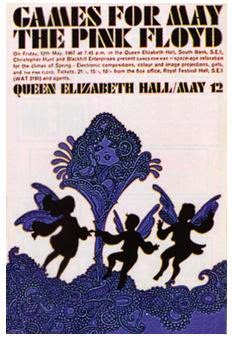
Today is also the birthday of one of the few current filmmakers I actually admire: Wes Anderson. And because Anderson used a soundtrack’s worth of David Bowie songs—in Portuguese no less—on his film The Life Aquatic with Steve Zissou I’ve decided to go with Bowie’s cover of a tune from Syd Barrett’s Pink Floyd, “See Emily Play,” originally released in 1967, because of its reference to playing “free games for May.”

Seu Jorge
As originally recorded it was a hit for the Summer of Love, a splash of psychedelia, arriving later in the same month, June, as the release of The Beatles' Sgt. Pepper. Bowie’s version, released in 1973 on Pin Ups, his album of covers of songs from the London of his youth, is a striking example of glam meeting psychedelia, with Bowie giving it his reverential all, but also working in even odder interludes than on the original (arguably) and with a background chorus of raucous voices. It’s a trippy little number no matter who takes it on.

Put on a gown / That touches the ground / Float on a river / Forever and ever / Emily, Emily.

Sounds a bit like Ophelia’s fate, maybe, but, even so, what better man to cover the song for today than one who wasn’t above donning a gown when it seemed to suit?  Bowie’s celebrated androgyny went further than just about anyone’s—that photo dates from 1970—and by 1973 there were glammed acts aplenty, not least the New York Dolls.  Bowie’s “See Emily Play” can be conceived as a cross-dresser’s song (not much of a stretch since Barrett wrote “Arnold Layne” about a guy who likes to steal women’s clothing from washing lines) with its “Emily tries but misunderstands / She’s often inclined to borrow / Somebody’s dreams till tomorrow.” Perhaps Emily is trying desperately to be a she.

In the Floyd’s version, at the height of psychotropic drugs as recreation (LSD wasn't illegal yet), the trying and the dreams and the misunderstanding sound like they may well be accompanying a trip, particularly with that “You’ll lose your mind and play”—lots of songs from that era were about reconnecting with childlike wonder, as it was often the case that the benign version of drugs made one feel every bit a Wordsworthian child of nature, “trailing clouds of glory”. . . yeah, lots of clouds of glory about the place, no doubt. You’d be happy to inhale.

But in Bowie’s more Mad Hatter version, he sounds to me perhaps like some Wonderland creature, maybe the Caterpillar proffering some jazzy doings to an earnest Emily filling in for Alice. In other words, there’s a touch of camp here, but it’s all in good fun—hear the weird little voice that Bowie uses in the background for “float on a river forever and ever,” as if the Caterpillar were played by a miniature Anthony Newley.  The guitar is riffier, the piano more extreme—I’m pretty sure it’s Mike Garson, the guy who graces “Aladdin Sane”—and those strings extending at the end lend a touch of the quaint.

Anyway, before I got this posted, the sun came out loud and clear, and is raining down on my chair.  

Who are youuuuuu?


Sunday, February 2, 2014

DB'S Song of the Day (day 33):"GOLDEN HAIR" (1970) Syd Barrett


Today is the birthday of my favorite author, James Joyce.  Joyce, if you don’t know, was the greatest prose writer of the 20th century, in English. I don’t insist he was the greatest novelist because he pretty much broke the mold, such as it was, of the novel. And though it was not a permanent effect (even if I wish it were) he did it in a rather flamboyant and non-repeatable (though perhaps imitable) fashion. He’s the bomb. But as a poet, rather less. As a poet, he’s essentially a lyricist. About this I don’t complain overmuch as I have a great respect for lyrics. It’s just that I have a hard time treating lyrics such as Joyce published as poems, per se.


Which brings us to today’s song, recorded in 1970 by Syd Barrett (him again!) for the album The Madcap Laughs. Barrett set to music and sings a lyric from Joyce’s volume Chamber Music. The lyrics have no actual title, as Joyce uses the old convention of calling the poem by its first line: “Lean Out of the Window.” Barrett entitles the song, more fittingly, “Golden Hair.” Or “Goldenhair” (Joyce had a thing for compound words).


Joyce was himself a singer and knew the words to lots and lots of songs—lyrics are included throughout his books Ulysses and Finnegans Wake. Joyce never set a poem to music, to my knowledge, though some of his lyrics were set to music in his lifetime. I like to think he would have enjoyed Barrett’s “Golden Hair”; it’s quite atmospheric, creating a mood that seems to suit the poem perfectly. It’s hard for me to say, in a way, because I knew the song before I ever read Joyce’s poems.

The part that really stayed with me from this song is “I’ve left my book / I’ve left my room / For I heard you singing / Through the gloom.”  The lines suggest a sort of siren song that calls a man away from his book and his room (and his no doubt quiet, bachelor life) to seek out a voice “singing and singing a merry air”—Barrett’s vocal on that is haunting rather than “merry,” so that we feel the tension of the “gloom” and the melancholy that leads the man on, longing for the source of this “merry air” (I can’t help thinking of a man seeking in his books “surcease of sorrow” and then he’s interrupted, not by a raven at his window, but by a voice singing “on the midnight air”). When he gets to her window, we imagine, he can see her and her golden hair within. And then comes the call for her to lean out of the window, Rapunzel-like, to let him come to her. And that’s it. It’s all in the longing that the singing creates, both song and longing find their image in—and listen to how Barrett draws out the final pronouncement—“golden hair.” It becomes now her name, and the name for this entire experience. And so, the name of the song as well.

Recorded with some of his former band-mates (those Floyd guys) the song has some eerie ambient sounds moving through it, like a sustained cymbal, and nice use of echo. Probably the Barrett track I liked best immediately. Others were more of an acquired taste.

Monday, January 6, 2014

DB's Song of the Day (day 6):"JUGBAND BLUES" (1968) Pink Floyd


Born today in 1946 was Syd Barrett, one of the founding members of Pink Floyd. His given name was Roger Barrett and he died, age 60, in July 2006.  His tenure in Pink Floyd was fairly brief—the period of its founding in 1965 until his ousting in 1968. After that he recorded a couple of solo LPs, The Madcap Laughs and Barrett, both released in 1970. The “legendary status” around Barrett was fully entrenched by the time I first began listening to Pink Floyd with the release of Dark Side of the Moon in 1973. At that point they were unavoidable. I’d heard of them, and heard a few tracks, probably, before that, but. It was really the release of the double LP, A Nice Pair (1973), containing the first two LPs—Piper at the Gates of Dawn (1967, mostly written by Barrett) and A Saucerful of Secrets (1968, with Barrett credited to only one song, our exhibit for today)—that got me in past casual listener status. Soon I was conversant with Relics and Ummagumma and Meddle and Obscured By Clouds, and then the band released Wish You Were Here, which included tributes to Barrett, “Shine On You Crazy Diamond” and “Wish You Were Here.”


So, yeah, Barrett was kind of the wizard behind the scenes at that point. People liked to throw around tags like “acid casualty” and all that, but, y’know, that’s just show-biz—drugs affected his behavior, certainly, too much a head, apparently, even for a major purveyor of head music. Barrett, like some pop savants, seemed not to have the stomach or nerves or whatever it takes to be a rock band front man. He also wrote incredibly odd songs—coy, fey, whimsical, trippy, psychotic, bluesy, childish, abashed, visionary, histrionic, charming, casual, hypnotic, and lots of other adjectives, like mercurial. Barrett’s legacy remains as some of the most original and immediately recognizable music—he did odd things with his guitar, particularly with distortion and effects—from a period where “everyone” was dropping acid, smoking pot, and trying to reinvent the use of their instruments, to say nothing of dabbling—in the rush of Sgt. Pepper—with as much studio sophistication as their budgets could muster. The Floyd, on that first LP, managed to do it all without being Beatles ephebes in the least. And if you think “Strawberry Fields Forever” is trippy, try “Jugband Blues.”


The song has three segments that seem like they could be parts of different songs. It’s a bit like a musical collage, in other words.  It begins with what sounds like a typical (if anything about Barrett is typical) Barrett tune: announcing itself with the kind of kick we know from “Bike”: “It’s awfully considerate of you to think of me here / And I’m most obliged to you for making it clear / That I’m not here.”  With that the verse sort of winds down unexpectedly to a haunting delivery of “And I’m wondering who could be writing this song.”

At that point we jump into the “jugband” segment, which starts very lively with “I don’t care if the sun don’t shine / And I don’t care if nothing is mine” and ending (apropos of today) “I’ll do my loving in the winter”—the last word is drawn-out and segues, with a kazoo-sound, into a kind of disheveled jugband banging out a segment that speeds up and starts to fall apart simultaneously, then it all tips over into the kind of spacey interlude that’s a Pink Floyd trademark—see “Astronomy Domine,” “Interstellar Overdrive” (on the previous LP), and “Set the Controls for the Heart of the Sun” (on this one)—with ambient sounds of the jugband on another channel of a broadcast, or in another dimension.  This crescendos, along with sound effects (the very epitome of psychedelia) and gets shut off.  Segue to Syd and strumming guitar, as he delivers lines bathetic in their childishness and fragmented sense: “And the sea isn’t green / And I love the Queen / And what exactly is a dream / And what exactly is a joke”?

Dreams, jokes, love, and not being here.  It’s a potent mix and ends the LP (and Barrett’s contribution to Pink Floyd) not with a bang, not with a whimper, but on a distracted and disjointed note.  What a way to go!  I’ve always admired this song for comprising, as it were, the essence of Pink Floyd in three minutes, sans the lyrical guitar solos of Gilmour or the wails of Waters. There’s always something comforting and disconcerting about Syd’s songs, at their best. I doubt anyone could’ve kept up that unique blend for long. Rather, think of it as a special brand for a limited time only, and for the benefit of Mr. Floyd, at their intergalactic majesties request, Barrett’s nut gone flake.

Mason, Barrett, Gilmour, Waters, Wright, 1968

Sunday, December 19, 2010

THE CDS: Syd Barrett

I’ve only got one Syd Barrett solo CD: The Madcap Laughs (1970).  The other one is called Barrett.  Both albums were released in 1970, though Madcap sessions began shortly after Barrett ceased to record with Pink Floyd, in 1968.  Both albums were released together, by the time I was aware of them in the wake of the huge success of Dark Side of the Moon (1973) and the sudden interest in all things Floyd, as a double album set.  I was about equally familiar with both since I had them on a cassette together and probably still do somewhere, but I always preferred Madcap because it's more dicey.

Syd, as you all no doubt know, was the inspired composer for the early Pink Floyd (“Arnold Layne”;“See Emily Play”; “Bike”; “The Gnome”; “Flaming”; “Jugband Blues”), as well as a legendary performer known for his idiosyncratic approach to all he did, particularly his guitar-playing.  His contribution to Piper at the Gates of Dawn (1967), the band’s debut, assures him a place in the front ranks of the annals of psychedelic pop.  But psychedelia was a short-lived phase, even if, to my mind, a delightful one, and when it came time for the Floyd to record their second album, only slightly less psychedelic, Syd was more or less undependable.  Instability having to do with (take your pick): those genetic problems we blame everything on these days; or the hallucinogens he was so fond of and the psychosis the same have a tendency to bring on in impressionable types; or the nature of genius (or pressures of fame) as being a burdensome gift that can cause massive hemorrhages of other aspects of the psyche (a familiar, heroizing tale whereby madness is the sign of true genius, etc.).

How out there did Syd get anyway?  I have no way of knowing, but something along the lines of Withnail and I seems suggested by the stories told; judging by this record, he was in some region where the usual conventions of professionalism were no longer a functioning concern.  But does that make the album amateurish?  Not quite.  It’s a bit like therapy, it’s a bit like a vanity project, but it’s also the kind of thing that cements the notion of Syd as utterly unique in all his plaintive oddity.  There are songs on here that I wouldn’t want any other way: “Terrapin,” “Octopus,” “Dark Globe,” “Here I Go,” “Late Night,” and the lovely melancholic setting to music of James Joyce’s poem “Golden Hair.”  But there are other places where better stuff wouldn’t hurt.  According to what I’ve read, the sessions were a chore for those working with Syd due to his way of going about it, and when his former band mates Gilmour and Waters stepped in to help they did so in a bit of a rush, being busy guys with a band and all.  Anyway, Syd is Syd and no one else is or was.  He died in 2006.


Please, please, please lift a hand
I'm only a person

with Eskimo chain
I tattooed my brain all the way...
Won't you miss me?
Wouldn't you miss me at all?
--Syd Barrett, “Dark Globe”