Showing posts with label Lou Reed. Show all posts

Monday, October 27, 2014

DB's Song of the Day (day 300): "SOME KINDA LOVE" (1993) Velvet Underground

Today marks the first anniversary of the death of Lou Reed. Last year, when the news hit, I wrote a tribute and so far on this series I’ve posted on three Reed songs, two he recorded in his solo career, and one on the first Velvet Underground album. For today, I’ve selected a song from the Velvet Underground reunion that took place in 1993 for a short European tour—and the album drawn from three concerts, three nights in Paris. It seems to me fitting as Reed and guitarist Sterling Morrison are both gone (Morrison since 1995) and so why not pay tribute to the most recent time when all the original VU members worked together?

What’s more, because John Cale was only on the first two Velvet Underground albums, and since I prefer the third album, without him, to the second album (the songs on Velvet Underground, 1969, are simply better than the songs on White Light/White Heat), it’s of interest to me to hear this live treatment of “Some Kinda Love” (originally on the third album) as though it’s a second album song. Get it? White Light/White Heat is the noisiest VU album; Velvet Underground is the quietest. In 1993, the “noise” factor is increased considerably, with Morrison doing one of his more extended guitar solos and Cale coming in at the end with a wonderfully disjointed electric piano solo.

Lou’s vocals can be a bit erratic on the released recording of the shows, as he seems to want to treat words as excuses for dragging out syllables, as though he’s trying to create a melodic line, when we all know that Reed’s great gift as a singer is to sound as though melody were the furthest thing from his mind. Oftentimes in his career he more or less talks rhythmically, but I suppose the rigors of playing live made him feel an urge to work his vocals a bit more.  His approach is particularly extreme on “Beginning to See the Light” where you’re happy for Cale’s attempt to deliver “how does it feel to be loved” more or less straight while Lou does his vocal hiccups.

“Some Kinda Love” suffers a bit from the tendency, but in general Reed keeps his eye on the ball, probably because it’s one of the more interesting lyrics from his VU days. In fact the opening verse is so good, it’s worth quoting in full: “In some kinds of love,” Marguerita told Tom, / “Between thought and expression lies a lifetime / Situations arise [here “evolve”] / Because of the weather / And no kinds of love / Are better than others” / La-di-ta-ta-ta

There you have two little comments that amount to something of a philosophical position. One is that “love” is something that must find its proper expression—and that the quest to find the right occasion might take a lifetime. Your expression may lag far behind your conception, in other words. The second statement is in two parts: the part about situations and the weather is a way of saying that there’s a certain je ne sais quoi to what makes love “happen,” and what makes love “depart.” It comes and goes, we might say, like the weather, but there’s also a certain pragmatism embedded in that in the same way that, y’know, you dress according to the weather. Similarly do you make up your mind how to “dress” appropriately for the “situations” of love. Finally, there’s a very open-minded embrace of whatever might arise (or evolve), as no kinds of love are better than others. A flat out statement not simply of equanimity but also of equality. As Andy Partridge says in “Peter Pumpkinhead”: “Any kind of love is alright.” How could one condemn an actual love?

The song goes on in this vein with Marguerita giving Tom the what-for. Going so far as calling him “a bore”—“but in that you’re not charmless.” One imagines that this is not an usual position as women can find bores charming much as men can find bitches charming, when the mood (or the weather) thus strikes. Though the end of Marguerita’s magnanimous gesture toward the lovableness of a bore ends with “and some kinds of love are mistaken for vision.” Which should give us a pause if we feel inclined to give ourselves too much credit in this romance biz. I take the sentiment to suggest that, though you might feel you are a giving person in allowing for the charm of bores, you are still self-serving. Love is a dish, we might say, that one cooks for oneself, then looks to find someone else who shares the taste and the appetite for the concoction.

The bridge, about putting jelly on your shoulder to do what you fear most, is odd but it leads to one of those moments when Lou Reed gets a bit more forthcoming than usual: “that from which you recoil but which still makes your eyes moist.” There you have his typical perversity, which might be something of an oxymoron. Reed knows that the thing that makes you uneasy is the thing you secretly crave, or at least is the thing to which you have a strong visceral connection and his point here is that “some kinda love” can be unpleasant, and make you anxious, and make you like that jelly. “Lie down upon the carpet / Between thought and expression / Let us now kiss the culprit.” I guess we’re a little closer to seeing the thought made flesh, so to speak.

The version of the song on Velvet Underground has a distinctive swirling guitar sound and a very lambent vocal from Reed. And that’s fine, but I like hearing the song become, live in ’93, one of those epic workouts I love so much on Live ’69 (also, sans Cale). So let’s hear it for the reunited VU even if it was just for the money. And let’s hear it for our lost Lou and his thoughts and expressions.


Tuesday, August 5, 2014

DB's Song of the Day (day 217): "NOBODY BUT YOU" (1990) Lou Reed and John Cale


Tomorrow is the birthday of Andy Warhol, and today I’m going into NYC, maybe even some art galleries in Chelsea, so why not pay tribute to Mr. New York himself. Throughout my younger years—into the 30s—I was no great fan of Warhol, rather resenting the fact that fine art sold out to pop art. I could say more about that—I’ve been reading Hal Foster’s The First Pop Age recently because I think, at long last, I’m ready to start thinking as a pop formalist—but this isn’t the time and place.

Instead, I’m harking back to 1990 and the album Lou Reed and John Cale wrote and performed, paying tribute to their fallen mentor, master, and, sure, sometime whipping boy (who died in 1987). Warhol produced the first Velvet Underground album, of course, the one with Nico, and seemed to think of the band as an art provocation. The album, Songs for Drella, chronicles the artist’s career much as he might have viewed it himself—both Reed and Cale can be counted on to have some insight into how Warhol’s mind worked, and are willing to look at the frictions in their respective relationships with him. The complete album is not always as fine as its best bits, but there’s some interesting facet explored in each song. I came away from my early listenings to the LP with a more forgiving sense of Warhol’s necessary presence in art history. And Reed and Cale—always rather fractious with each other—overcoming their antipathy to create and perform a fitting tribute is actually touching, as are a few of the songs.

In other words, I could say that I was skeptical and that I became convinced. And still am. Even more so now that Lou’s gone too. And this video of the two performing on the David Letterman Show revives a bit of the awe I was capable of, where such persons were concerned, around 30. It still gets to me seeing two of my musical heroes paying tribute, on TV, to one of their heroes.

The song, “Nobody But You,” was the first song I heard because I saw them on Letterman before I had the record. It’s actually a bit better in performance than it is on the record. And it’s one of the best songs and was a good choice—even if you don’t know Reed is speaking “as” Warhol for much of it, the song still gets across the attitude it is trying to capture. Reed’s lyrics tend to be very direct, with a kind of stream of consciousness that, lots of times, only he can make work. The jibes at Warhol, sung as if coming from Warhol, are full of a very deadpan charm. Reed is a master of deadpan and it seems he learned it from Warhol, another master.

The lyrics capture the kind of low key whine that seemed to be Warhol’s most common interpersonal style, moving from “I really care a lot / Although I look like I do not” (pretty much summing up their view of Warhol) to “At dinner I’m the one who pays” to “I want to be what I am not” to comments on his health after being shot by Valerie Solanis in 1968, with “the doctors said that I was gone” (he was pronounced dead back then), and “I’m still not sure I didn’t die / And if I’m dreaming I still have bad pains inside.” This excavation of Warhol’s suffering (who’da thought?) comes across—a bit—as grandstanding, and that’s where the great Lou Reed deadpan delivery counts so much. The whole album, for Reed, seems an exercise in tough love, of Warhol, of Cale, of himself as seen through the prism of those involvements. I’ve never doubted Reed’s credentials as one of the great mavericks of rock, answerable, ultimately, only to himself, and to see him shadow someone so closely, keeping Warhol in his sights but also seeing himself as reflected from Warhol, is fascinating. It shows that Reed was a very good student of what Warhol represents, after all.

The great touch in the song is the way the line “Nobody But You” keeps morphing into “Nobody Like You” and “A Nobody Like You.” The bridge between the two is the middle term: “Nobody Like You” means “you’re unique, one of a kind”—a very key statement in the originality sweepstakes. On either side is “Nobody But You” which is one of those borderline masochistic positions: you are the only one who matters, there’s no one or nothing else in my life that could matter as much or more; and on the other side, when resentment of that adulation comes up, “A Nobody Like You” is the sadistic side of the coin: “you’re nothing, you’re not worth my time or attention.”

The song very carefully steps through that minefield—“Nobody but you / A nobody like you / Since I got shot / There’s nobody but you.” We might imagine that’s Andy consoling himself with the idea that, now that a brush with death has made him realize he’s all he has, ultimately, he must be the “you” in this equation. Even to the point of seeing that he himself was a “nobody” who has to accept the preciousness of his own being. So the self-effacing descriptions—“I wish I had a stronger chin / My skin was good, my nose was thin / This is no movie I’d ask to be in / With a nobody like you”—are very apropos. Warhol’s sensitivity to his own posturing comes forward as a grasp of how tenuous his grasp is—on his identity, on his art, on his looks, on his personal (as opposed to net) worth. Warhol knows that being a “somebody” cancels being a “nobody” except that “there’s nobody like you.” Nobody can be the Somebody he most wants to be, at least nobody like him: “I know I’ll never be a bride / To nobody like you.” There is a “one and only”—our best beloved, and our heroic sense of ourselves—that forever eludes us. Or at least those heroes as candid about their failings as Reed and Cale make Warhol, here.

And that great closing line, “All my life / It’s been nobodies like you,” resonates as a Warhol put-down but also the cry of the put-upon. Warhol was shot by a “nobody” who became a “somebody” by shooting him, revealing the machinery of the kind of fame Warhol himself was in service to, in cahoots with. It’s only ironic when looked at from without, historically as it were (or as it was). In propria persona, Warhol is the guy who got shot, regardless of who or what he is. That level playingfield is what still haunts. Andy was the last guy you’d expect to die for his art.

Anyway, I’m glad Reed and Cale got together to do this. And I get such a charge seeing them together on TV, in New York, paying tribute. It’s a funhouse—the pop world, the media, the fine arts. Warhol, in this little ditty, is still at play in them all.

You know I like to look a lot.

Friday, March 14, 2014

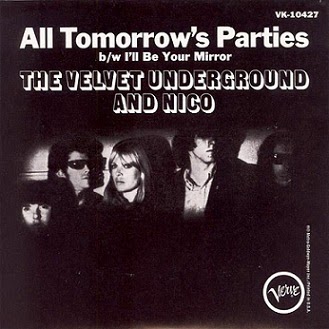
DB's Song of the Day (day 73):"ALL TOMORROW'S PARTIES" (1967), Velvet Underground


Let’s hear it for 1967. This month (two days ago) in that year, Velvet Underground with Nico was released. Also known as Peel Slowly and See, it’s the album with the iconic banana on the cover, silkscreened by Warhol, that you were supposed to be able to peel slowly and reveal . . . a naked banana. And them’s good eatin’.

Today’s song was, in shortened form, released as a single in 1966. The album version is the only version I know (apart from the demos). I chose it today because it’s the definitive song featuring Nico’s vocals, as well as the kind of dirge-rock sound that VU patented. And so much since has come from there.

It’s in those tom-toms and tambourine of drummer Moe Tucker; it’s in the “prepared piano” of John Cale, who doubles on bass; it’s in the echo-y recording quality, with Nico double-tracked to sing with herself. That almost expressionless vocal with the Teutonic accent—it sounds both icy and crisis-y. Could anything be more perfect for a song about having to dress up for parties when costuming is so important? It could be your poor girl wanting to wear what’s required—think of proms, think of belle of the ball attire, or think of Goth accessorizing, maybe—but it could also be your poor TS having to put together a costume that would make him a her. In any case, what stays in play is that “hand-me-down gown / Of rags and silks / A costume / Fit for one who sits and cries / For all tomorrow’s parties.”


When Cale sings the vocal on the demos, it has a more madrigal-like feel, so that the costuming starts to seem like something vaguely medieval. That’s not unfitting either, for the Sixties, where being a folk princess was all the rage. But that’s not the case on the released version where Nico’s inflections seem to befit the reigning Ice Queen. All the more effective, then, that this song dwells on someone who will “cry behind the door.”  Or “cry beh-hiiind dadore.” We get a glimpse of how Cinderella felt after midnight, y’know, with that pumpkin and one less glass shoe.

The song was also covered by Nick Cave (artist featured yesterday) on his very interesting LP Kicking Against the Pricks. One might surmise that all the artists he covers are “the pricks”—no, not that kind of prick, though maybe, if you like, but rather the “pricks” the Bible speaks of when Christ says to Saul that it is “hard to kick against the pricks”—or “goads.”  Y’know, the annoying, stinging pricks that guide the ox where it must go . . . . So, let’s consider VU a “goad” for Nick, and for so many others (though, yeah, Lou could be a prick, and let’s not get started on Andy . . .).  Anyway, here’s the link because Nick does it full justice with an even stronger sense of its dense, metronomic drone, and lots of cool effects.


The VU version is actually somewhat sweet. Which, oddly, is true of all the songs Nico sings on the LP. What makes those numbers particularly interesting, to me, is that they are like negative versions of the typical chanteuse type songs that girl singers were singing all over the radio back then (think of someone like Lulu, or Joey Heatherton, or Nancy Sinatra), all those blonde pop girl voices, and then if you add those Specter-produced tunes with girl groups. . . You can see how off-kilter Nico is, where, as here, she drones rather than croons. But it’s still got something so Sixties about it. Cue the montage of Mary Quant originals.

Time has only improved the first Velvet Underground album. When I first heard it in 1976 or 1977, I preferred the VU of Live ’69. The pressing I had left a bit to be desired. I can vouch for the re-issued mono LP as the best you can expect to find, now. The stereo re-issue for the VU CD box set is good too. There is no album that better establishes, aurally, the brave new world of rock to come. Velvet Underground with Nico is a one-time deal, like most works of art. Even though promulgated by Pop meister Warhol, who believed religiously in the work of art as mechanical reproduction, the first VU album, though certainly endlessly reproducible, in that sense, was impossible to duplicate, in the sense of “do another,” though it was, in so many ways, imitated.

For me, the sound of this album is like the sunshine you see in black-and-white movies from the mid-Sixties. It’s so gone, and yet it’s still there. And there is a little memory frisson that tells me I once shared that time, though not that place (New York). And that’s important because, if you were then, you know how nothing like this album already existed. Now, there’s so much “like” it, it’s kind of hard to see this clearing for all the trees around it. And yet it’s there, then. It’s the first album, the only album, by the Velvet Underground with Nico.  And it’s forty-seven fucking years old.

Nico, Andy Warhol, Moe Tucker, Lou Reed, Sterling Morrison, John Cale, in CA