Showing posts with label painting. Show all posts

Wednesday, May 17, 2023

WHATCHA READIN?: WHAT EVER HAPPENED TO MODERNISM? (2010)

Grey Matters in New Haven is a fairly new addition to the city that has changed its character a little. Book Trader, the former primary used bookstore, stocked mostly trade books—novels of all kinds, biographies, books on a range of subjects, yes, but not many purely intellectual works. Grey Matters is more like visiting “the old curiosity shop” and at least some Yale students I’ve met view it as the means to serendipitous finds, browsing their way into the byways of texts not on the syllabus.

I say that, but I don’t know for certain. Maybe there are still theory classes like there were in the ‘90s, but I doubt it. In fact, the shelves of Grey Matters let me glimpse again what it was like to elbow one’s way around Micawber Books on Nassau Street in Princeton or Labyrinth Books on York in New Haven back there at the end of the previous century and the beginning of this one; even the university bookstores attached to Yale and Princeton were once full of books! Strange but true. And so you could go in at any time and expect to find bound copies of the entire works of a considerable range of authors, or at least the best-known or most oft assigned. And there were shelves packed with the products of university presses, each proclaiming that new research and new terminology and new career-making inquiries or late career-capping retrospectives were as important and timely as whatever latest celebrity memoir or business, money, love or family How To.

At Grey Matters, which used to be a clothes store, it’s like you’re in the attic where all those used student copies from the ‘80s and ‘90s went to remote storage. Sometimes you’re even faced with a collection curated from the library of a deceased professorial eminence, a memento mori of texts, books that may bear an inscription from the author, letting your mind wander for a moment over conversations and conference meetings and correspondence that may have gone into a lengthy acquaintance over the course of time needed to bring an idea to birth as a book. The writer’s life, so very rewarding! And yet it all seems filmed over with the dust that has long since settled on print culture, blown in from the long years that have intruded themselves between my earliest thirties and my dawning mid-sixties.

The students, at play in grandpa’s library of long gone intellectual heroes, may take what value they find. Me, I’m on the lookout—as sometimes in used record shops—for this or that find that reminds me there’s room for one more. Something I passed over before but which now will have its day, suiting my mood or a quest for a new wrinkle in an old suit of clothes. I’m not that various, sticking usually with What I Know, but the landscape of that terrain has altered in sometimes unrecognizable ways by this point. And with books, unlike music, I don’t feel the same friction of identity. A book can be picked up out of idle curiosity. Music, less so. Music will need to be inhabited and the object itself has to have a certain allure or aura. A book—usually I have “heard of” the author at least—can just be a momentary indulgence.

So it was when I stepped away from a conference celebrating the career of Peter Brooks (one of those important professors of literature in my grad school days who is stlll with us, as emeritus, and still producing books) to browse a bit and let my mind wander: I came upon a Gabriel Josipovici hardback in clean wrappers—with a Klee on the cover—from Yale University Press: What Ever Happened to Modernism? (2010). Now, it wasn’t simply that perhaps elegiac or perhaps jeering or perhaps ironic rhetorical question/title that got my interest, but also the date of publication. Having recently begun a new fiction ms. set in 2010, I found the coincidence providential. I’d already found—from what little I’d written—that an author born in 1937 and so in his early seventies is holding forth on his views on literature. So why not a quick acquaintance with what GJ (born in 1940) has to say about that literary and artistic movement or tendency or aesthetic doctrine that fascinated me so in my early twenties and became significant to my education and professionalization (such as it was) from the mid-Eighties to . . . well, yes, about the time of GJ’s book! For 2010 is just after the Birth of the Smart Phone, and just after the Big Buy Out, and just two years before my last five week course devoted to Ulysses. Whatever happened, indeed?

The book, it turns out, derives from lectures given in 2007—so not quite the coincidental chime I’d imagined, but no matter. It’s not as if my fictional novelist is not drawing on a lifetime of reflection on his art, much as GJ—a novelist and playwright as well as critic—is doing. In fact, the GJ book that I seemed to dimly recall as I flipped through this later work was Lessons of Modernism (1977; 1987), a book that I at least glanced at somewhere there in my undergrad and/or grad days—1985-94—and so he seemed an old mentor or former teacher showing up again. Why not? I left with the book.

Actually, reflecting on it while carrying groceries home today, I recalled an advisor in grad school mentioning GJ with approval and can only assume Lessons of Modernism was the text in question; it may be that she was pointing to his work as insights from a practitioner of fiction and not simply a critic or scholar. That there was something more at stake for him that had to do with a dissatisfaction with contemporary fiction, which is certainly something I was always going on about back then. The period between the wars had seemed to promise so much for what novels and poems and paintings could be; GJ is fed up by having the likes of Martin Amis and Iris Murdoch and Ian McEwan trotted out as worthwhile novelists. Part of the problem is that GJ is situated in the UK and it’s well known that Modernism didn’t have much purchase there—especially if you clear out the Americans like Pound and Eliot or the Irish like Joyce and Beckett. You’ve basically got Woolf, Forster (if you think so) and Ford Maddox Ford. Lawrence? Well, there you have it. Lawrence is certainly a modernist in his interests but his methods are pretty much cut in the good old yarn-spinner’s mode. But I guess there is a syllabus where Lawrence can sit with “American modernists” like Fitzgerald and Hemingway, sure. The point is that Modernism—which, because of the last named, throws a long shadow of influence in the U.S.—doesn’t inspire the next generation much in the UK. And so GJ imports almost all his examples from Europe and even from other eras.

And that’s where I found him on familiar ground—because arguments about the modernity of Don Quixote and Pantagruel and Tristram Shandy had all fed into background arguments I’d found useful for what made Ulysses the unique work it is. Not that GJ is all that keen to deal with Joyce. He’s much more likely to find figures for his supreme modernist in Kafka, Beckett, Picasso, Stravinsky, and Borges. He’s also apt to pull in Robbe-Grillet and Simon and all those French figures who kept the radical stress on form alive and active in the 1950s and into the 1960s. It’s not that I’m out to fault GJ for his references; I merely read his book to see how well what he says jells with my own discontentment with fiction as generally practiced, looking for maybe the odd apercu that would bounce around in my brain while at work on what my Jonathan Hawthorn is hawking.

Following the idea that serendipity has its own logic, or at least that what gets taken up randomly may provide random yet providential input, the passages in What Ever Happened that appealed most to me came from Kierkegaard (who I’ve mainly read in quotations, though he seems to be for GJ the kind of “modernizing thought influencer” that I found in Nietzsche, way back there in my schooldays), and, which I'll get to first, some quotations from visual artists that struck me as apropos to my own endeavors in that realm. The first from—so unlikely a source as to be memorable—Marcel Duchamp, he of the objets trouvé and source of all that “is it art?” “what makes it art?” rigamarole that keeps the critics and scholars busy and Duchamp, no doubt, laughing in his grave:

“Choice is the main thing, even in normal painting.”

For Duchamp: what object to choose and what to do with it?  In “normal painting” (which is I guess what I do), “what size,” “what orientation,” “what surface,” “what colors,” “what brushes,” “what ‘object’ or ‘subject’ or ‘image’” . . . notice how the second we move away from tangibles—the materials that are used to make the art object I’m making (called “a painting”) we get bogged down. Is the object I’m making a depiction of some other object (the “object” of my attention—in my case, often a photograph or photographs I’ve chosen), or is it a depiction of a “subject”—as in a topic or theme? Or both? And is the ”choice” of an image to depict—based on photograph or image of a painting or some other kind of visual source—the start of the object I’m making or is it not really “an image” until I’ve done something with it? The good news is that—in order to paint—I don’t have to care at all! I’ve only got to make my choices and get busy, which is what I like about Duchamp’s statement. I don’t even have to choose how I want to talk about the painting really. (I’m still put-off by the fact that what I’m doing while I’m at work on the ”piece” is called “painting” and that when I’ve stopped work on it, it is now called “A painting.” The point seems to me to be that “painting” is what you do (as in: applying paint to a surface), and the thing you achieve is a painted surface and we should have some term for the thing other than that which designates the act itself. But we don’t. To even call it “a work of art” is a distortion, since not all will admit that every painting is a work of art, because “art” has a limited range of applicability, whereas “painting” is a generic term (it’s a painting, not a drawing, etc.). But then so many works of art aren’t paintings and the whole problem of “work”—again an activity that gets imported into the static object at the end of the process—is its own headache.)

What this all gets at, to me, is the fact that “the painting” is never really finished, so “painting” it is because it could go on, but also it points to the fact that the painting is not a static object at all—though a photograph of it is. The painting keeps changing—first as the pigments set, then as they age, and, always, depending on the light and temperature in which they are situated, they look different to different eyes, which also age and change. So, if you are at all an aware viewer, you know that you yourself—in terms of your attention and focus and awareness—are never exactly the same when you look at the thing. You keep seeing it differently, if you bother to look carefully.

So, I’ll go with “choice is the main thing” when we’re talking about making the thing—or appropriating a thing for artistic use. But “choice” is not the main thing about the “finished thing.” Except to the extent we become critics and, like GJ, choose our quotations and our examples. So let’s turn to another quotation I wrote down, this time from Francis Bacon, the powerful twentieth-century British painter (I’ve seen two retrospectives, one at Yale British Art Gallery, the other at MoMA), who said, in an interview: “I believe art is recording; I think it’s reporting.”

Now, the context for Bacon’s statement is he’s explaining why he doesn’t care much for abstract, non-representational painting, but also why his style of painting—which is truly unique and a significant achievement for twentieth-century painting—isn’t simply “illustration.” In other words, even as great a painter as Bacon has to worry about what the hell he’s doing. It’s not enough to just be a great painter and get on with it. No, you’ve got to carve out some space between those who believe all representational imagery is “illustration” (clearly, an “applied arts” and not “fine arts” region) and those for whom “abstraction” is built into the very nature of painting since the point of the procedure is not to make an exact copy of some already existing thing but to alter it according to a method, style or manner. Bacon has a definite style, manner, and method and it should be enough to have those things and so be discussed for what those things, in his case, bring to the table. But Bacon, in trying not to just dump on shaping colors on canvas for the sake of visual effect as an end in itself, has to take on a dimension that matters to him (and to me): “recording . . . reporting.” As in: his paintings have “subject matter.”

At the outset though I want to say that I believe that any kind of painting is recording and reporting. An artist of abstract painting is recording and reporting too. It’s just that what they record and report doesn’t take the form of a representational image, and so the “report” is something you have to work to intuit. But the point is that, even with a representational image you recognize at once—Christ’s nativity, say, or a Rembrandt self-portrait—you have to work to intuit the “report.” Because the report is how the painting is a painting. It’s always a report on what was made. Now, with a more abstract canvas the record is really just the record of what got painted, and that’s what makes abstract painting so satisfying as an object: there’s nothing but the painting as painting to be concerned with. But the kind of “recording" Bacon means has to do with the artist as a person who exists in time and so wants to leave a record of that—which may take the shape of a series of non-representational paintings, or which may take the shape of a series of faces or places or animals or what-you-choose.

And so, for my projects of “renderings,” I felt implicated. Since I have one series, called “Philly Days,” in which I choose scans of photos taken in the period when I lived in Philadelphia (1979-83) and make them the basis of paintings: “for the record,” so to speak. That was. Now I’m reliving it (not just recording but reliving because the whole time I’m painting I’m in some space not wholly contained by the here and now). 

Then there’s a series called “21st Century Studies” from photos taken in the 21st century, which, because the pictures chosen are at most 23 years old, feel more immediate and so a “report” on life in the 21st century, so far. In both series, I’ve so far drawn only from my own “circles”—of friends and families, but the “reporting” on the 21st century could go on into other areas. 


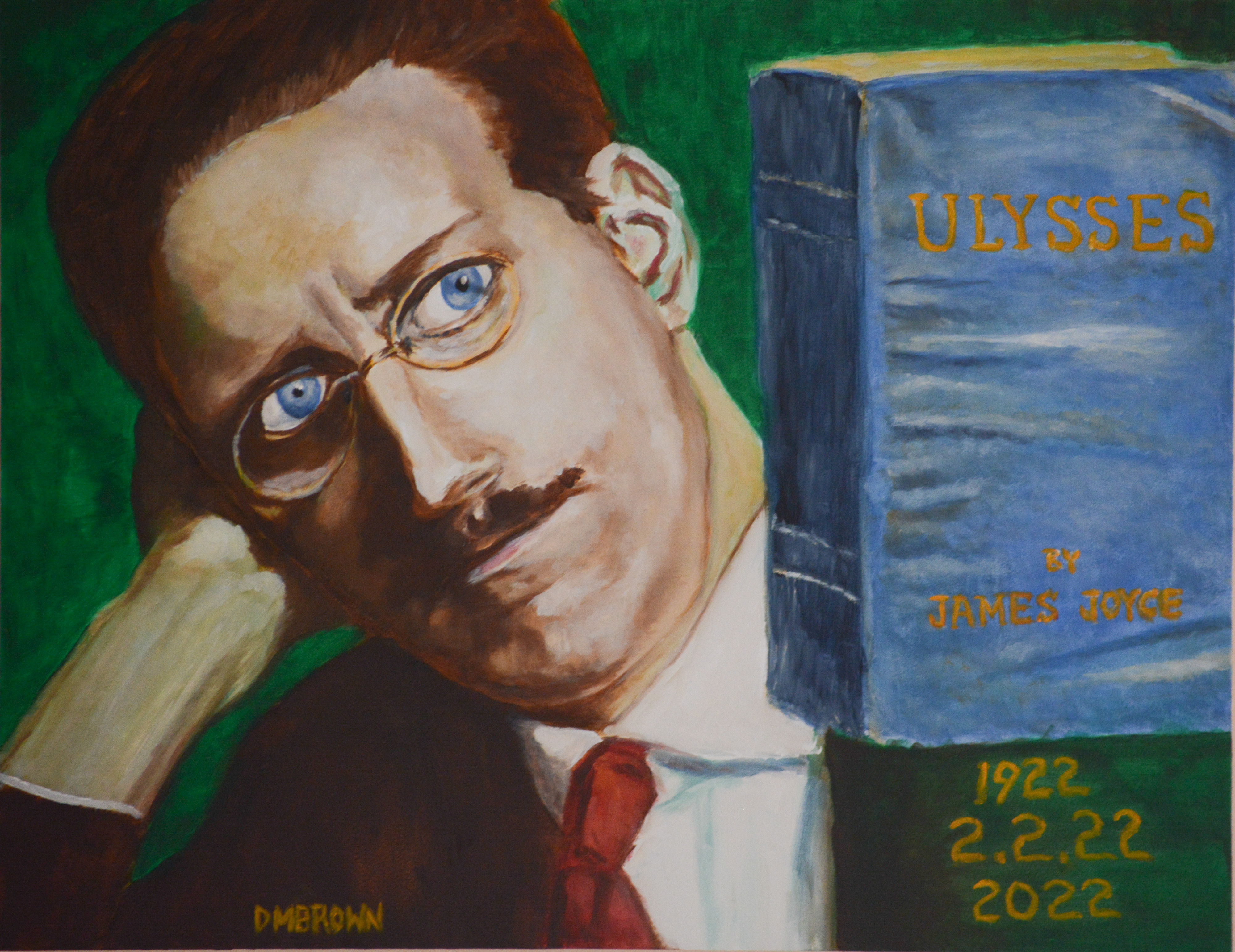
I’ve also commenced two series that allow me to “record” images that “stand for” certain influences in my early life: one I call “Pop Figures,” which so far consists of a rendering of James Joyce and his book Ulysses, painted for its centenary; a rendering of the photo of The Beatles on the cover of The Beatles For Sale (1964); a rendering of a composite of stills of Boris Karloff as ‘the Creature” in the original film of Frankenstein (1931). 

The other, related, series is called “Masters Revisited” in which I take an image of a painting by a master painter and submit it to my style of rendering; so far I’ve done a study of the mother and children in Michelangelo’s Flood sequence on the Sistine Chapel; a study of a Madonna and child by Raphael; a reconfiguring of the “muse of history” model in Vermeer’s The Art of Painting, complete with images of places of personal relevance on the map behind her; and a painting done from a lithograph by Delacroix—illustrations for Goethe’s Faust—depicting Faust and Mephistopheles on horseback.


So, the final point: because I’m nothing like so great a painter as Bacon I don’t mind at all that what I do be considered “illustration.” In fact, I think that, if Bacon pushed a bit harder on his language, he’d see that “recording and reporting” simply means—in one sense, at least—illustrating one’s point. One puts up images when words fail or when—perish the thought!—they are utterly irrelevant to the act of looking. Even better than the act of looking is the act of painting.

Then there’s the act of writing (as opposed to reading) but more on that next time . . . 


Monday, October 10, 2022

IN COMMON SPACES: ARTSPACE 2022 OPEN SOURCE FESTIVAL


Artspace Open Sources 2022

This year Artspace’s Open Studios permits in-person showing of art in a public space. I’ll be located in the Creative Arts Workshop at 80 Audubon Street, New Haven, on Saturday, October 29, and Sunday, October 30 where some samplings of my paintings will be on display. Here are the nine photos I submitted this year that are now uploaded to the Artspace site here, and I suspect most of these will show up, and possibly others, while I’m in situ.

1. Philly Days 1: Mary + Kajsa 1981 (March, May, October 2020), 30x24 stretched canvas


The painting is based on a photo from 1981 showing my wife, Mary, and our newborn daughter, Kajsa, on a summer morning in 1981 in Philadelphia. The point of the rendering is to capture the light, as the photo did, but where the conversion factor into paint is determined by the feelings and perceptions of the moment. This is still my most painterly production where there is some evidence of painting “for the sake of” painting. Favorite features: the cut-off jeans, the reflected light in the diaper, and the central creases in the background pillow. Theme song: “In the Summertime” by Bob Dylan (1981)

2. 21st Century Studies 1: Kajsa in Norway 2015 (July-November 2021), 16x20 stretched canvas


Based on a photo I took of Kajsa in Norway amidst our northern European cruise in 2015, the painting aims for a harmonious rendering of foreground subject and background landscape. Since I hadn’t really tried to render landscape before, this was an experiment in how I’d work from a source much more detailed than I wanted to deliver, while avoiding Impressionism. I think I sort of managed it. It’s also, for me, unusual to render a profile, which I didn’t quite get accurately though the finished painting is “like” Kajsa. Favorite feature: Kajsa’s jacket. Theme song: “Goodnight, Oslo” by Robyn Hitchcock & the Venus 3 (2009)

3. 21st Century Studies 2: Max in Hamden 2021 (July-October 2021), 22x28 stretched canvas


Mary’s grandson Max visited us in January 2021 and posed for a photo in our sunroom. That’s the basis for this painting which tries for a looser interpretation than the previous two, if only in response to Max’s youth (age 20) and attitude. The likeness isn’t as precise as I might like but then again I’m deliberately trying not to be too slavish to photo reality in these renderings. Favorite feature: Max’s jacket where the force of some of the strokes on the sleeves is shown by residual swipes I chose to leave in. Theme song: “Snowblind” by Black Sabbath (1972)

4. Philly Days 3: MEM 1980 (October 2021), 18x18 gesso board

The photo of Mary in our first Philadelphia apartment in the spring of 1980 is, as one friend said, “mesmerizing” in terms of the gradations of light on her face. I didn’t do a bad job rendering them though I’ve simplified the photo—as for instance the painting in the background, which is Vermeer’s “Girl in a Red Hat” but which I’ve changed to a kind of modernist portrait. In a way that sets the tone of what I’d like to get to eventually. Theme song: “Dreaming” by Blondie (1979)

5. Philly Days 4: DB, PAFA 1983 (November 2021-January 2022), 22x28 stretched canvas 

A photo of me, taken by a co-worker at the Pennsylvania Academy of the Fine Arts, on the office stairs (designed by Frank Furness) at the school door on Cherry Street, has long been a favorite of mine because of how the light “abstracts” the shapes and details in the shot. In the photo I’m 24 or almost and it’s very near  the end of my time in Philadelphia, so the sense of disappearing in broad daylight, as it were, is the point. Favorite feature: the reflected light at far left and my left arm. Theme song: “Of the Instant” by Gang of Four (1982)

6. Philly Days 5: Tim 1979 (January-March 2022), 22x28 stretched canvas


Mary took a black and white photo of Tim, my oldest friend (since middle school), in August, 1979, a few months before his twentieth birthday, while he was helping us move into our first apartment, 1931 Callowhill Street, Philadelphia, in a building where he was our upstairs neighbor. The view out the window was of a parking lot behind the Philadelphia Public Library on Logan Circle, though in the painting it’s improvised (the photo’s windows white out). The point: to render this image with a sense of its present—back then—and my present, looking back. Favorite feature: my rendering of Tim’s legs, and the aforementioned view out the window, a kind of modernist fantasy of a neo-classical building. Theme song: “Cities” by Talking Heads (1979)

7. Pop Figures 1: 2.2.22: James Joyce, Ulysses at 100 (February 2022), 14x18 gesso board 

During my time in Philadelphia, one of my big obsessions was James Joyce’s Ulysses which I first read in 1980; eventually I became a bit of a Joyce scholar, writing a thesis on Finnegans Wake and a doctoral thesis that included a chapter on Joyce’s novels, as well as teaching Ulysses to undergraduates in Yale Summer Sessions on six different occasions from 2002 to 2012. So when Ulysses turned 100 this year I had to commemorate it. My painting combines a rendering based on a photo of Joyce in his late 30s (he turned 40 on February 2, 1922, and at his birthday party was presented with the first bound copy of his great masterpiece) and an image of the original blue-bound version of the book. My intention was to do this in as few sessions as possible; it took five, Feb 2, 3, 5, 6, 9. Favorite features: Joyce’s wrist and forehead. Theme song: “Flower of the Mountain” by Kate Bush (2011)—which takes its words almost wholly from the “Molly Bloom monologue” at the close of the novel.

8. 21st Century Studies 3: Jerry by the Delaware, New Castle 2013 (May 2022), 16x20 stretched canvas


Back to photos from the 21st century: in this case, my younger brother Jerry, the year he turned 50, by the banks of the Delaware in Battery Park, New Castle, Delaware, our hometown. The month is August, my birth month, and the painting combines a photo of Jerry by the river with a photo of boats on the river, to create a kind of a companion piece to Kajsa by the fjord in Norway. In this case, the light on Jerry and the clouds in the sky are my favorite features, and just feel like Delaware to me. Theme song: “June Hymn” by The Decemberists (2011)

9. 21st Century Studies 4: Mary in Hamden 2016 (May 2022), 18x18 gesso board


Clearly, I tend to find photos of Mary worthy of rendering. This one she took herself (somehow) in the backyard of our home in Hamden, early in our residence there, as a self portrait for a photography class. My rendering deliberately went for a certain minimalism while remaining true to the dramatic lighting. Favorite features: the jacket on the left hand side and hand on the hat, and the jeans. It’s taken awhile, but I think I prefer the painting to the photograph now. Theme song: “Sins of My Youth” by Tom Petty & the Heartbreakers (2014)

More paintings may appear as I get photos of them . . .

Friday, December 31, 2021

THE TAROT TAPES, Side 1: 0 THE FOOL

Near the end of Fearful Symmetry, Northrop Frye’s book on William Blake (which I finished reading in December 2020, before beginning the second group of Tarot panels), I came upon this reflection:

“Blake … seems to be striving for an ‘alphabet of forms,’ a Tarot pack of pictorial visions which box the entire compass of the imagination in an orderly sequence. The alphabet itself, if we may do some imaginative guessing, may be a fossil of some such work of art, the Zodiacal signs another, and the Tarot pack (with which [Blake’s] Job series has been associated) a third.”

I got a kick out of that, certainly, because some such intuition was the basis of me picking up a book on Blake (and not just anyone’s, but Frye’s—the master of the “anagogic method”) and beginning some readings in Blake at the start of my consideration of the Tarot panels. Indeed, the idea of an “alphabet of forms,” or a series of pictorial visions, is the driving force behind the Tarot panels and the example of Blake as a poet, artist and visionary is at least provocative. My earliest reading of any of his verses was probably around 15, and I remember time spent with the Viking Portable Blake at 19. But there was little in-depth exposure to his work, mainly because of the alien mythography at work in his writings and art. I didn’t pursue the English Romantics in college, and in graduate school improved my familiarity with Wordsworth and Keats, but that was about it. There was a semester at Yale, in the 2000s, when I sat in on a seminar that took up Blake among the other Romantics and it was there I first saw an image that I’ve recalled in the fourth Tarot panel for Ethos, XV: The Devil. So let’s say there’s some debt to Blake somewhere in the deep background, but even more so in trying to imagine “illustrations” for the Tarot figures.

But that’s the panels, as an ongoing visual art project. Accompanying each panel is a cassette tape’s worth of songs, a 45-minute playlist that assembles itself in the process of transferring the tracks from vinyl or CD onto tape, but which may be prepared for by any number of list-making sessions to see which songs most readily suggest themselves as part of the tone, mood, or theme of the Card. And I should point out that I think of the Tarot as a complex system of playing cards, and I have done readings to see what a lay-out of cards “says.” For the purposes of the panels, though, which are not cards and not meant to be used as anything more than paintings, an “alphabet of forms” is apt enough since the cards, in my decision to break them up into four different groups, do “spell out” an associative logic. And associative logic is the key to how playlists form, aural illustrations of “the spirit” the panel is aiming for.

The first group is Ethos, which is to say, based in character and upbringing, in the kind of collective rationales for behavior that mark anyone’s Bildung, but which, in terms of artistry, can also create a dichotomy between the individual person (in this case, me) and the symbolic conditions of art . . . or the artistic realization of symbols. However you put it, Ethos keeps in mind that the person who is aiming at art is forming an ethos that differs to some degree—and maybe in kind—from other practices, such as those primarily concerned with getting along with others and performing the tasks of non-artistic activities. The onus of an artist’s Ethos, simply put, is self-realization, in no matter what forms that takes. So, for me, the five Cards grouped under Ethos are the five I recognize as the most germane to my sense of what an artist is.

Tape I

A. Ethos 1 (center panel): 0 The Fool (April-May 2020)

Track A1: “The Fool”—Camper van Beethoven (Our Beloved Revolutionary Sweetheart, 1988; David Lowery, Jonathan Segel, Greg Lisher, Victor Krummenacher, Chris Pedersen)
This instrumental track from my favorite Camper van Beethoven album could be said to be the “curtain’s up” on the entire tape, maybe the entire series of tapes. I don’t know why the song is called “The Fool,” but I’d be willing to bet it has something to do with the Tarot card, though it might also be a reference to a 60s psychedelic band of that name (elsewhere on the album is a cover of “O Death,” the Dock Boggs song also covered by a 60s psychedelic band, Kaleidoscope). The late ‘80s, twenty years on from the height of psychedelia, found more than a little inspiration in the artists of that earlier period.

Camper van Beethoven, with that joke name, are suitable to start things off on our Fool’s terrain, certainly, being a fairly whimsical and comical band, heroes of the “indie” or “alternative” world of college radio rock from the 1980s. The ‘80s, in my view, have much to answer for, but the good side of it all was the number of bands who were never in any danger of becoming monster artists of the inescapable mainstream airplay variety, but would always be a bit of caviar to the general. It was a time rife with subcultures, and why not tip my hand at the start, as part of the appeal of “The Fool” is that very willingness to pursue a quixotic goal, to be an adept of an unknown practice, to prefer the cult or coterie offering. The cards themselves, no matter how popular or ubiquitous, will always be a bit esoteric by the standards of world-wide religions and symbolic systems.

The track sounds like a movie theme, almost, or at least a soundtrack for a kind of carnivalesque sequence. Sort of eastern European, ‘80s gypsies feel. Brash, with a certain Old World charm that’s seductive in its own way. No fooling.

Track A2: “The Fool on the Hill”—The Beatles (Magical Mystery Tour, 1967; John Lennon, Paul McCartney)
Most of the songs on these playlists will date from the era long since designated as “classic rock,” and this song was already a classic when I finally got around to acquiring Beatles albums in the late 1970s. And yet I do remember when it was on the radio—there were several covers of it, as I recall, not least by Sergio Mendes and Brazil ’66—and on the Beatles cartoon TV show. It may well be my first cognizance of a use of “the Fool” in a way that seems properly capitalized. Not “a fool”—as in some stooge or dunce—on the hill, but “the Fool,” as, for instance, a character you could meet (and I did by around 1974) in King Lear. Of course, the phrase could also simply be pointing out a particular fool—the one on the hill as opposed to the one in the meadow, or next door, or in the White House (the sense of a political fool suggested perhaps by “the man of a thousand voices” whom no one hears, “they can tell what he wants to do.”)

In any case, as sung with his characteristic twee-ness by Paul McCartney, the song struck me—as a child and later—as oddly ruminative. You know, the mid-late ‘60s period was when McC was apt to come up with weird little ditties of dysfunction like “Eleanor Rigby” and “Penny Lane.” This song is somewhere in between, not as dolorous as Rigby nor as jaunty as Penny but detached. The contrast is between the Fool—who sees the sun going down and the world spinning ‘round—and the people who don’t like him. He doesn’t care because “he knows that they’re the fool.”

So at the outset we get what will be a theme to this side: the Fool who knows he’s considered a fool (as in idiotic or silly), but who takes that in stride because maybe he knows something “They” don’t know. The Beatles, with their madcap, antic natures—as a collective—captured well the nature of the Fool as someone who is wise in his own way. McCartney has claimed—so Wikipedia tells me—influence from The Fool (the band mentioned above which was also a design collective) and from the Maharishi Yogi, who may or may not have had a laugh on our nirvana-seeking Brit tunesmiths.

Track A3: “Fearless”—Pink Floyd (Meddle, 1971; David Gilmour, Roger Waters)
Now that the Beatles have provided us with both a fool and a hill, we will take it to the next step. Here someone, who may be seen as something of a fool by the crowd, is challenged to climb a hill—which he’ll do “in my own time.” Like: when I’m good and ready. The notion of climbing a hill becomes a theme, and there’s also an element of tempting fate or of relying on God, or of, God knows, trying to achieve some particular facet of selfhood or even to attain . . . the ultimate Self. Which, I just want to say at the outset, may in fact be a Supreme Fiction.

You can see how well Gilmour and Waters feed into our topic (and it would not surprise me to learn that they might have had some memory of “The Fool on the Hill” floating in the background when they wrote the song’s lyrics). From “Fearlessly, the idiot faced the crowd” to “And who’s the fool who wears the crown?” we know we’re in the world of trying to judge between “the idiot” who may be a wiseman, and the earthly authority who may in fact be a fool. And with that bit about “Go down in your own way,” how could I hear this song, when I got around to this album in 1974, gripped by my earliest reading of Thus Spoke Zarathustra, as not sharing some of the spirit of Nietzsche’s opening, where Zarathustra decides to go down from the mountain and back to the people? And the first thing he encounters is a crowd watching a tightrope walker, who falls to his death when a Fool comes onto the wire and leaps over him.

“Fearless” ends with the interpolation of “You’ll Never Walk Alone” as sung by a crowd at a football match in England. Apparently that song, which I associate with Jerry Lewis telethons, is often sung at such sites of collective outpourings of belonging. According to Wikipedia, the song, in 2020, was put at the service of tribute to the sacrifice and dedication of the frontline workers facing the COVID-19 pandemic. So, all the more appropriate for my Fool, painted in April/May 2020, while lockdowns were general. He’s walking off a cliff, though, so is, indeed, walking alone. Except that maybe, just maybe, we’re all going off the cliff with him.

Track A4: “Up the Hill Backwards”—David Bowie (Scary Monsters, 1980; David Bowie)
This song is not even one of the best tracks on this great album which I bought immediately upon its release in 1980 because of “Ashes to Ashes.” “Up the Hill” appears here because of that hill and because of its key line: “It’s got nothing to do with you, if one can grasp it.” Could be a reference to that plummeting Fool (“witnesses falling”), could be a reference to the hundreds of thousands of deaths due to COVID-19, or even to any eventual extinction that may be awaiting mankind, to say nothing of whatever shibboleths of social justice are currently on crusade. Quietism? Perhaps, but it’s more—in the context of our theme of a crowd misjudging a “fool”—about the fact that “I’m OK, you’re so-so.” All y’all.

In other words, it’s a wonderfully insouciant song, full of casual aplomb. And what we might call a survivor’s attitude. “While we sleep they go to work / We’re legally crippled, it’s the death of love.” Hard not to think of those who have to go struggle in Covidville while others get to be at home in their legally crippled privilege. Death of love—what do you call it when sacrifice goes awry? Or when love has to be proved by deaths? When you get to a certain age, the grim reaper is waiting in the wings, so why not ignore the struggle of others to stay alive and concentrate on what you might make of the time you’ve got?

Me, I’m just a painting fool for the time being, stirred by “the arrival of freedom and the possibilities it seems to offer.” For one thing, a shrug directed at all the things I’d otherwise be doing if not trapped at home. And climbing the hill “in my own way,” didn’t someone say? How about backwards? Here being a good place to pile up that detritus that Walter Benjamin imagines Klee’s Angel of History looking back at as he is blown into the future, which is bound to be an uphill course. Unless in fact it’s all downhill from here. As our plummeting Fool is no doubt about to find out, the hard way.

Track A5: “Po’ Boy”—Bob Dylan (“Love and Theft”, 2001; Bob Dylan)
I have to say that when I first thought of compiling mixtapes for the Tarot cards, I went through picking a Dylan song for each card, and I also played the same matching game with The Beatles. For probably obvious reasons, those two musical acts set much of the tone for what my record/CD collection became, and these playlists come from that collection. This “late period” Dylan track (the 21st century, for me, is “late,” as middle-age and after) continues the insouciance of “Up the Hill Backwards” but now things get positively jokey as Bob indulges in some one liners, a knock-knock joke, and conjures a Po’ Boy (not the sandwich but a kind of wise-guy rube).

That element of jokester/jester/comic gets picked up in some later songs on the side, and this is its first sounding. The Fool has to master a certain self-deprecation, playing for laughs. My list of favorite comics would include Groucho Marx, the troupe of Monty Python, Bill Murray, in many of his roles, but my sense of comic hijinks in song begins with The Smothers Brothers and Allen Sherman, both gifted with altering song lyrics for laughs, a knack I’ve indulged on occasion. Dylan here is riffing on that kind of thing, it seems to me. He could play the “poor boy” straight, as an underdog of the underclass, but instead he gives him the gift of absurdity, which is one of the great strengths to have in this world.

And that is what I’d say is the dominant sense of this side: a willingness to risk the absurd, to do things for no particular reason, to be a fool to one’s own vanity or ambition or desire or attachments, but also to laugh at one’s absurd effort to overcome such limitations, as though there is a Big Pay-Off waiting for the Fool on the hill, or the Fool climbing the hill, backwards and probably sticking his tongue out. Is the most foolish line in the song “things’ll be alright by and by”? You decide. “I already tol’ ya, won’t tell ya again.”

Track A6: “Ship of Fools”—John Cale (Fear, 1974; John Cale)
The Ship of Fools (Die Narrenschiff) by Sebastian Brant dates from the fifteenth century, in German; in an introduction to that work, in English, its translator, Edwin Zeydel, attributes to Brant the notion that “all sins are reducible to forms of folly.” But maybe it’s the sins that are expandable into acts of folly; which is to say “sin” could be a lesser idea than “folly” or greater. Zeydel, and Brant, go for sin as greater, but I wonder. It may be that the inclination to sin is, in itself, folly, making folly the force that drives the wheel, so to speak. Brant created a work in which a wide variety of follies are depicted, some of which—like avarice or gluttony—do get called ‘sins’ as well. In any case, the idea of a group of ne’er-do-wells aboard a ship bound for disaster—a ship of fools—sticks. So much so, that there are two songs on this side with that title.

In John Cale’s version, the ship of fools almost sounds like a collective of worthies—I think of Chaucer’s pilgrims on their trek to Canterbury. “The ship of fools was sent / to make sure we all got home for Christmas.” Not a bad thing, I take it. But the opening, with its weary request “take me off I’ve got to eat” and reference to “the same old story, the same old thing,” makes the ship seem not so much foolish as boring. And Cale’s tune is bright, with those tinkling sounds—a celeste?—that give the whole a stately air, full of a lighthearted dignity. And the goings-on are comic book style—“we picked up Dracula in Memphis / It was just about the break of day”; and there are ominous bits of detail: “a black book, a grappling hook, a hangman’s noose from a burnt-out tree—guess we must be getting close to Tombstone” (one of my favorite sequences in all of Cale’s oeuvre). The whole lyric feels like a fantasy of traveling through America, with a wish, for fisherman, that they “could sail from Tennessee to Arizona” (making the heartland not “flyover States” so much as “sail over”). In the end, Cale brings it all back home to his native Wales—in fact, his hometown, Garnant, gets a shout-out—and, in general, I think of this song as giving us a positive sense of the Ship of Fools.

And that’s important because the jokiness that came aboard with Dylan, and that “in my own way” theme, from Floyd, and the “they’re the fool” and “it’s got nothing to do with you” views, all come together now to give us a glimpse, maybe, of fools who are glad to be sailing away from the world where everyone else resides, whether content or contentious. And when we do get back “all the people seemed quite glad to see us.” Maybe that’s foolish on their part: to be glad to welcome a ship of fools. As the sixth song of twelve, Cale’s “Ship” ends the first half of the tape on an up note—the song’s mood, to me, feels like early spring, the season of Aries (and of All Fool’s Day), and is lively if also somewhat haunted by “something in the air that made us kind of weary.”

Track A7: “Running Up That Hill”—Kate Bush (Hounds of Love, 1985; Kate Bush)
With Kate Bush’s opening track from probably her greatest album we sound another take on “that hill.” Kate’s singer wants to be running up that hill “with no problems” and as the reward or punishment of a “deal with God.” The key idea here—since the singer is addressing a “you”—is that the deal with God would let the singer and the “you” swap places, so they could “exchange the experience.” Like, the only way to understand someone is to become that someone and vice versa. Like all those movies from the 1980s in which a parent and a child exchanged places. Presto: a pre-glimpse of maturity, and what it requires, and a reminder of immaturity, and why it works.

But in typical idiosyncratic fashion, I rarely listened to the song as a way of swapping viewpoints with some difficult personage in one’s life but rather a deal to swap places with God, thus making that climb wholly unimpeded by human foibles and concerns and failings. It would be a climbing that would be utterly transcendent, we might say. That is the aspect of the song that feeds into this tape because, while the Fool is on his way down, the eventual appearance of the Wheel of Fortune—way up ahead there in the 11th place of this schema—means he’ll also be on his way up, eventually. And the Fool, in shedding the limited perspectives of all those wise guys who think the things of the world are where it’s at, is transcendence writ small and humble and simply—as we’ll see with a few songs showing up soon—getting by by his wits.

Kate Bush’s song is propulsive and features a great rhythm track, something the 1980s were pretty good at, creating rhythm tracks which can sort of stand alone and be wedded to songs as one chooses. It’s a kind of autonomy, the rhythm that rules, and that’s important here because I feel certain that—whether as oneself or as God—the hill compels one to climb it, the propulsive rhythm of life will have it so, much as the great Wheel must spin and the earth must spin as it circles the Sun (which is coming up next). Much here lies with Kate’s repeated “if I only could / be running up that hill.” Like a Sisyphus fated to run up the hill forever and never have to come down when his big rock does. A running, climbing fool, and no mistake.

Track A8: “Fool’s Gold”—Graham Parker & the Rumour (Heat Treatment, 1976; Graham Parker)
But what’s such a fool after? Graham Parker, with his usual surly view of the mass of humanity, clues us in a bit: the search itself makes the fool a fool. He’s after “fool’s gold,” which can be read as any possibly fictive or chimerical goal, something others—more sensible—would decry. And here I have to say that I’m maybe not fool enough myself to share the vision fully. I can see the transcendent view—climbing forever—but not the notion that there is something—physical, tangible—that can answer the seeker with a definitive status of “found.” Thus my favorite part of Parker’s song is “people say heaven knows heaven knows heaven knows / see what comes I suppose.” Yeah, if it’s good enough it will be worth the search . . .  I suppose. “Well, well the event” as someone says rather testily in Lear.

As an expression both of the limit of judgment and an exasperation with explanatory comments, my mother was fond of saying “heaven knows” (and it appears in the title of one of my dad’s favorite movies, Heaven Knows, Mr. Allison), so that may be one reason that line resonates for me—with its repetitions—but it also falls into line with the notion of a “deal with God.” Meaning that there might be a perspective—from heaven’s view or God’s eye—that sees the search fulfilled. Like: you gained the goal, Fool, and just didn’t know it. But heaven knows. That’s a strong fulfillment, but it’s also quite possible that the search is the goal, in some Zen-like way, Grasshopper. Like climbing that hill, backwards, in your own time, the search is your fate and your folly, one and the same for any good fool.

Parker is a blustery singer and I like the way he handles this lyric, giving it his White Soul all. It starts quiet and ruminative but with heaps of passion surging again and again, and I always listen for him getting worked up in the fade, “and in the deep blue sea,” which is a nice segue to our next track, another “ship” on the sea, helmed by fools en route to disaster.

Track A9: “Ship of Fools”—The Grateful Dead (From the Mars Hotel, 1974; Jerry Garcia, Robert Hunter)
With this track—our second “Ship of Fools”—we can say that we’re entering the non-transcendent portion of the tape. The three tracks after the Dead are about jokers—not, perhaps, fools outright, but they do bring into question the interplay between fools—in the more spiritual sense we’ve been working up—and jesters, those who simply use levity to amuse or undermine or, maybe, enlighten. Lear’s Fool is a good case in point because he does want his jokes to “land” in such a way that Lear will perceive his own folly, but, because he’s a jester, he can allow that he’s just “fooling.” But before we get to our jesters, let’s give Robert Hunter’s lyrics their due.

This is one of those slow, mellow Garcia tunes, the kind that usually means he’s pondering big questions, trying to find a form for Hunter’s more searching lyrics. Here, the perspective is of a young man (thirty years upon his head . . . it’s when that Baby Boomer generation born in the early to mid ‘40s, hit their 30s, in the 1970s, a pretty dysfunctional time) who has had enough with the powers that be. The world, as conducted by these stalwarts, is a ship of fools, doomed. I’ve long aligned the song with the “non serviam” of Joyce’s Stephen Dedalus, particularly in those lines: “though I could not caution all, I still might warn a few / don’t lend your hand to raise no flag atop no ship of fools.” Here again we might see quietism more than activism—we’re being told what not to do, not what to do—but that caution suits the situation, perhaps. We’re not sinking yet, in 1974, so maybe it’s enough to NOT get caught up in the actions that are leading many fools to their flag-waving perdition.

And anyway the opening of the song is more aggressive: “I would slave to learn a way to sink your ship of fools.” That’s pretty emphatic, like—in “Candyman”—when usually docile Jerry muses that “if I had me a shotgun I would blow you straight to hell.” Sentiments like that are what give the lie to what is too often perceived as laid-back, hippie bliss-out as the dominant mood of the Dead. This song is not only bemused, it’s mournful and maybe ready to get serious. At any rate, the singer “cannot share your laughter.”

And that line can stand as the thin end of the wedge here. Since, in the fool/jester’s province, it’s all for laughs. Which is a way of saying, as Hamlet does, “why, what should a man do but be merry?” He asks that, of course, with all the sarcasm he can give voice to, being neither merry nor assured that there is any action—not even those a man might play—that is of any use . . . not even laughter. And if that’s so, we’re fucked.

So, before our ultimate demise, let’s have a few laughs with some jokers ready in the wings.

Track A10: “Man on the Moon”—R.E.M. (Automatic for the People, 1992; Bill Berry, Peter Buck, Mike Mills, Michael Stipe)
Michael Stipe’s lyrics for R.E.M.’s “Man on the Moon” directly reference comedian Andy Kaufman and a few of his comic routines—from “goofing on Elvis” to playing Twister live on national television with volunteers from the audience to the “breakfast mess” with pro-wrestler Fred Blassie—and the whole song has a kind of quizzical, quixotic vibe, signaled in that “IF you believed they put a man on the moon” chorus. The questioning of the moon-landing is one of those great “conspiracy theories based on media events” that leave us uncertain about what’s real and what’s not. And it’s in that space (“is it real or is it Memorex?”) that Kaufman’s humor lives: which is to say, thanks to media, we don’t know what’s real and so we’re all fools being fooled or primed to be.

Kaufman’s fooling may have had its transcendent side—at least I feel that his persona was “holy fool” enough to lend itself to that interpretation—and in the song he’s linked to figures such as Moses, Newton, and Darwin, the kind of fools who bring on a serious change in values. Which is a way of aligning them with Hunter’s spokesman in the preceding song; these are men who won’t lend their hand to lift no flag the fools are saluting. They have a different sense of things. Egypt, aka Cleopatra, “troubled by the horrible asp” is a bit of a non sequitur in that crowd, though I think we can allow that a victorious Egypt would’ve made for a different world than the one Rome bequeathed us.

The genius of the song is that such grand figures are still reduced to sound bytes, to what “we”—in the blips of our media brain—can call up about them. And, in that company, Andy—like a “truck stop instead of St. Peter’s”—is just a little ghost for the offering. “Mister Andy Kaufman’s gone wrestling”—which was a non-put-on-put-on of a sport that’s all put-on, for the sake of comedy and satire and something else, which might be ego-as-event. Like when Andy put his continued presence on Saturday Night Live to a vote and was voted off the show. It’s reality television, that great oxymoron of our times, and maybe that begins with a televised moon-landing, way back in 1969.

“Nothing up his sleeve,” of course, makes us think of magicians, and that type of potential charlatan is coming up soon—the third panel—but for now it’s enough to register the inclusive/exclusive nature of laughter—we’ve got to be in on the joke to get it—and the fact that belief is always at risk of “the joke’s on you.”

Track A11: “Dear Madam Barnum”—XTC (Nonsuch, 1992; Andy Partridge)
And with that said, let’s recall the man who famously said “there’s a sucker born every minute.” Surely, they come along much more quickly in these accelerated times, but, even so, P. T. Barnum knew whereof he spoke. And it’s fitting that Andy Partridge, while imagining himself in the role of circus clown, addresses himself to Madam Barnum, conceived as the mistress of the spectacle—a ringleader—he’s now about to depart.

“You tread the high wire between truth and lies” certainly gets at the aspects of performance, and fooling, that we saw with that Fool in the Zarathustra scene, but Partridge is also thinking of the truth and lies of romantic involvement. His fool is a fool for love who draws the line at being a cuckold “If I’m not the sole fool who pulls his trousers down / then, dear Madam Barnum, I resign as clown.” Clowns, of course, often get their trousers pulled down in performance, for laughs, but lovers pull their trousers down for other reasons and linking the two acts is a great notion of Partridge’s.

Here the clown quits the show. Let’s say it was causing him some psychic distress, playing for laughs, sure, until he realized the joke was on him. And that no self-respecting clown can endure. We could let it stand there as the end of the tape, a resigned fool resigning from his act. Cured! Or at least a fool no longer—at least not consciously. Lear’s Fool doesn’t get to leave, really. He gets a last line—“and I go to bed at noon”—and then is heard and seen no more. I’m inclined to link that statement to Zarathustra’s great noontide, but that’s merely a figment of tangential reading, at a time when fools were brave for risking mirth where others were solemn, not least in philosophical circles. And yet the possible incentives of mirth can’t be contained, like high tides at flood walls, and soon we’re laughing at ourselves for our own foolishness.

Track A12: “Happy Jack”—The Who (Happy Jack, 1966; Pete Townshend)
So why not one more track (because it fits on the span of the tape’s 45 minutes or so)? The Who’s “Happy Jack” is possibly the most quizzical track on the tape, its subject a person known as Happy Jack who gets persecuted, seemingly, for singing off-key and for generally not fitting in. “He lived in the sand at the Isle of Man” is one of those lines that might be literally true but also highly figurative. He’s a figure for the fool, to me, because his feeling happy is linked to the waters lapping—neither of which can be affected by the kids. Here, the kids are not “alright” but rather malevolent, as kids often are, and their targeting of Jack is just one of those “us against him”—or “them against me”—situations that fools are apt to find themselves in. 

The water lapping in the harmonies and the tide in Keith Moon’s drumming make for a wonderfully pungent aural world in this song, the kind that only The Who could bring to us with such unvarnished authority. I always think of the Who as the coolest Brit Invasion band, not madcaps like the Beatles, not surly and sexual like the Stones, just not easily made fools of, and Happy Jack, as a short, simple track, gives us a little anthem for the insouciant fool who maybe knows more than others, maybe less, and who may be the kind of figure Kurt Cobain expressed when he sang “I think I’m dumb, or maybe just happy.” Is God happy? I don't know but I like the line delivered by Karen Blixen's factotum in Out of Africa: “God is happy, Msabu. He plays with us.” No fool like an eternal fool. 

Wednesday, September 15, 2021

ARTSPACE OPEN SOURCE EXHIBITION, OCTOBER 2021

In the year since Artspace’s Open Studios 2020 (see my contribution here), I’ve continued my work on the Tarot panels and on the series called “renderings.” My work on this year's website can be found here (when the Artspace link goes live October 15).

First up, one of the latter. This painting, which I worked on in May and October 2020, is based on a photograph I took of my wife Mary and our newborn daughter in Philadelphia in summer 1981. Apart from its considerable personal meaning for me, as an image and as a souvenir of a particular time and place, I’ve always felt the image had a great potency. The protective abandon of the maternal figure, the way the child in sleep is still in the posture of nursing, but also looks as if she’s trying to “take in” the mother. The mother’s T-shirt and cutoffs certainly conjure fond memories for me, but are also great fun to paint, set against all the pillows and sheets, as are the flesh tones. It’s probably the first painting I’ve done where painting for the sake of painting is involved. I hope there will be more.

In this series there are three other works in progress that are too in flux for me to want to post their images. All three are intended as gifts anyway so I don’t mind keeping them under wraps for now.

And now, onto the Tarot panels.

Last year, I had finished the first 3 panels of the “Ethos” section. Now I can present them together with the last two to comprise what should be a quincunx of paintings, like this:

Individually, here they are:


“Ethos 1: O The Fool” (April-May, 2020): The image of The Fool is of a man stepping off a cliff because he’s not paying attention.

 “Ethos 2: XIX The Sun” (May-July, 2020): The Sun is depicted as a naked cherub looking at his own reflection, above a desert.

“Ethos 3: I The Magus” (June-September, 2020): On a stage which might also be a church, the Magus kneels on one knee, lifts a microphone and an illuminating finger.

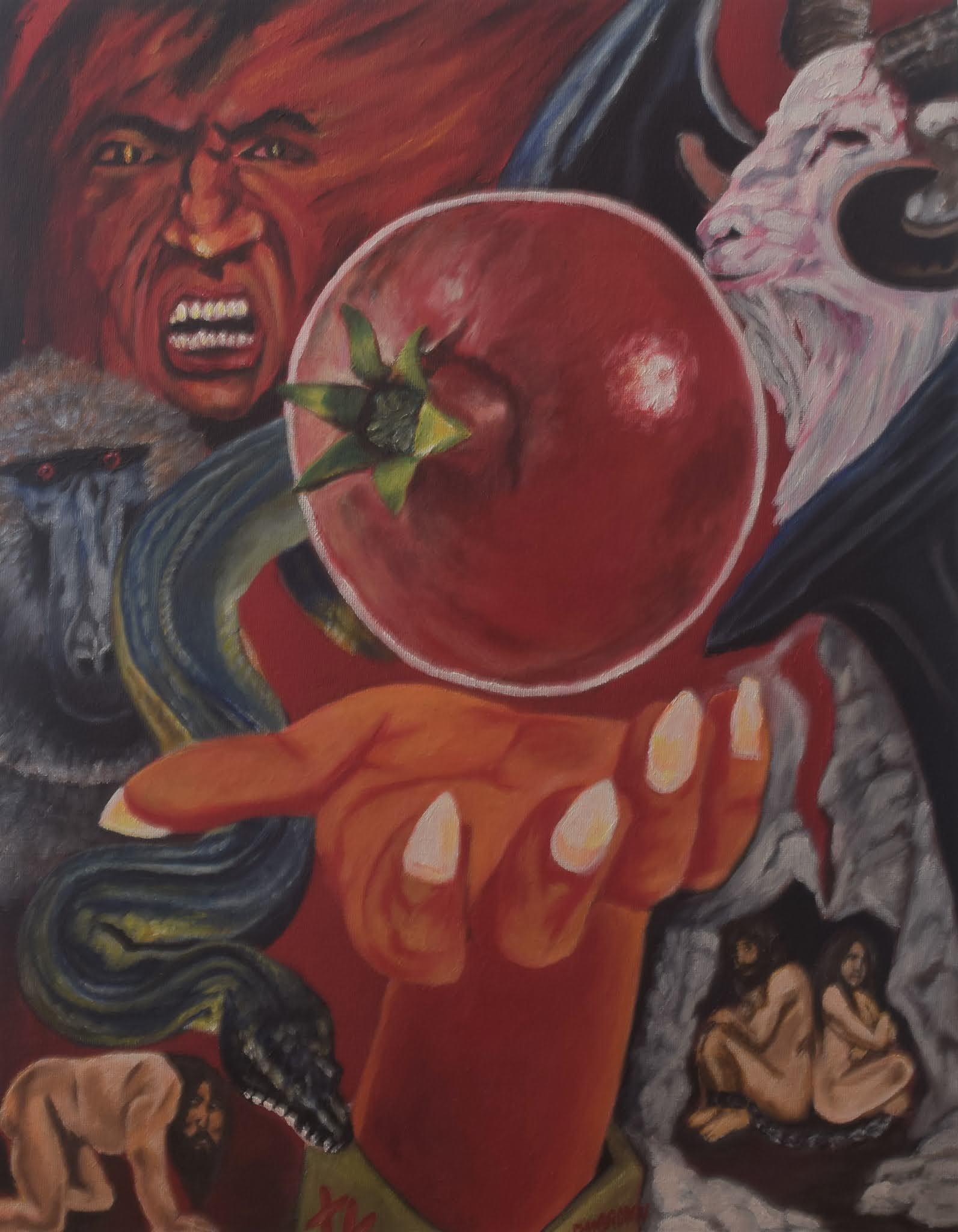
“Ethos 4: XV The Devil” (August-October, 2020): A collage of images for “the great deceiver,” including a pomegranate (as the fruit of temptation), a goat, a baboon, a serpent, a snarling face and images borrowed from William Blake.

“Ethos 5: IX The Hermit” (October-November, 2020): A single figure, derived from an Egyptian statue of a scribe, in an empty room, prepares to write his visions.

The latter painting was mostly painted last November. No matter how much I might like to be a hermit and withdraw from the world to paint and write and read and so forth, November, you may recall, was a particularly fraught time with the contested election and a host of unsettling events that culminated in the assault on the Capitol before the inauguration in January. It’s a fact anyway that I didn’t do much painting, if at all, after Thanksgiving weekend until the inauguration. That month I got started on Eros, the second segment in the Tarot series. And here are the first three. Again, these are meant to be seen as a group of five with VI The Lovers in the center, XVII The Star above, and III The Empress to the left of center; XIV Temperance, the panel below, is mostly completed but not yet signed or numbered, and VIII Strength, the righthand panel, was begun in August but hasn’t had much progress due to work on those three other “rendering” paintings.


“Eros 1: VI The Lovers” (January-March, 2021): Derived from an image for alchemical transformation, two winged figures, male and female, couple in a pond beneath a tree, a lyre nearby; the composition alludes to Chagall’s “Daphnis and Chloe.”

“Eros 2: XVII The Star” (March-June, 2021): A nude woman pours water from a vase into a pool in which she stands while gazing at the viewer, elements of her features and figure borrowed from friends, Dürer’s Eve, and a Waterhouse nymph.

“Eros 3: III The Empress” (April-July, 2021): A woman on a throne in nature, her figure and clothes derived from a statue of Parvati, the wife of Shiva and a Hindu goddess of fertility.

We're allowed nine images on the site, so that’s it for me, this year. Maybe around Christmas I’ll get those other three “Renderings” up. I’ve got quite a number of those planned, and should also be starting the panel for “X The Wheel of Fortune” which is the first “outcome” card—one at the halfway point, the other at the end. Thus I’m almost at the halfway point in the panels, but at least two to four months away.


Wednesday, June 30, 2021

SUMMER CITADEL

It’s summertime for real, right now. Here in the northeast US there are heat advisories and warnings and there is some noticeable discomfort if, like me, you live a life without air-conditioning—and work at home. But it’s the work that distracts from the heat—if you let it.

Today, making breakfast, I recalled the song by The Rolling Stones—from their 1967 psychedelic LP Their Satanic Majesties Request—called “Citadel.” Like many a psychedelic paean to the joys of the Inner Man, “Citadel” takes up an exotic theme (citadel as a castle with classical or biblical overtones because the word finds use in many such texts, whereas “castle” seems more deliberately medieval and European) as a metaphor for the “trip” mentality. The fantasy in the lyrics, initially, is of crusaders “armed with bibles,” then we get glimpses of flags and dollar bills (the U.S. market, of course), then “peasants” crawling (the fans, the press, etc.) to hear their numbers called, and finally the “woods of steel and glass” of a busy urban scene—all the things these citadel-dwellers are avoiding by staying in their indwelling universe, fixing a hole where the rain gets in, and all that. And always that child’s rhyme chorus: “Candy and Taffy, hope you both are well / Please come see me in the citadel,” where Candy—a playful plaything’s name at the time—gets stretched into confection by palling around with Taffy (these girls are sweet!) and both are invited to the citadel, where no doubt our singer reclines in utter decadence, plump grapes poised upon plump lips.*

Well! My sense of a working citadel is nothing like that! More like what I imagine Keef might be up to in the studio with Brian, layering all those sounds onto tape. For me, it’s layering colors and I’m concluding The Empress and a few days into Temperance. But the song was suggested by my subconscious (or something), due no doubt to a fleeting thought that painting while listening to my many mixtapes compiled in the summers (starting in 1978 and reaching to the present—I made the tape side for Temperance just last week) is about as withdrawn as I can be from the world at large.

Left to my own devices in the house of Eros on my painting tour of the 22 cards of the Major Arcana of the Tarot. The section Eros, as just became definite to me early in June before my visit to the shore in Maryland for two weeks, consists of: VI The Lovers (center), XVII The Star (above), III The Empress (left), XIV Temperance (below), XIII Strength (right). This configuration is pleasing as a departure from what I had considered the sequence to be, up to that point. I had thought I would be moving on to do The Emperor after The Empress. The change came about because, in searching for images to composite into the Emperor, I was struck by the pathos of the figure. And so that card will be the third panel in Pathos, corresponding to the place The Empress holds in Eros. And that’s fitting because The Empress represents the fully empowered female—mother, queen, the ruler of the roost, both sexual and maternal, all that. Whereas The Emperor—following the old idea that the son, come to manhood, is the king/father’s replacement—is a figure for decline, for the old that is passing away. Pathos, in other words.

In the four overlays, the center panels have been definite for some time: The Fool for Ethos, The Lovers for Eros, and Justice for Logos (all obvious to me). The first major change came in shifting The Wheel of Fortune from the center of Pathos (a good figure for all the changes that cause our sense of time passing toward the grave) to its place as the outcome of the first series, thus matching perfectly with The World (the idea of the eternal that supersedes that transient wheel) as the outcome of the second series. Which is a way of noting that Ethos (the Bildung) and Eros (the reign of desire) bring us to a sense of the Wheel (how all things do change and love fades and mentors die and nothing lasts) which must be endured through Pathos (the struggle to assert something that lasts at least a generation or two), aided by Logos (the idea of the eternal, as suggested by religion—for some—art, for others, and, well, at least by the systems of signs by which we make sense of the world as something to be made intelligible, for ever and ever anon). The new center figure for Pathos is The Hanged Man, a figure for the suffering body itself, and of “the sacrifice for the sake of”—wisdom (Odin), the sins of man (Christ) and so forth. So then, The Fool (my spirit guide, let’s say), The Lovers (my youthful ideal, late teens through twenties), The Hanged Man (upon the rood of time), Justice (you decide if he was wise). The circling we’re into now, around those lovers, takes in The Star—as a figure for the ingenue, the sweet thing (Candy and Taffy), but also all those forbidding maidens never manned, à la Cohen’s “Came So Far For Beauty”—The Empress (see above, here figured as an Empress of India who is in fact Indian), and, now, Temperance as the Angel who mixes duality into unity while also, like a horse of many colors, radiates all we project upon them (the Angel, being neither male nor female, is a perfect instance of the need for a “multi” pronoun as designation—particularly as, in a sense, any Angel is every angel, no?). Anyway, I’m having a wonderful time on this one just now.

But then, I have a wonderful time on each of them—the panels, that is—until I reach the limits of my ability and wish I could do something different. In any case, they are what they are, cartoon approximations of concepts that have to take the form of pictures since words don’t really convey what they are either. There are only tales told, rhymes rhymed, songs sung, and abstruse and recondite interpretations to approximate what these figures actually figure. The wonderful time, for me, is seeing what the paint does while I engage in that slippery pursuit of Image. A word I’ve always viewed with a certain awe as I understand it to be vision arrested by the mind—which some call “a vision” but which I’d rather call “an Image.” Keeping alive the relation to ‘imagine/imagination’ as well as recalling hoary old usages such as “made in his own image” and “the very image of a modern major general.” And maybe it’s just fanciful on my part to relate “Image” to “i mage, or I magus,” with “Magus,” card number I.

I guess this has gone on long enough. And what I really meant to talk about was the experience of listening to all those summer tapes. I arrange them by month—June, July, August—and, where possible, by the day I made them, rather than by year. So I’m not moving chronologically through the years in this trip through time, but through the months, after a fashion. June dropped away because I was away and I’m making it up as best I can. May found me listening through the series of May tapes my daughter Kajsa and I made. It became a tradition to make them at the end of each school year, beginning with the end of twelfth grade, and stretched into a few years after she graduated college. The summer tapes, though, make me tour through a variety of times. There is at least one summer tape for every year up through 1999 (when I turned 40). After that, tape-making for myself falls off, but, generally, a tape in summer and in fall continues for another decade give or take (I’ll have to tabulate them some time).

Are they all relevant to Eros? More or less, I’d say, though some are more tinged by Pathos than others, doubtless. And that’s fitting because we’re in the “bottom” of Eros, with one last turn to go. And I hope that I'll be through the circle—with at least a start on that Wheel—ere this summer is past.


*: note: In Andy Warhol's Popism, which I just finished reading, 7/3/22, Andy says that Candy is Candy Darling the person who Andy respects as the most successful drag queen he ever knew, and Taffy is one of Candy's drag friends, and that once, while the song was playing, Candy pointed out the lyrics to Andy as Mick inviting the girls to visit and mentions the hotel the Stones were staying in which becomes, by that reckoning, the citadel. According to Andy, though, Candy was a bit embarrassed because she could never tell the Stones apart and wasn't sure "which one is Mick."


Sunday, April 11, 2021

POP GOES THE WEASEL


A note, dated 6/21/14, I wrote in ink in the back of my copy of Hal Foster’s The First Pop Age (2012, Princeton UP) says: 

What I’m after: abstract photographs or photographs as abstract paintings. I think Richter [of the five artists Foster examines: Richard Hamilton, Roy Lichtenstein, Andy Warhol, Gerhard Richter, Ed Ruscha] is the most germane for my immediate idea (from oceanscape or cityscape photos) but could see the possibility of figures, portraits, ‘iconic images’ (of friends, influences, celebrities) being used the same way.

It’s been done, I know—but the interest is still in the use of fields, lines, planes for form.

Am I ready to become a pop formalist?

Today, having finished the chapter on Richter (back in 2014 I apparently stalled in the Warhol chapter), I can see that I was right. (Not surprising as I’d seen Richter’s “40 Years of Painting” exhibition at MoMA in 2002. I’m thinking that it’s possible I bought Foster’s book at MoMA’s bookstore after viewing the Sigmar Polke exhibit that ran April-August 2014. Both shows gave me much food for thought where making images is concerned.)

Foster strikes me as much more in tune with Warhol and that mechanical aspect of Pop as in thrall to the productiveness of commodity culture. Products for the sake of production rather than production for the sake of product. The very notion of “product” as somehow synonymous with “object” takes its impetus from that conflation, a conflation that, it seems, art in my lifetime (since the end of the Fifties) can do nothing to avoid, can at best exploit.

What Richter—whom Foster quotes a lot with a certain hands-thrown-up gesture—gets at, it seems to me, is the spanner that someone who actually cares about painting throws into the works. Because Warhol doesn’t care, nor does Foster, really. The conceptual force of art is all he can work up any attention to, even if it means that a dizzying level of production on Richter’s part meets with points like: “They [an entire body of “blurred” paintings in gray paint] suggest how our very sensorium, memory, and unconscious have become, at least in part, ‘photogenic,’ that is to say, not only affected by photography and film but also somehow adjusted to them—suited, even designed, to be photographed or filmed, created with such light in mind, along the lines suggested by Kracauer in 1927” (196). So that numerous paintings were created, in the mid-1960s, simply to illustrate a condition that Siegfried Kracauer was onto in the late Twenties. It’s a common feature of Foster: the thesis, uncontroversial as it might be, is supported by the art. No need to really look at it after that.

But the quotations from Richter start to steal the show. “Something has to be shown and simultaneously not shown in order perhaps to say something else again, a third thing” (196—the quotation apparently comes from Richter’s Writings, pg 272, but is not dated explicitly in Foster). “’Illusion—or rather appearance, semblance—is the theme of my life’ Richter also commented in 1989” (215 in Richter; 198, Foster). Foster tries to develop this question of “semblance” to serve his theme of the “photogenic” as an element of Richter’s painting: “semblance is not the resemblance produced in representation any more than it is the negation of this resemblance produced in abstraction. Semblance comprehends both modalities because it concerns the very consistency of appearance—it is what allows the world before us, natural or mediated, or natural as mediated, to cohere—and this concerns Richter above all else: “'Appearance,’ that is to me a phenomenon” (405).” Then Foster cites Richter “in the 1989 statement” saying “All that is, seems, and is visible to us because we perceive it by the reflected light of semblance,” and sums up that “according to Richter, the painter must ‘repeat’ [the semblance of the world] or, more exactly, ‘fabricate’ it” (199, Foster). It would be nice to read Richter’s entire statement but even in this cherry-picked version I like the way Richter suggests that we live in a world that is not simply already viewed through media, as Pop (in Foster’s version) belabors endlessly, but in which “appearance” or “semblance” is a condition of recognizing anything, or having, as it were, visual relations with the world and the things and people in it. His fabrication of that, as what an artist’s act amounts to, puts the burden on the viewer I suppose to determine what relation one of his paintings has to the other elements of the visual world that we recognize. Where do these fabricated semblances fit in in our universe of semblances?

To me, the fascination with what Richter achieves, as a painter, is tied up with my own burgeoning fascination with painting. I can’t say I ever had the fascination with painting as activity that sustained so many careers. I generally wanted the paint to do something I was trying to do, to strike the eye a certain way, and that’s that. The fascination of the painted was something to be found in the hands of masters, or at least in very gifted students. Nowadays I’d say I’m fascinated by the question of what I call “rendering.” And what gets rendered, to some extent, is what Richter is calling “semblance” or “appearance.” Foster insists this has nothing to do with the resemblance between the photograph and its subject and or between the painting and the photograph (the paintings by Richter being discussed all derive from photographic sources). And it’s true that “resemblance” is a lower order quality, one that Richter, as a painter, is too gifted to be bothered by. But it is, to me, a part of the concern of rendering: if I want the image to “look like” the person the picture is of, though not a stenciled version of the image. In other words, the photographic image, or the reproduction, I’m working from is indeed a semblance—of someone or something—but I want to render my relation to that semblance, which is not contained by that image nor exhausted by it, nor by my rendering of it. All the rendering does is perform that relation.

This is something Foster eventually gets to: Richter’s painting “is neither a progressive form of critical art nor a cynical kind of posthistorical pastiche. It does not resolve its contradictions so much as it performs them, and in this performance, it sometimes suspends them as well” (207). It’s not that Foster really sees painting as performance, and yet his formulation, once we get past his usual binary choices about what art can be (critical/cynical, progressive/posthistorical), almost articulates what is at work there. The art of painting as performance. What the whole “performance art” aspect of our contemporary art world [recently watched The Artist is Present] stresses is that the audience wants to be a part of the act/art. Fine. But the Old School approach was about coming to see the finished product/object—all the performance had already taken place, in the studio. Still my preference. And that’s because what happens, in the witnessing/observing/perceiving, is like what happens in reading/listening. I can’t see with another’s eyes nor hear with another’s ears nor read with another’s mind. I bring my own gear wherever I go. I want the artist to show me the semblance arrived at for the sake of my seeing. I'll take it from there. To be “in the scene”—like taking a selfie next to a masterpiece—is to underscore the historical dimension of art. You are there, it’s in your space and time. So what?

But in making art I have no such escape valve. I mean it is in my space and time because I am the one there making it. And there’s no sense of audience, only a sense of when I’m done, if only because I’m tired of “seeing what I can do.” I hit the limits of my ability or of my patience and so it’s time to move on. Otherwise, the rendering is its own agenda, to play with paint for the sake of form. What used to stymy me wasn’t just my lack of skill, but my lack of conviction that there should be something rather than nothing. Not nihilism so much as no commitment to an enduring image. The Pop culture that Foster is keen to elucidate struck me as not worth the candle. Tedious enough in each encounter, why proliferate Campbell soup cans to underscore the tedium? At the same time, there were fabricated images that fascinated—including even fully commercial products like album covers and book jackets, to say nothing of magazine ads. Meanwhile, any canvas no matter how grandly sublime could become an icon in a textbook, a thumbnail. An image, not a painting. The victory of Pop in the sense that seeing the actual “one and only” artwork could seem redundant. Though it’s really not if you really are looking/seeing and not simply conceptualizing as you wander through.

So maybe art isn’t exhausted by the tedium of making things but by the tedium of explicating, of fitting the object into the syllabus, of analyzing for the sake of an activity that, unlike art itself, seems to need no justification. If only because it has academic pedigree.

 All of which is simply a way to further render my note at the back of the book, a way of saying that I could see, in 2014, a détente with Pop, which I otherwise fault with being the a la mode from my childhood onward that seems impossible to outdistance, outlive, escape, or fully accept. And I say, as I did then, that Richter does help me see the way to that end. It’s in the performance of rendering semblance. What anyone other than me sees in that semblance? What the fuck do I care? As SD sez: “unsheath your dagger definitions.” Call it something, if it suits. As all these Pop guys know so well, it must be addressed by the critical—I won’t say “community”—apparatus (apparatchiks?) in order to really exist. But that’s just saying that any semblance one renders as an object must be given its wraithlike existence in the permanent embalming fluid of history or else . . .  we might as well, as Christopher Fry once put it, sculpt in snow.

 Yeah, but I like paint.