Showing posts with label art. Show all posts

Wednesday, May 17, 2023

WHATCHA READIN?: WHAT EVER HAPPENED TO MODERNISM? (2010)

Grey Matters in New Haven is a fairly new addition to the city that has changed its character a little. Book Trader, the former primary used bookstore, stocked mostly trade books—novels of all kinds, biographies, books on a range of subjects, yes, but not many purely intellectual works. Grey Matters is more like visiting “the old curiosity shop” and at least some Yale students I’ve met view it as the means to serendipitous finds, browsing their way into the byways of texts not on the syllabus.

I say that, but I don’t know for certain. Maybe there are still theory classes like there were in the ‘90s, but I doubt it. In fact, the shelves of Grey Matters let me glimpse again what it was like to elbow one’s way around Micawber Books on Nassau Street in Princeton or Labyrinth Books on York in New Haven back there at the end of the previous century and the beginning of this one; even the university bookstores attached to Yale and Princeton were once full of books! Strange but true. And so you could go in at any time and expect to find bound copies of the entire works of a considerable range of authors, or at least the best-known or most oft assigned. And there were shelves packed with the products of university presses, each proclaiming that new research and new terminology and new career-making inquiries or late career-capping retrospectives were as important and timely as whatever latest celebrity memoir or business, money, love or family How To.

At Grey Matters, which used to be a clothes store, it’s like you’re in the attic where all those used student copies from the ‘80s and ‘90s went to remote storage. Sometimes you’re even faced with a collection curated from the library of a deceased professorial eminence, a memento mori of texts, books that may bear an inscription from the author, letting your mind wander for a moment over conversations and conference meetings and correspondence that may have gone into a lengthy acquaintance over the course of time needed to bring an idea to birth as a book. The writer’s life, so very rewarding! And yet it all seems filmed over with the dust that has long since settled on print culture, blown in from the long years that have intruded themselves between my earliest thirties and my dawning mid-sixties.

The students, at play in grandpa’s library of long gone intellectual heroes, may take what value they find. Me, I’m on the lookout—as sometimes in used record shops—for this or that find that reminds me there’s room for one more. Something I passed over before but which now will have its day, suiting my mood or a quest for a new wrinkle in an old suit of clothes. I’m not that various, sticking usually with What I Know, but the landscape of that terrain has altered in sometimes unrecognizable ways by this point. And with books, unlike music, I don’t feel the same friction of identity. A book can be picked up out of idle curiosity. Music, less so. Music will need to be inhabited and the object itself has to have a certain allure or aura. A book—usually I have “heard of” the author at least—can just be a momentary indulgence.

So it was when I stepped away from a conference celebrating the career of Peter Brooks (one of those important professors of literature in my grad school days who is stlll with us, as emeritus, and still producing books) to browse a bit and let my mind wander: I came upon a Gabriel Josipovici hardback in clean wrappers—with a Klee on the cover—from Yale University Press: What Ever Happened to Modernism? (2010). Now, it wasn’t simply that perhaps elegiac or perhaps jeering or perhaps ironic rhetorical question/title that got my interest, but also the date of publication. Having recently begun a new fiction ms. set in 2010, I found the coincidence providential. I’d already found—from what little I’d written—that an author born in 1937 and so in his early seventies is holding forth on his views on literature. So why not a quick acquaintance with what GJ (born in 1940) has to say about that literary and artistic movement or tendency or aesthetic doctrine that fascinated me so in my early twenties and became significant to my education and professionalization (such as it was) from the mid-Eighties to . . . well, yes, about the time of GJ’s book! For 2010 is just after the Birth of the Smart Phone, and just after the Big Buy Out, and just two years before my last five week course devoted to Ulysses. Whatever happened, indeed?

The book, it turns out, derives from lectures given in 2007—so not quite the coincidental chime I’d imagined, but no matter. It’s not as if my fictional novelist is not drawing on a lifetime of reflection on his art, much as GJ—a novelist and playwright as well as critic—is doing. In fact, the GJ book that I seemed to dimly recall as I flipped through this later work was Lessons of Modernism (1977; 1987), a book that I at least glanced at somewhere there in my undergrad and/or grad days—1985-94—and so he seemed an old mentor or former teacher showing up again. Why not? I left with the book.

Actually, reflecting on it while carrying groceries home today, I recalled an advisor in grad school mentioning GJ with approval and can only assume Lessons of Modernism was the text in question; it may be that she was pointing to his work as insights from a practitioner of fiction and not simply a critic or scholar. That there was something more at stake for him that had to do with a dissatisfaction with contemporary fiction, which is certainly something I was always going on about back then. The period between the wars had seemed to promise so much for what novels and poems and paintings could be; GJ is fed up by having the likes of Martin Amis and Iris Murdoch and Ian McEwan trotted out as worthwhile novelists. Part of the problem is that GJ is situated in the UK and it’s well known that Modernism didn’t have much purchase there—especially if you clear out the Americans like Pound and Eliot or the Irish like Joyce and Beckett. You’ve basically got Woolf, Forster (if you think so) and Ford Maddox Ford. Lawrence? Well, there you have it. Lawrence is certainly a modernist in his interests but his methods are pretty much cut in the good old yarn-spinner’s mode. But I guess there is a syllabus where Lawrence can sit with “American modernists” like Fitzgerald and Hemingway, sure. The point is that Modernism—which, because of the last named, throws a long shadow of influence in the U.S.—doesn’t inspire the next generation much in the UK. And so GJ imports almost all his examples from Europe and even from other eras.

And that’s where I found him on familiar ground—because arguments about the modernity of Don Quixote and Pantagruel and Tristram Shandy had all fed into background arguments I’d found useful for what made Ulysses the unique work it is. Not that GJ is all that keen to deal with Joyce. He’s much more likely to find figures for his supreme modernist in Kafka, Beckett, Picasso, Stravinsky, and Borges. He’s also apt to pull in Robbe-Grillet and Simon and all those French figures who kept the radical stress on form alive and active in the 1950s and into the 1960s. It’s not that I’m out to fault GJ for his references; I merely read his book to see how well what he says jells with my own discontentment with fiction as generally practiced, looking for maybe the odd apercu that would bounce around in my brain while at work on what my Jonathan Hawthorn is hawking.

Following the idea that serendipity has its own logic, or at least that what gets taken up randomly may provide random yet providential input, the passages in What Ever Happened that appealed most to me came from Kierkegaard (who I’ve mainly read in quotations, though he seems to be for GJ the kind of “modernizing thought influencer” that I found in Nietzsche, way back there in my schooldays), and, which I'll get to first, some quotations from visual artists that struck me as apropos to my own endeavors in that realm. The first from—so unlikely a source as to be memorable—Marcel Duchamp, he of the objets trouvé and source of all that “is it art?” “what makes it art?” rigamarole that keeps the critics and scholars busy and Duchamp, no doubt, laughing in his grave:

“Choice is the main thing, even in normal painting.”

For Duchamp: what object to choose and what to do with it?  In “normal painting” (which is I guess what I do), “what size,” “what orientation,” “what surface,” “what colors,” “what brushes,” “what ‘object’ or ‘subject’ or ‘image’” . . . notice how the second we move away from tangibles—the materials that are used to make the art object I’m making (called “a painting”) we get bogged down. Is the object I’m making a depiction of some other object (the “object” of my attention—in my case, often a photograph or photographs I’ve chosen), or is it a depiction of a “subject”—as in a topic or theme? Or both? And is the ”choice” of an image to depict—based on photograph or image of a painting or some other kind of visual source—the start of the object I’m making or is it not really “an image” until I’ve done something with it? The good news is that—in order to paint—I don’t have to care at all! I’ve only got to make my choices and get busy, which is what I like about Duchamp’s statement. I don’t even have to choose how I want to talk about the painting really. (I’m still put-off by the fact that what I’m doing while I’m at work on the ”piece” is called “painting” and that when I’ve stopped work on it, it is now called “A painting.” The point seems to me to be that “painting” is what you do (as in: applying paint to a surface), and the thing you achieve is a painted surface and we should have some term for the thing other than that which designates the act itself. But we don’t. To even call it “a work of art” is a distortion, since not all will admit that every painting is a work of art, because “art” has a limited range of applicability, whereas “painting” is a generic term (it’s a painting, not a drawing, etc.). But then so many works of art aren’t paintings and the whole problem of “work”—again an activity that gets imported into the static object at the end of the process—is its own headache.)

What this all gets at, to me, is the fact that “the painting” is never really finished, so “painting” it is because it could go on, but also it points to the fact that the painting is not a static object at all—though a photograph of it is. The painting keeps changing—first as the pigments set, then as they age, and, always, depending on the light and temperature in which they are situated, they look different to different eyes, which also age and change. So, if you are at all an aware viewer, you know that you yourself—in terms of your attention and focus and awareness—are never exactly the same when you look at the thing. You keep seeing it differently, if you bother to look carefully.

So, I’ll go with “choice is the main thing” when we’re talking about making the thing—or appropriating a thing for artistic use. But “choice” is not the main thing about the “finished thing.” Except to the extent we become critics and, like GJ, choose our quotations and our examples. So let’s turn to another quotation I wrote down, this time from Francis Bacon, the powerful twentieth-century British painter (I’ve seen two retrospectives, one at Yale British Art Gallery, the other at MoMA), who said, in an interview: “I believe art is recording; I think it’s reporting.”

Now, the context for Bacon’s statement is he’s explaining why he doesn’t care much for abstract, non-representational painting, but also why his style of painting—which is truly unique and a significant achievement for twentieth-century painting—isn’t simply “illustration.” In other words, even as great a painter as Bacon has to worry about what the hell he’s doing. It’s not enough to just be a great painter and get on with it. No, you’ve got to carve out some space between those who believe all representational imagery is “illustration” (clearly, an “applied arts” and not “fine arts” region) and those for whom “abstraction” is built into the very nature of painting since the point of the procedure is not to make an exact copy of some already existing thing but to alter it according to a method, style or manner. Bacon has a definite style, manner, and method and it should be enough to have those things and so be discussed for what those things, in his case, bring to the table. But Bacon, in trying not to just dump on shaping colors on canvas for the sake of visual effect as an end in itself, has to take on a dimension that matters to him (and to me): “recording . . . reporting.” As in: his paintings have “subject matter.”

At the outset though I want to say that I believe that any kind of painting is recording and reporting. An artist of abstract painting is recording and reporting too. It’s just that what they record and report doesn’t take the form of a representational image, and so the “report” is something you have to work to intuit. But the point is that, even with a representational image you recognize at once—Christ’s nativity, say, or a Rembrandt self-portrait—you have to work to intuit the “report.” Because the report is how the painting is a painting. It’s always a report on what was made. Now, with a more abstract canvas the record is really just the record of what got painted, and that’s what makes abstract painting so satisfying as an object: there’s nothing but the painting as painting to be concerned with. But the kind of “recording" Bacon means has to do with the artist as a person who exists in time and so wants to leave a record of that—which may take the shape of a series of non-representational paintings, or which may take the shape of a series of faces or places or animals or what-you-choose.


And so, for my projects of “renderings,” I felt implicated. Since I have one series, called “Philly Days,” in which I choose scans of photos taken in the period when I lived in Philadelphia (1979-83) and make them the basis of paintings: “for the record,” so to speak. That was. Now I’m reliving it (not just recording but reliving because the whole time I’m painting I’m in some space not wholly contained by the here and now). 

Then there’s a series called “21st Century Studies” from photos taken in the 21st century, which, because the pictures chosen are at most 23 years old, feel more immediate and so a “report” on life in the 21st century, so far. In both series, I’ve so far drawn only from my own “circles”—of friends and families, but the “reporting” on the 21st century could go on into other areas. 


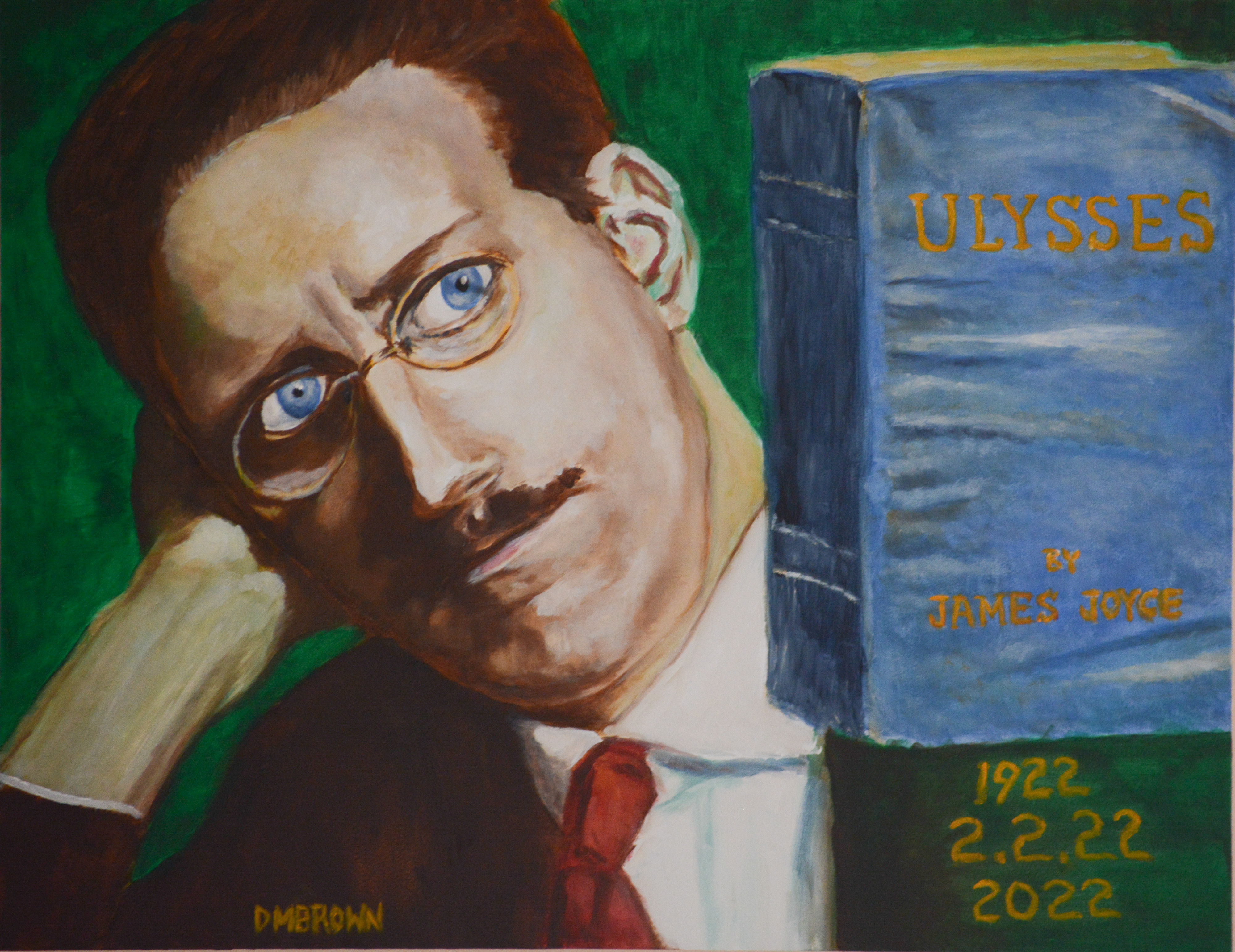
I’ve also commenced two series that allow me to “record” images that “stand for” certain influences in my early life: one I call “Pop Figures,” which so far consists of a rendering of James Joyce and his book Ulysses, painted for its centenary; a rendering of the photo of The Beatles on the cover of The Beatles For Sale (1964); a rendering of a composite of stills of Boris Karloff as ‘the Creature” in the original film of Frankenstein (1931). 

The other, related, series is called “Masters Revisited” in which I take an image of a painting by a master painter and submit it to my style of rendering; so far I’ve done a study of the mother and children in Michelangelo’s Flood sequence on the Sistine Chapel; a study of a Madonna and child by Raphael; a reconfiguring of the “muse of history” model in Vermeer’s The Art of Painting, complete with images of places of personal relevance on the map behind her; and a painting done from a lithograph by Delacroix—illustrations for Goethe’s Faust—depicting Faust and Mephistopheles on horseback.


So, the final point: because I’m nothing like so great a painter as Bacon I don’t mind at all that what I do be considered “illustration.” In fact, I think that, if Bacon pushed a bit harder on his language, he’d see that “recording and reporting” simply means—in one sense, at least—illustrating one’s point. One puts up images when words fail or when—perish the thought!—they are utterly irrelevant to the act of looking. Even better than the act of looking is the act of painting.

Then there’s the act of writing (as opposed to reading) but more on that next time . . . 


Monday, October 10, 2022

IN COMMON SPACES: ARTSPACE 2022 OPEN SOURCE FESTIVAL


Artspace Open Sources 2022

This year Artspace’s Open Studios permits in-person showing of art in a public space. I’ll be located in the Creative Arts Workshop at 80 Audubon Street, New Haven, on Saturday, October 29, and Sunday, October 30 where some samplings of my paintings will be on display. Here are the nine photos I submitted this year that are now uploaded to the Artspace site here, and I suspect most of these will show up, and possibly others, while I’m in situ.

1. Philly Days 1: Mary + Kajsa 1981 (March, May, October 2020), 30x24 stretched canvas


The painting is based on a photo from 1981 showing my wife, Mary, and our newborn daughter, Kajsa, on a summer morning in 1981 in Philadelphia. The point of the rendering is to capture the light, as the photo did, but where the conversion factor into paint is determined by the feelings and perceptions of the moment. This is still my most painterly production where there is some evidence of painting “for the sake of” painting. Favorite features: the cut-off jeans, the reflected light in the diaper, and the central creases in the background pillow. Theme song: “In the Summertime” by Bob Dylan (1981)

2. 21st Century Studies 1: Kajsa in Norway 2015 (July-November 2021), 16x20 stretched canvas


Based on a photo I took of Kajsa in Norway amidst our northern European cruise in 2015, the painting aims for a harmonious rendering of foreground subject and background landscape. Since I hadn’t really tried to render landscape before, this was an experiment in how I’d work from a source much more detailed than I wanted to deliver, while avoiding Impressionism. I think I sort of managed it. It’s also, for me, unusual to render a profile, which I didn’t quite get accurately though the finished painting is “like” Kajsa. Favorite feature: Kajsa’s jacket. Theme song: “Goodnight, Oslo” by Robyn Hitchcock & the Venus 3 (2009)

3. 21st Century Studies 2: Max in Hamden 2021 (July-October 2021), 22x28 stretched canvas


Mary’s grandson Max visited us in January 2021 and posed for a photo in our sunroom. That’s the basis for this painting which tries for a looser interpretation than the previous two, if only in response to Max’s youth (age 20) and attitude. The likeness isn’t as precise as I might like but then again I’m deliberately trying not to be too slavish to photo reality in these renderings. Favorite feature: Max’s jacket where the force of some of the strokes on the sleeves is shown by residual swipes I chose to leave in. Theme song: “Snowblind” by Black Sabbath (1972)

4. Philly Days 3: MEM 1980 (October 2021), 18x18 gesso board

The photo of Mary in our first Philadelphia apartment in the spring of 1980 is, as one friend said, “mesmerizing” in terms of the gradations of light on her face. I didn’t do a bad job rendering them though I’ve simplified the photo—as for instance the painting in the background, which is Vermeer’s “Girl in a Red Hat” but which I’ve changed to a kind of modernist portrait. In a way that sets the tone of what I’d like to get to eventually. Theme song: “Dreaming” by Blondie (1979)

5. Philly Days 4: DB, PAFA 1983 (November 2021-January 2022), 22x28 stretched canvas 

A photo of me, taken by a co-worker at the Pennsylvania Academy of the Fine Arts, on the office stairs (designed by Frank Furness) at the school door on Cherry Street, has long been a favorite of mine because of how the light “abstracts” the shapes and details in the shot. In the photo I’m 24 or almost and it’s very near  the end of my time in Philadelphia, so the sense of disappearing in broad daylight, as it were, is the point. Favorite feature: the reflected light at far left and my left arm. Theme song: “Of the Instant” by Gang of Four (1982)

6. Philly Days 5: Tim 1979 (January-March 2022), 22x28 stretched canvas


Mary took a black and white photo of Tim, my oldest friend (since middle school), in August, 1979, a few months before his twentieth birthday, while he was helping us move into our first apartment, 1931 Callowhill Street, Philadelphia, in a building where he was our upstairs neighbor. The view out the window was of a parking lot behind the Philadelphia Public Library on Logan Circle, though in the painting it’s improvised (the photo’s windows white out). The point: to render this image with a sense of its present—back then—and my present, looking back. Favorite feature: my rendering of Tim’s legs, and the aforementioned view out the window, a kind of modernist fantasy of a neo-classical building. Theme song: “Cities” by Talking Heads (1979)

7. Pop Figures 1: 2.2.22: James Joyce, Ulysses at 100 (February 2022), 14x18 gesso board 

During my time in Philadelphia, one of my big obsessions was James Joyce’s Ulysses which I first read in 1980; eventually I became a bit of a Joyce scholar, writing a thesis on Finnegans Wake and a doctoral thesis that included a chapter on Joyce’s novels, as well as teaching Ulysses to undergraduates in Yale Summer Sessions on six different occasions from 2002 to 2012. So when Ulysses turned 100 this year I had to commemorate it. My painting combines a rendering based on a photo of Joyce in his late 30s (he turned 40 on February 2, 1922, and at his birthday party was presented with the first bound copy of his great masterpiece) and an image of the original blue-bound version of the book. My intention was to do this in as few sessions as possible; it took five, Feb 2, 3, 5, 6, 9. Favorite features: Joyce’s wrist and forehead. Theme song: “Flower of the Mountain” by Kate Bush (2011)—which takes its words almost wholly from the “Molly Bloom monologue” at the close of the novel.

8. 21st Century Studies 3: Jerry by the Delaware, New Castle 2013 (May 2022), 16x20 stretched canvas


Back to photos from the 21st century: in this case, my younger brother Jerry, the year he turned 50, by the banks of the Delaware in Battery Park, New Castle, Delaware, our hometown. The month is August, my birth month, and the painting combines a photo of Jerry by the river with a photo of boats on the river, to create a kind of a companion piece to Kajsa by the fjord in Norway. In this case, the light on Jerry and the clouds in the sky are my favorite features, and just feel like Delaware to me. Theme song: “June Hymn” by The Decemberists (2011)

9. 21st Century Studies 4: Mary in Hamden 2016 (May 2022), 18x18 gesso board


Clearly, I tend to find photos of Mary worthy of rendering. This one she took herself (somehow) in the backyard of our home in Hamden, early in our residence there, as a self portrait for a photography class. My rendering deliberately went for a certain minimalism while remaining true to the dramatic lighting. Favorite features: the jacket on the left hand side and hand on the hat, and the jeans. It’s taken awhile, but I think I prefer the painting to the photograph now. Theme song: “Sins of My Youth” by Tom Petty & the Heartbreakers (2014)

More paintings may appear as I get photos of them . . .

Wednesday, September 15, 2021

ARTSPACE OPEN SOURCE EXHIBITION, OCTOBER 2021

In the year since Artspace’s Open Studios 2020 (see my contribution here), I’ve continued my work on the Tarot panels and on the series called “renderings.” My work on this year's website can be found here (when the Artspace link goes live October 15).

First up, one of the latter. This painting, which I worked on in May and October 2020, is based on a photograph I took of my wife Mary and our newborn daughter in Philadelphia in summer 1981. Apart from its considerable personal meaning for me, as an image and as a souvenir of a particular time and place, I’ve always felt the image had a great potency. The protective abandon of the maternal figure, the way the child in sleep is still in the posture of nursing, but also looks as if she’s trying to “take in” the mother. The mother’s T-shirt and cutoffs certainly conjure fond memories for me, but are also great fun to paint, set against all the pillows and sheets, as are the flesh tones. It’s probably the first painting I’ve done where painting for the sake of painting is involved. I hope there will be more.

In this series there are three other works in progress that are too in flux for me to want to post their images. All three are intended as gifts anyway so I don’t mind keeping them under wraps for now.

And now, onto the Tarot panels.

Last year, I had finished the first 3 panels of the “Ethos” section. Now I can present them together with the last two to comprise what should be a quincunx of paintings, like this:

Individually, here they are:


“Ethos 1: O The Fool” (April-May, 2020): The image of The Fool is of a man stepping off a cliff because he’s not paying attention.

 “Ethos 2: XIX The Sun” (May-July, 2020): The Sun is depicted as a naked cherub looking at his own reflection, above a desert.

“Ethos 3: I The Magus” (June-September, 2020): On a stage which might also be a church, the Magus kneels on one knee, lifts a microphone and an illuminating finger.

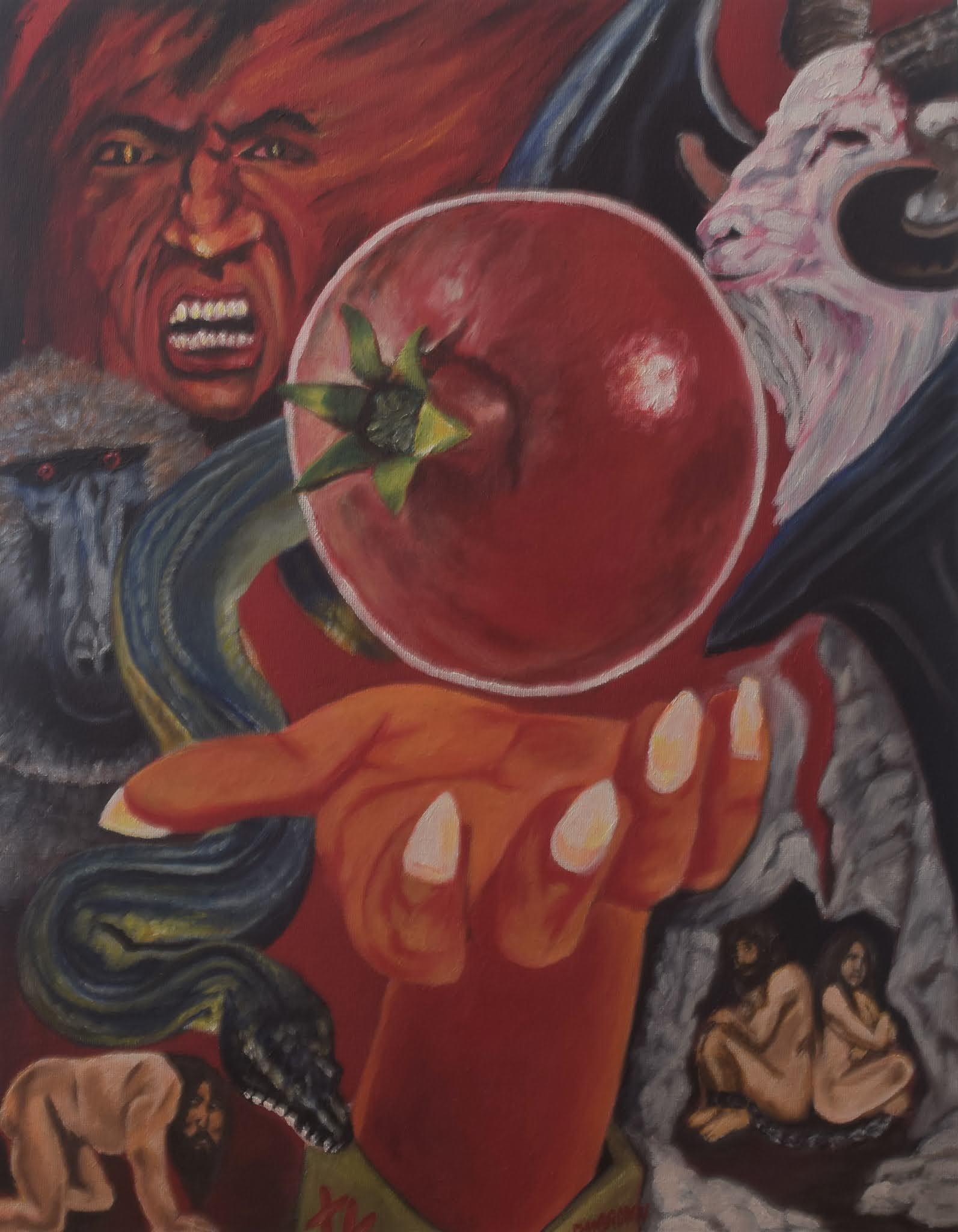
“Ethos 4: XV The Devil” (August-October, 2020): A collage of images for “the great deceiver,” including a pomegranate (as the fruit of temptation), a goat, a baboon, a serpent, a snarling face and images borrowed from William Blake.

“Ethos 5: IX The Hermit” (October-November, 2020): A single figure, derived from an Egyptian statue of a scribe, in an empty room, prepares to write his visions.

The latter painting was mostly painted last November. No matter how much I might like to be a hermit and withdraw from the world to paint and write and read and so forth, November, you may recall, was a particularly fraught time with the contested election and a host of unsettling events that culminated in the assault on the Capitol before the inauguration in January. It’s a fact anyway that I didn’t do much painting, if at all, after Thanksgiving weekend until the inauguration. That month I got started on Eros, the second segment in the Tarot series. And here are the first three. Again, these are meant to be seen as a group of five with VI The Lovers in the center, XVII The Star above, and III The Empress to the left of center; XIV Temperance, the panel below, is mostly completed but not yet signed or numbered, and VIII Strength, the righthand panel, was begun in August but hasn’t had much progress due to work on those three other “rendering” paintings.


“Eros 1: VI The Lovers” (January-March, 2021): Derived from an image for alchemical transformation, two winged figures, male and female, couple in a pond beneath a tree, a lyre nearby; the composition alludes to Chagall’s “Daphnis and Chloe.”

“Eros 2: XVII The Star” (March-June, 2021): A nude woman pours water from a vase into a pool in which she stands while gazing at the viewer, elements of her features and figure borrowed from friends, Dürer’s Eve, and a Waterhouse nymph.

“Eros 3: III The Empress” (April-July, 2021): A woman on a throne in nature, her figure and clothes derived from a statue of Parvati, the wife of Shiva and a Hindu goddess of fertility.

We're allowed nine images on the site, so that’s it for me, this year. Maybe around Christmas I’ll get those other three “Renderings” up. I’ve got quite a number of those planned, and should also be starting the panel for “X The Wheel of Fortune” which is the first “outcome” card—one at the halfway point, the other at the end. Thus I’m almost at the halfway point in the panels, but at least two to four months away.


Sunday, April 11, 2021

POP GOES THE WEASEL


A note, dated 6/21/14, I wrote in ink in the back of my copy of Hal Foster’s The First Pop Age (2012, Princeton UP) says: 

What I’m after: abstract photographs or photographs as abstract paintings. I think Richter [of the five artists Foster examines: Richard Hamilton, Roy Lichtenstein, Andy Warhol, Gerhard Richter, Ed Ruscha] is the most germane for my immediate idea (from oceanscape or cityscape photos) but could see the possibility of figures, portraits, ‘iconic images’ (of friends, influences, celebrities) being used the same way.

It’s been done, I know—but the interest is still in the use of fields, lines, planes for form.

Am I ready to become a pop formalist?

Today, having finished the chapter on Richter (back in 2014 I apparently stalled in the Warhol chapter), I can see that I was right. (Not surprising as I’d seen Richter’s “40 Years of Painting” exhibition at MoMA in 2002. I’m thinking that it’s possible I bought Foster’s book at MoMA’s bookstore after viewing the Sigmar Polke exhibit that ran April-August 2014. Both shows gave me much food for thought where making images is concerned.)

Foster strikes me as much more in tune with Warhol and that mechanical aspect of Pop as in thrall to the productiveness of commodity culture. Products for the sake of production rather than production for the sake of product. The very notion of “product” as somehow synonymous with “object” takes its impetus from that conflation, a conflation that, it seems, art in my lifetime (since the end of the Fifties) can do nothing to avoid, can at best exploit.

What Richter—whom Foster quotes a lot with a certain hands-thrown-up gesture—gets at, it seems to me, is the spanner that someone who actually cares about painting throws into the works. Because Warhol doesn’t care, nor does Foster, really. The conceptual force of art is all he can work up any attention to, even if it means that a dizzying level of production on Richter’s part meets with points like: “They [an entire body of “blurred” paintings in gray paint] suggest how our very sensorium, memory, and unconscious have become, at least in part, ‘photogenic,’ that is to say, not only affected by photography and film but also somehow adjusted to them—suited, even designed, to be photographed or filmed, created with such light in mind, along the lines suggested by Kracauer in 1927” (196). So that numerous paintings were created, in the mid-1960s, simply to illustrate a condition that Siegfried Kracauer was onto in the late Twenties. It’s a common feature of Foster: the thesis, uncontroversial as it might be, is supported by the art. No need to really look at it after that.

But the quotations from Richter start to steal the show. “Something has to be shown and simultaneously not shown in order perhaps to say something else again, a third thing” (196—the quotation apparently comes from Richter’s Writings, pg 272, but is not dated explicitly in Foster). “’Illusion—or rather appearance, semblance—is the theme of my life’ Richter also commented in 1989” (215 in Richter; 198, Foster). Foster tries to develop this question of “semblance” to serve his theme of the “photogenic” as an element of Richter’s painting: “semblance is not the resemblance produced in representation any more than it is the negation of this resemblance produced in abstraction. Semblance comprehends both modalities because it concerns the very consistency of appearance—it is what allows the world before us, natural or mediated, or natural as mediated, to cohere—and this concerns Richter above all else: “'Appearance,’ that is to me a phenomenon” (405).” Then Foster cites Richter “in the 1989 statement” saying “All that is, seems, and is visible to us because we perceive it by the reflected light of semblance,” and sums up that “according to Richter, the painter must ‘repeat’ [the semblance of the world] or, more exactly, ‘fabricate’ it” (199, Foster). It would be nice to read Richter’s entire statement but even in this cherry-picked version I like the way Richter suggests that we live in a world that is not simply already viewed through media, as Pop (in Foster’s version) belabors endlessly, but in which “appearance” or “semblance” is a condition of recognizing anything, or having, as it were, visual relations with the world and the things and people in it. His fabrication of that, as what an artist’s act amounts to, puts the burden on the viewer I suppose to determine what relation one of his paintings has to the other elements of the visual world that we recognize. Where do these fabricated semblances fit in in our universe of semblances?

To me, the fascination with what Richter achieves, as a painter, is tied up with my own burgeoning fascination with painting. I can’t say I ever had the fascination with painting as activity that sustained so many careers. I generally wanted the paint to do something I was trying to do, to strike the eye a certain way, and that’s that. The fascination of the painted was something to be found in the hands of masters, or at least in very gifted students. Nowadays I’d say I’m fascinated by the question of what I call “rendering.” And what gets rendered, to some extent, is what Richter is calling “semblance” or “appearance.” Foster insists this has nothing to do with the resemblance between the photograph and its subject and or between the painting and the photograph (the paintings by Richter being discussed all derive from photographic sources). And it’s true that “resemblance” is a lower order quality, one that Richter, as a painter, is too gifted to be bothered by. But it is, to me, a part of the concern of rendering: if I want the image to “look like” the person the picture is of, though not a stenciled version of the image. In other words, the photographic image, or the reproduction, I’m working from is indeed a semblance—of someone or something—but I want to render my relation to that semblance, which is not contained by that image nor exhausted by it, nor by my rendering of it. All the rendering does is perform that relation.

This is something Foster eventually gets to: Richter’s painting “is neither a progressive form of critical art nor a cynical kind of posthistorical pastiche. It does not resolve its contradictions so much as it performs them, and in this performance, it sometimes suspends them as well” (207). It’s not that Foster really sees painting as performance, and yet his formulation, once we get past his usual binary choices about what art can be (critical/cynical, progressive/posthistorical), almost articulates what is at work there. The art of painting as performance. What the whole “performance art” aspect of our contemporary art world [recently watched The Artist is Present] stresses is that the audience wants to be a part of the act/art. Fine. But the Old School approach was about coming to see the finished product/object—all the performance had already taken place, in the studio. Still my preference. And that’s because what happens, in the witnessing/observing/perceiving, is like what happens in reading/listening. I can’t see with another’s eyes nor hear with another’s ears nor read with another’s mind. I bring my own gear wherever I go. I want the artist to show me the semblance arrived at for the sake of my seeing. I'll take it from there. To be “in the scene”—like taking a selfie next to a masterpiece—is to underscore the historical dimension of art. You are there, it’s in your space and time. So what?

But in making art I have no such escape valve. I mean it is in my space and time because I am the one there making it. And there’s no sense of audience, only a sense of when I’m done, if only because I’m tired of “seeing what I can do.” I hit the limits of my ability or of my patience and so it’s time to move on. Otherwise, the rendering is its own agenda, to play with paint for the sake of form. What used to stymy me wasn’t just my lack of skill, but my lack of conviction that there should be something rather than nothing. Not nihilism so much as no commitment to an enduring image. The Pop culture that Foster is keen to elucidate struck me as not worth the candle. Tedious enough in each encounter, why proliferate Campbell soup cans to underscore the tedium? At the same time, there were fabricated images that fascinated—including even fully commercial products like album covers and book jackets, to say nothing of magazine ads. Meanwhile, any canvas no matter how grandly sublime could become an icon in a textbook, a thumbnail. An image, not a painting. The victory of Pop in the sense that seeing the actual “one and only” artwork could seem redundant. Though it’s really not if you really are looking/seeing and not simply conceptualizing as you wander through.

So maybe art isn’t exhausted by the tedium of making things but by the tedium of explicating, of fitting the object into the syllabus, of analyzing for the sake of an activity that, unlike art itself, seems to need no justification. If only because it has academic pedigree.

 All of which is simply a way to further render my note at the back of the book, a way of saying that I could see, in 2014, a détente with Pop, which I otherwise fault with being the a la mode from my childhood onward that seems impossible to outdistance, outlive, escape, or fully accept. And I say, as I did then, that Richter does help me see the way to that end. It’s in the performance of rendering semblance. What anyone other than me sees in that semblance? What the fuck do I care? As SD sez: “unsheath your dagger definitions.” Call it something, if it suits. As all these Pop guys know so well, it must be addressed by the critical—I won’t say “community”—apparatus (apparatchiks?) in order to really exist. But that’s just saying that any semblance one renders as an object must be given its wraithlike existence in the permanent embalming fluid of history or else . . .  we might as well, as Christopher Fry once put it, sculpt in snow.

 Yeah, but I like paint.

Monday, September 21, 2020

Paintings, City Wide Open Studios, New Haven, October 2020

The following introduces the images I’m sharing in this year’s City-Wide Open Studios in New Haven, CT (here’s a link to the site at Artspace).

1. “Now & Then: Self Portrait with Photos” (January 1983, and August/September 2020; 24" x 30")


I'm feeling more Proustian than usual, thanks to this inter-temporal slam. Back in the winter of 1983, I was 23 and worked in security at the Pennsylvania Academy of the Fine Arts, and spent a lot of time hanging out with current and former students there, as well as a number of Philadelphia poets and artists. I painted a self-portrait that featured, on the right-hand side, my image in the bathroom mirror (the boards through the plaster showed renovation work that was halted when we moved in), and, on the left, a painting in black and white based on a photo of me in March, 1982, around the time of my daughter’s first birthday. In between were pasted three reproductions of a photo of me at 20 (my first winter in Philly) which I painted upon. The lower left showed a sunrise on the ocean when we stayed in Ocean City, MD, in June of 1981, and the upper left showed a view of Bar Harbor, ME, from Cadillac Mountain, from a visit in October the same year. The idea was to preserve me at that moment (the start of the end of the Philly era, as it turned out), set beside some images from the recent past that informed that period.

In 2020, the Kehler-Liddell Gallery in Westville put out a call for artists to contribute to a show called “I Am”: “How do you see yourself? How do others see you? What makes you, you? From selfies to personal branding to the complexities of identity politics, our carefully crafted personas are routinely broadcast to the world via the internet. The modern world revels in the revelation of a semblance of self, allowing us to conceal as much as we reveal. In this age of unprecedented exposure, how can an artist offer some fresh statement of self?” (Here’s a link to Brian Slattery’s coverage of the exhibit for the New Haven Independent.) I didn’t submit anything but the question made me think of my youthful self-portrait, which I wouldn’t have submitted as is because I was never quite satisfied with it. That got me thinking about painting-in a new, contemporary, twenty-first-century face.

Initially I thought I might use a very good photograph my wife Mary took of me for a class she was taking around 2017. But that already was a little dated. I turned 60 in 2019 and it made sense that the picture should be from the new decade in my life—the 60s!—and from the new decade we’ve begun—the Twenties! Shortly after my sixty-first birthday in August, with “Covid hair” in evidence, I took a selfie with my Surface and that’s what the new face on the left is based on. Further work was done on the “me” of 1983 as well, and the ocean (which was the part most fun to paint and which looks forward to a series of seascapes I hope to get started on soon).

While working on the painting, I played cassette tapes I still have from 1983 as well as an iTunes playlist featuring only LPs from 1980-83 that I owned at the time. Who says you can’t go home again?

In response to the K-L Gallery query: The activity of painting recalls someone I have been at various times in my life, and am trying to be again. For it’s not simply an action—painting—it’s an assertion of identity. One becomes the maker of this particular thing, and of another, and another . . . But there is no resting within that identity because it’s predicated on activity, an activity that changes with each new attempt. The task of painting what one sees becomes at once a reflection upon how perception changes day to day. There’s no enduring gaze, there are only the discrete moments of looking. Even a static image changes. And that fact, which used to defeat me and make me despair of ever “getting it right,” now keeps me in the game, given over to the effort to paint the way I see at the moment. And—here music contributes in subtle ways—the way I feel from moment to moment, or song to song. Part of the process of trial and error means relearning how to paint, or of learning how I paint now. “I Am” both painter and painted, and, in the painting, both 23 and 61.


2. “Baby Mommy” (September-December, 2019; 14" x 18")


The return to painting after a twenty-year lay-off started a year ago with this painting. The photograph shows my mother—who died in 2011 at age 82—at three or four, and so dates from around 1932. She is dressed for her portrait in a white, billowy dress adorned with embroidery across the shoulders and neckline, with puffy short sleeves and a cape, discernible off to her left side. Dress shoes—one is visible as she sits with one leg beneath her, the other foot is out of the frame. She leans forward slightly, eyes gazing at something, or simply intent upon not blinking. The face is a bit tense but also—I sense—greatly impressed at the fuss it must have taken to appear so perfect. Her hair is carefully combed, and she wears a bracelet on her right arm and a pendant around her neck. There she sits, Elaine May Taylor, third child and third daughter of Mr. and Mrs. James Patrick Taylor of Wilmington, Delaware, at her best. Understood even then, I suspect, as an icon of the ephemeral beauty of childhood.

The activity of painting involves what’s called “muscle memory”—indeed, that’s one of its great attractions, as some might feel for cooking or running or playing an instrument or any of dozens of physical activities. Which may include dancing or making love. And the latter is the act I find most akin to painting because it is a labor of love, this effort to render an image. Working from a photograph presents certain immediate frustrations—you can only see what the camera shows. And what the camera shows has been frozen in a lifelike but non-living image. To put life into it—my life—is the task, certainly. But, more importantly, the effort means putting my mother’s life into the image. Day after day I painted and watched her face change—watched as I changed her face—letting me glimpse my older brother, Tom, or Joan Walters, a cousin my age (who then died in April), or my mother’s father—recalling his resemblance to my younger brother, Jerry—or our sister Kathy, or even my daughter Kajsa, whose face I drew many times for a collage of images from photographs of her, newborn to age ten, back in the mid-90s. To find those other faces lurking in my mother’s child-face as I painted and repainted it was to see again our interrelations, while the face that emerged in the painting was not my mother as a child, or not only. The look in her eyes—in the eyes I fashioned for her—was a look I had seen, it was the stare not of the child in the photo, who would become my mother, but of my mother as I knew her. That double vision—was it only in my eyes, looking at what I had done, or was it there more tangibly? My deceased mother’s living gaze brought back to me as an object to be regarded, as a “thing” that had been, that had—in a sense—never gone away. The painting I created was not my mother as a little girl, but a little girl as my mother, a baby mommy.


3. “Not Yet Dad” (January-April, 2020; 14" x 18")


Here the idea was to do a quick study from a photograph of my father, Fred Earl Brown, 1927-1996. The picture was taken in a photo booth with my mother around the time, I believe, they became engaged in 1949. They married in August of that year and my dad turned 22 in October. I liked the way my father engaged the camera in this photo, ready to start his life with the woman at his side. He had been in the service as a Marine, but he was not yet a dad. Their first child would not be born until March 1952, when my father was 24. The fact that I was a dad before my 22nd birthday gave me a certain pleasurable feeling of priority over that young dude. The photo is black and white so I had considerable leeway in choosing colors, and the expectation that I would paint this one quickly soon faded away. I had thought, because my mother’s photo was such a fine studio affair, that it would be the more difficult to render, but the flash-bulb-lighting on my father was the kind of distortion that is foolish to render as is, in paint. So it took some time before I got a tonality and balance I could live with.

There’s the old canard of the poet Paul Valéry saying that, for amateurs, a poem is never finished, only abandoned. A comment I’ve often applied self-consciously, with an ironic smirk, to my own efforts. Valéry, a certain kind of perfectionist, wouldn’t undertake any work unless he knew what “the end” was, what it was he wanted to achieve and why. Well, we all can’t be Valéry, and many of us simply blunder along, trying things, eventually saying “I give up.” In fact, the only thing that made me stop work on this painting was the fact that I needed to move on, to begin the series that comprises the rest of the images in this inventory. And because any further work would only distort what I’d already achieved, and I didn’t want to find out where such distortion would take me. Not with this. The photograph, unprofessional as it is, has a charm I wanted to maintain and that has to do with walking a line between simply sentimental evocation—which I don’t at all disparage, at this point in my life, whatever I might’ve felt about such motivations as a younger man—and something more elusive. That “something” kept me involved because (whatever it is), it entails a search within myself for a reason to do anything so de trop, so superfluous, as making a thing. A photograph can be scanned, made into a digital facsimile, photoshopped, and shared. What can be the purpose of rendering that image as a separate object, if not the experience that occurs in the fashioning? And that’s the very thing—my skepticism says—not likely to be present to other eyes or at least not as a particular experience. The question of particularity—this particular image at this particular time—is apt to be meaningless to anyone but me. Even my siblings or my father’s grandchildren, familiar or not with this image of his youth, aren’t likely to relive their relation to him simply because I made this painting. And yet something like that is my goal: to live the hours spent making the image as a kind of homage—to my father’s past, to the beam in his eye, and to my past indebted to him and to whatever aspect of our connection still lives. While painting “Baby Mommy” I thought of my father once saying—watching me paint as a teenager still living at home—“I’m gonna have to chain you to the easel.” He meant, quite rightly, that I was very lazy about painting, even back then when I was doing Frank Frazetta copies for spending money, and I wasted a lot of time not making any effort and a lot of effort not putting in the time. So, on this one, I put in a lot of time.


The Tarot Panels

This is not the place to go into the history of my interest in the 22 cards called the “Major Arcana” in the Tarot deck. Suffice to say the curiosity dates from around 1980 and that I wrote a poem for each of the 22 cards between 1988 and 1992, which I gave a public reading of while in grad school at Princeton. A few efforts to publish them as a chapbook went nowhere and my interest drifted to other things. When I moved to Hamden in 2016, I hoped the extra room would give me a place to paint and one of the ideas was to do an “illustrated Arcana” in some fashion. When the COVID lockdown occurred in March, I got immersed in texts and notes to see how I’d approach that. Developing a logic I’ll maybe go into on some other post, I broke up the 22 cards into four groups of five, with two leftover, one as transition and the other as outcome. The four groups were titled—following on ideas about literary interpretation I spent some post-doc years developing—“Ethos,” “Pathos,” “Eros,” “Logos.” I considered doing a very big painting for each group with the two extras as stand-alone images. But that didn’t feel right. And I don’t really want to work so big in my spare room home studio anyway. The two paintings of my parents both happened to be 14” x 18” and that seemed a good size for the Tarot panels. Panels because canvas stretched on board to feel and look a bit more like playing cards. So it should be possible to hang all five on a wall at once, and to even rotate them through the seasons and so forth…

Initially, my plan to join the City-Wide Open Studios was to garner a wall to hang the first group of five on—“Ethos”—which should be in a quincunx with #1 in the center, #2 above, #3 to the left, #4 below, #5 to the right. My hope was to do one a month and have all five done by September. It didn’t happen and COVID meant no wall anyway. So, here are the three I consider “done” as of now. #4, “XV The Devil” is begun and #5, “IX The Hermit,” may be by the end of October? In any case, I’ll add them as they come along.


4. Tarot Panel 1: “0 The Fool” (April-May, 2020; 14" x 18")


The standard image—borrowed from the Golden Dawn Tarot pack developed by A.E. Waite and Pamela Colman Smith—is of an aesthete-looking guy stepping off a cliff while brandishing a flower and carrying a knapsack. I didn’t ponder too long over this card because I’ve drawn a couple different adaptations of it, in different contexts, over the years. The main change was to depart from motley for the Fool—I liked the association with the Fool in King Lear, one of my favorite Shakespeare characters in one of my favorite Shakespeare plays. But this time I wanted a contemporary fool, and the act of checking his phone while stepping into the abyss struck me as irresistible. His clothes came from a google search of hip threads of the times, while the figure’s stance came from Rodin’s statue “John the Baptist preaching.” I needed a naturalistic space, I felt, so the fact of his imminent plunge would be clear. I selected the Cliffs of Moher in Ireland, well-known as “the Cliffs of Insanity” in The Princess Bride. And the Fool’s features are meant to recall those of the young Hermann Hesse (around the time he wrote Knulp, a novella about a free-spirit who wanders about without any ties to person or place) whose works helped me, as a teen, get into Nietzsche’s Thus Spoke Zarathustra, which I associate with the spirit of The Fool, in its more philosophical inspirations. (For more synopsis, via a song playlist, go here.)

5. Tarot Panel 2: “XIX The Sun” (May-September, 2020; 14" x 18")


Unlike the Fool, which has a story of sorts, the Sun is mostly just a symbol, or else it’s the heavenly body itself. To paint a picture of the sun is not an easy thing to do, and what should its foreground or background be? All along I knew—drawing again on the Waite-Smith deck—that there would be a young nude male in the image. He should be an embodiment of the Sun. A Sun-child. The Sun god. The search went out for cherubs and cupids and a number were found that might suffice. In the end I came to rely, mostly, on the figure of Cupid that stands, mini-me style, on a first-century statue of Augustus Caesar from Prima Porta. Except that my Cupid-Sun figure would be holding a glass up to see his own countenance. To get the look on his face was a long bout of trial and error—at one point I had a face that was quite lyrical and dreamy, then a self-satisfied look that reminded me of the young Marlon Brando, and a couple others. The face that finally emerged owes something to an image of a Renaissance putti a facebook friend happened to post. The idea is that The Sun is personified as a nude man-child looking raptly at himself in a kind of “sun bubble” that flourishes with sunflowers and corn, to symbolize summer in my part of the world, while below all is desolate sunbaked wasteland, recalling two famous poetic lines: “a gaze blank and pitiless as the sun” (from Yeats’ “The Second Coming”) and “boundless and bare / The lone and level sands stretch far away” (from Shelley’s “Ozymandias”). (For more synopsis, via a song playlist, go here.)

6. Tarot Panel 3: “I The Magus” (July-September, 2020; 14" x 18")


The figure of the Magus, or Magician, should be potent. Initially, my conception of the figure I wanted to portray drew on Jimi Hendrix, a magician of the guitar whose playing first held me rapt around age 10 (when Hendrix was still alive). Some subsequent thought made me think of merging Hendrix with Prince, a musical figure from my own generation to whom he could be compared in creating a unique niche in rock music as a black artist. The image would be a charismatic performer, maybe with a guitar maybe not, kneeling on a stage singing into a microphone, his clothes a flamboyant mash-up of Jimi and Prince. For further inspiration I compiled a tape alternating songs by the two performers. Then came the protests for the ruthless murder of George Floyd in Minneapolis (Prince’s hometown) and my Magus would have to be seen taking a knee. He would hold his microphone aloft to invite the voices of the crowd, his raised finger showering sparks—perhaps incendiary, perhaps illuminating. His hat I borrowed from a photo of Lamont Steptoe, a black poet-friend of mine from Philadelphia, while the rainbow sash recalls Hendrix’s Rainbow Bridge and the alchemy of colors in “Bold as Love,” as well as the rainbow of LGBTQ awareness. The plaque in the background copies an ancient Egyptian relief of the god Thoth, a kind of analogue to the Greek god Hermes, known for his magical knowledge and for having given humanity writing, and often associated with The Magus card. The Ankh symbol on the hat I used to wear on a chain around my neck, in high school, and is generally interpreted as a symbol for eternal life.


Sunday, July 3, 2016

TOWARD CRITICISM, 2


Reading is different as one grows older. Young, I used to read “for all time,” my brain alive to the words as though a photographic plate, letting the lines be burnt upon my imagination so that the words and the images they create would never fade. First readings of certain books remained largely intact. I could leaf through the books in my mind, “see them” again, if not read them again. The capacity that allowed me to recall the actual words used, to see them before me in my mind’s eye, dispersed probably around age 30. Thereafter, it became harder to call to mind all the particulars, but that wasn’t simply due to aging memory, it was also due to educational dispatch: in college, which I attended between ages 26 and 30, one read for short-term memory, for the sake of “the course.” Much of what one studied was given definite temporal parameters. After all, old knowledge will always be replaced by new. Nothing is for all time.

But those earlier readings, in my teens and twenties, were for the sake of my own mind and development, not for the sake of the curriculum. Those readings were between me and the world of letters, and I belonged there by virtue of my curiosity, my hungry search for writing that would matter to me, that would shape my mind and imagination and word-usage, my way of thinking as though in a book. My way of reading my own mind.

In college my mind was enlarged by many more avenues of study, of discipline and major, than I had sought out on my own, and yet that enlargement created a darkening of the photographic plate. There were simply too many facts, dates, names, places, works, events, readings. While I still preferred re-reading those in my pantheon of greats, that pantheon was no longer a world unto itself; it was a collection, a constellation, created by my initial inquiries.

Now, mid-fifties, I can look back on my educated reading as well, so that arranging my books on my bookshelves after what may be the last big move of my adult life, I relive, or reanimate imaginatively, the process by which I filled in the gaps so that literature becomes not simply my circle of heroes, but a continuum in which one tendency replaces another “forever”—or, until it simply becomes, for the moment, contemporary. The mental walk through literary history (my books are arranged chronologically by year) furnishes me with many thoughts and memories, many of ideas never realized. Time was, these ruminations would have been considered material for lectures about developments in art and literature, lectures never delivered nor written because, in the manner of the student who prepared but didn’t get “called on,” all my study did not lead to a university position. So part of what I reflect on is what that preparation amounts to, in and of itself. The ability to pass exams, to read for and pass “generals,” to have a body of knowledge that isn’t “useless” so much as “unused.” But knowledge—knowing who wrote what when, or who said what about which work, or the plot of various novels and plays—isn’t the point of such study, it’s a by-product, not an outcome.

The point is argument. And perhaps it’s enough to reflect that the argument against reading as education is inherent in the failure to find the job offer one expected. But that’s not the argument that motivates me, that too is an element of happenstance—of opportunities missed or abilities lacking. The argument furnished by my originary reading relied upon the necessity of reading as a developmental decision; reading as an auto-didact would be improved by subsequent education, certainly, but that doesn’t overshadow the initial impetus: the belief in that early reading was belief in myself within the world of letters, not belief in myself as an academic, as a professor. The fact that I did attain to a knowledge base that enabled me to lecture authoritatively in my field means nothing beyond that. That knowledge makes one a teacher. The Ph.D., arguably, makes one a scholar, or gives one the wherewithal to research and argue at a professional level. But neither of those capacities makes one “a writer,” as I understood the term in my youth. Though even that term is a dodge. I had no interest in “writers,” per se. My heroes were not “writers,” they were artists, with all the romantic—and perhaps subversive—associations that might conjure, because what they created were works of art. And much of my study at the doctoral level was aimed to understand that distinction. What does it mean to consider some product of writing—a novel, play, essay, poem, book, text—a work of art?

I had entered the university at the age of twenty-six because I felt I’d gone as far as I could on my own. I wanted to learn to read French and German; I wanted to study the history of art and of literature so that I could understand how my latter day heroes—Joyce and Thomas Pynchon—fit in. But also art. I’d spent a few years working as security at an art academy/museum and the sheer diversity of forms considered art in the ‘80s burdened me with an irksome incomprehension. If there was a history, if there were principles, then one might devise an argument for some works and against others. I suspected that such was not really necessary—neither for artists nor professors nor critics—but I wanted to insist upon it for myself. I was already possessed—I believed—of a discerning critical sensibility, but what was it discerning? What was the basis of my own affinities? What was the purpose of convictions other than simply having them?

All along I was convinced that I read not to become an informed critic, or a good student or teacher, but to become an artist in my own right, and that meant—to myself in the mid-twenties—getting a handle on what my heroes had achieved in the grand scheme of things. Which meant coming to terms with the fact that there is something like a “scheme” in the world of letters. Even though many of my heroes were iconoclasts and rebels within any such scheme. And that worried me. Trying to create an ad hoc “scheme” into which the writing—the art—that mattered to me might fit was a disservice to some affinity that mattered to me more than keeping company with what Nietzsche—one of my earliest heroes—liked to call “schoolmen.” In fact, apropos of Nietzsche’s idiosyncratic autobiography Ecce Homo, I once remarked to one of my dissertation advisers that I’d like to entitle my thesis “Why I Like the Books I Like.”

Not content with only one aspect of the portrait of my affinities—the literary—I have expanded the list to include films and rock music and poetry, perhaps even fine art. As an undergrad, I was a student of both art history and comparative literature and my list-making from that combined study followed more closely historical and aesthetic tendencies not decreed solely or even mostly by my own preferences. But to create a personally relevant list was always the more compelling aim. There are philosophical grounds for this, having to do with the idea that experience occurs in a time for all time, but that the time when something happened and the time in which it is recalled are never one and the same, much less the time when something first appeared and the time when it was first appreciated in a critical fashion.

Thus my stress on these different experiential points: the time of emergence, when something first comes to light, call it (the following terms derive from Mallarmé) “the scene”; then the time when something is experienced/appreciated by the critic—in this case, me—as “the figure”; then the time when something is recounted, placed into thought and writing—as “the fiction.” The idea that exercised my mind in my time at Princeton was that of the “supreme fiction,” an idea taken from Wallace Stevens, who formulated, as did Mallarmé, a tripartite division: “It Must Be Abstract,” “It Must Change,” “It Must Give Pleasure.” The “abstraction” is “the scene,” that idea of a time and place that remains—as idea or conception—after the time and place has passed away, in the manner that one speaks of “the Sixties” or “the fin-de-siècle,” or “the Renaissance.” Zooming in, one is concerned with the blooms that are flourishing at a particular moment, whose having been alters the air we breathe thereafter. Change is part of “the figure,” the being or bloom who instantiates the idea in its moment, but then continues to alter, for nothing gold can stay.

The “pleasure” corresponds to “the fiction,” in which experience makes a claim to endure. There are many easily forgotten or undifferentiated experiences, but some others have a definite thrust or power or vibrancy that makes them lucid, knowable, preferred. The factor of pleasure—hedonistic as it may seem—has to do with beauty as the high desiderata of aesthetic experience. We may wish to marry the simple contemplation of beauty with something more active, with “the beautiful gesture,” or the acte gratuit, or with the selfless sacrifice of a Christ or a political dissident, but I would argue that, transposed to art, such acts still must be contemplated, and so we remain within a realm of the pleasure of our own experience, inseparable from the pleasure of being alive, or of being itself.

For me, the fiction that seems to matter more than any other—as the basis, I suppose, of all my pleasure in whatever I take pleasure in—is “the growth of the critic’s mind,” where the critic is both author and reader, and the “growth” is the interdependent reading of one by the other, of a changing “figure” read against an abstract “scene,” for the sake of that enduring fiction: consciousness.