
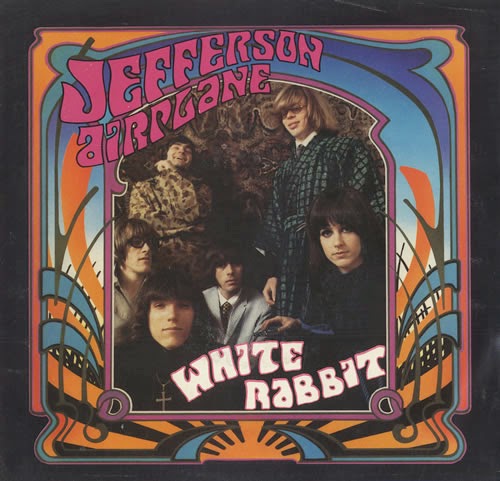
Tomorrow is the birthday of Grace Slick, who sang lead on a
number of my favorite Jefferson Airplane songs, particularly today’s song,
which she wrote. I’m also very partial to “Somebody to Love” and “Lather.” In
fact, I considered posting about the latter since it’s less well known, but, it
being Halloween time and all, “White Rabbit” fills the bill better. We could say
it’s all about tricks and treats.

The trick is the way the song quickly escalates into a
heart-pounding shot of adrenalin. The treat is all the pills Alice is popping
in the song—to get bigger and smaller, just like in Alice in Wonderland,
though, of course, we know that’s not what’s really going on. “And the ones that Mother gives you don’t do
anything at all.” Well, they don’t have psychotropic properties, but one
imagines that they might be birth control pills, so they definitely do
something. Which reminds me not only of the Stones’ “Mother’s Little Helper”—those
speed pills the average housewife is popping for weight issues and depression
and that general feeling of lassitude, doctor—but also Elvis Costello’s line
(in “You Little Fool”): “mother just gives her some pills to choose / and says go
use / your imagination.”
So, yeah, mom and pills might lead to whatever we imagine. But let’s get back to our Alice, shape-shifting
like a sonuvabitch. It’s all part of growing up in the high and happy days
before things like LSD were outlawed, to say nothing of psilocybin mushrooms.
The Airplane were a pretty trippy band and this song was sort of the theme song
for mental exploration, set to an insinuating bolero-style lead-in that gets faster and faster till it seems the beginning of the song is ages past and it ends with a crescendoed slogan essentially (but I always wanted something a bit more revelatory for Slick to wail at the end): “Remember what the Dormouse said / Feed your head.” I suppose “feed your head” is being
attributed to the Dormouse, so, yeah, who wouldn’t take the advice of a talking
furry critter? We’ve all been colonized
by Disney, ain’t we? They even have an animated version of Alice in Wonderland.

And let’s hear it for that “hookah-smoking caterpillar.” In
fact, Lewis Carroll gives us this dude, a nod to, shall we say, the dreamy
poppy that came to general knowledge via the Raj. And India—its drugs and its
spiritual exercises—would be a hit with the kids of the TV generation . . . the
Vietnam generation . . . the dropout generation . . . the Mod generation. All
that. The Airplane, wittingly or not, created the go-to song for kids to get freaky in the rec-room. The
phrase “go ask Alice” was even filched for one of those TV movies of the
Seventies, maybe it was a book first, about a girl who gets strung out on drugs
and comes to grief. A warning to you all not to become a wigged-out waif with a
habit to support. I'm pretty sure we had to read it in middle school and it got me interested in today's song, and that got me interested in those bygone glory days of the Acid Generation. With all due respect for the dangers involved. And it’s true that Slick’s song does pack a certain
malevolent energy. It’s when those distortions start kicking in—you feel the
rising wave of the “bad trip” about to overwhelm the protagonist: When logic
and proportion have fallen sloppy dead / And the White Knight’s talking
backwards / And the Red Queen’s off with her head. Well, when all that comes to pass, you’re
tripping, girl! That's what you get for chasing rabbits down the rabbit hole.
But of course things even trippier happen in Carroll’s
story. Which is a way of saying that one of the key factors of the psychotropic
experience was how it opened not only what Huxley called “the doors of
perception” (you see and hear and feel differently) but also the doors of
imagination. Things you’d stored away, like details from childhood, could
become re-animated with peculiar vividness, as though a part of your mind you
had “outgrown” was fully available to you again. Some, like Timothy Leary, went
further and claimed you could experience memories that were genetic, going back
to ancestors, even to the primal soup of being. Well, sure, why not? Feed your
head, Tim.

I will always associate this song with the scene in Hunter
Thompson’s Fear and Loathing in Las Vegas when Dr. Gonzo’s attorney, tripping
on a whole blotter of acid in the tub, insists that the Doc chuck the tape
player—playing “White Rabbit”—into the bath water as the song peaks. That part,
as the attorney says, when the rabbit bites its own fucking head off (or words
to that effect). Dr. Duke can’t bring himself to do so, and throws a grapefruit in
instead, though it seems to achieve the same effect of causing the attorney to
scream and thrash in some kind of death-trip ecstasy. And that’s part of
Thompson’s brilliance in that book: seeing that much of what passed for the
contagious drug-wisdom of the era was a death-trip. Seeking in hallucinogens and
meditation and sexual be-ins an annihilation of the self. Getting back to the
primal soup to which you once belonged. Which is why HST was so fond of Dr.
Johnson’s statement as his epigram: “He who makes a beast of himself gets rid
of the pain of being a man.”
So, sure, feed your head, but let’s keep it in perspective.
It is your head. And always will be, world
without end.
When the men on your
chessboard get up and tell you where to go


