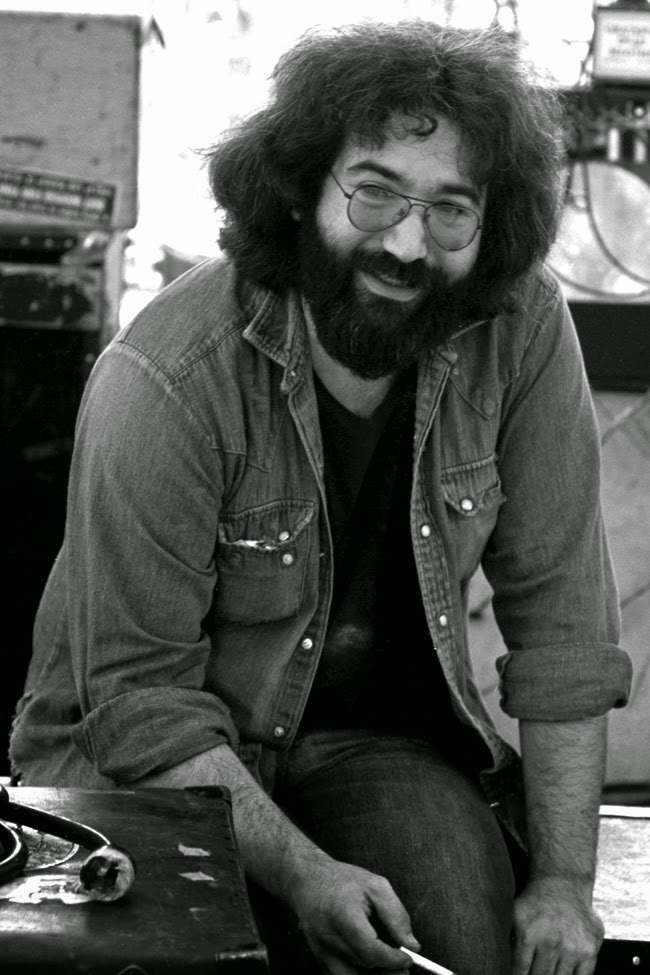
Today, in 1942, Jerry Garcia was born. As the guitarist for
The Grateful Dead and for the Jerry Garcia Band, Garcia left his mark. When we
talk about long-lived guitar heroes of the Sixties/Seventies heyday, Garcia is
in that top vanguard. He continued at his post until his death in 1995 (on
August 9th), but, for me, the period of strongest attachment was from 1976
till 1981. In that period I got to know their best albums—made from 1970 to
1981, particularly American Beauty
(1970), Grateful Dead (“Skull and
Roses,” 1971), Europe ’72 (1972), Wake of the Flood (1973), Terrapin Station (1977), Go to Heaven (1980), Reckoning (1981).

My main concert events with the Dead were at Englishtown
Raceway in September, 1977, and a show at Giants Stadium in summer 1978—both were
outdoor shows and thus fondly remembered because the Dead always sounded best
outdoors; in fact, the Englishtown show was never surpassed in my concert
experiences, and I was tempted to pick a song from their set there. I decided
instead to pick my favorite track from their officially released LPs. (Other
shows I’m very glad I attended were the back-to-back nights I saw them at the
Spectrum in May, 1981.)
In 1976 I started partying with my older brother a bit and
he had all the Dead albums up to that point. And I got to know them all. My
favorite was and still is Europe ’72,
a three disc selection from a series of concerts they played in Europe in 1972
(the entire 22 shows, without overdubs—which are present on Europe ’72—were released on 73 discs in
2011). My brother saw them before that tour and his tales of how distinctive
they were as a live band were supported by the high-points of the records,
fueling my own desire to see them live. The 1972 tour was the last with
original member Ron “Pigpen” Kernan and featured what was, in some ways, the
definitive Dead sound. The version of “(Walk Me Out in the) Morning Dew” on the
album comes from a show in London and became my reference point for what the
Dead could be capable of, live. I never heard them perform the song while I was
in attendance, which I don’t bemoan since I have the feeling that any version I
might have heard might not equal much less surpass this version.

In terms of rock history, the song is a folk song from the
early Sixties, written by Bonnie Dobson after seeing the film On the Beach about life on the planet
after a nuclear holocaust. The Dead made it one of their earliest borrowed
songs—it had already been recorded by a number of people in addition to Dobson—releasing
it on their first album. Thus the song has the status of a kind of “what we
fear from the world around us” air that was one of the incentives to the
counter-culture as it developed. The “drop out” notion wasn’t simply because
people wanted to enjoy youth and drugs and sex and not be “hung up” by careers
and jobs and families. It had more to do with the notion that “regular folks”
were marching like zombies toward some kind of impending apocalyptic mega-death
or, if not that, then a Metropolis-style world of corporate government selling
out the people’s soul for ruthless efficiency and the highest possible profit
margin.

Dewy-eyed, of course, “Morning Dew” is intended as a baleful
glimpse of a “morning after” in which the world as it was no longer exists. For
me, first hearing the song in 1976 (the Bicentennial of the U.S., at it happens),
“Morning Dew” felt very much like an elegy for the counter-culture itself. The
Pigs had won, bro. Remember—1972 was the year of Nixon’s landslide victory. And
1976—the year of Jimmy Carter’s victory, following the Fall of Saigon and the
pardon to Nixon—didn’t seem like it was any kind of recovery of the high
ground. By 1979 there would be various “no nukes” rallies, and concern over Russia
in Afghanistan would lead to further apocalyptic outpourings. The song’s
sentiments were still relevant, as they say, throughout my period of Dead advocacy.
What’s more, the live version’s crescendoing guitar solos by
Garcia paved the way, in my listening, for the kind of intricate guitar solos
with which Tom Verlaine graced “Marquee Moon” (1977). The interplay of guitars
in the Dead between Garcia and Weir, with funky Phil Lesh on bass, still
provide some of my favorite live music listening. And on the 1972 version,
Garcia, whose vocals could be kinda will-o-the-wisp—now here, now gone—reaches a
peak of passion and pleading as well. The whole thing still floors me.

The song follows the classic statement and response format.
The first voice (female) is unaware of what has occurred—“walk me out in the
morning dew, my honey”; “I thought I heard a baby cry this morning”; “Where
have all the people gone, my honey”; “I thought I heard a young man mourn this
morning”—and meeting responses (from a male) that are rather guarded: “I can’t
walk you out in the morning dew”; “you didn’t hear no baby cry this morning”; “There’s
no need for you to be worrying about all those people / You never see those
people anyway,” the latter statement a rather deft admission of indifference to
the fate of all those others. But the question about the young man mourning
gives the lie to that: And after his tearful reiteration of “I can’t walk you out in the
morning dew today” comes a blazing and lyrical solo from Garcia
that tears your fucking guts out. It’s played with righteous feeling and
mourning and here and there the lights of some possible redemption (especially
around 6:18-24, then that great run from 6:33-53 which is almost beatific).
Then we come around to a quieter, more resigned request (and listen to how,
with Godchaux’s piano, they lope back into it), and then a response that is
truly devastating: “I’ll walk you out in the morning dew, my honey / I guess it
doesn’t really matter, anyway.” Because there’s nothing left and so not much
left to fear and so nothing really matters any more. And then the floodgates
really break wide open, with Garcia’s vocals reaching from a downtrodden
whisper to the top of his bent, and the guitar (hear Weir cranking forward as
he gets worked up) finally climaxing in—what?—complete annihilation?
There are then some fully articulated thoughts (from the fingers)
for several bars, particularly at 9:53 and following, then just hold your
breath and hold on for that final slashing climb to the ultimate acceptance,
from about 10:20 to the end.
Yeah, circa 1977 and graduation from high school into utter
Nowheresville—my beacons were “Morning Dew,” “Marquee Moon,” “Like a Hurricane,”
and “Heroin” (from Live ’69). Oh, and throw in Pink Floyd's “Dogs,” for good measure.
I guess it
doesn’t matter anyway.