Showing posts with label King Crimson. Show all posts

Saturday, October 25, 2014

DB's Song of the Day (day 298): "PRINCE RUPERT AWAKES" (1970) King Crimson


Today’s the birthday of Jon Anderson, lead vocalist for Yes. And yet today’s song is not a Yessong. Back when King Crimson was recording its third album, Anderson sang as guest vocalist on one track, today’s song.

Lizard is one of those acquired tastes I remember acquiring as a teen. At first I was somewhat aghast at it, as I had such hopes for it and, upon listening, found the album not at all to my liking. Horns, I felt, had no place in Prog! “Prince Rupert Awakes,” the first segment of Side Two’s sidelong “Lizard Suite,” though, was OK, largely because of Anderson’s vocal. He has a choir-boy-like sound that suits the song well, and the upbeat sound of the singalong chorus, with hand claps, perhaps recalled a bit a song from that same year: “Your Move,” from Yes’s third album, The Yes Album, which was the song that got them on the radio.

“Wake your reason’s hollow vote / Wear your blizzard season coat / Burn a bridge and burn a boat / Stake a lizard by the throat.” Well, sure. Though I’m not at all sure what the song—or indeed the entire Suite—is about, there’s no way I would go through a year of song posts without including the lyrics of Peter Sinfield. His lyrics—in their obtuse, ornate style—grace the first four Crimson albums, and it may be that on Lizard they’re at their richest and strangest.


 The track is distinctive to me for its many interesting musical fills that seem almost like asides or comments on the basic tune. Fripp and company have no end of evocative sounds to pull out of their bag of tricks, including—besides the horns, including Mel Collins’ sax—synthesizer and Keith Tippett’s jazzy piano and fluid electric piano. Indeed, the piano playing on the album is one of its strengths, as is Fripp’s acoustic guitar playing. The album, but for “Prince Rupert,” features the vocals of Gordon Haskell who sings for Crimson only on this album. That too put me off a bit in the early going because the singing of Greg Lake had seemed to suit the heaviness of the first two Crimson albums. Lizard is so very different in all possible ways.

The part of the vocal that seems to really set the flavor of the whole is “Of rainbow eh-eh-ends and gold,” that way Anderson gives it such a madrigal-like feel. The song boasts many lines that I love just for the sound of them—“all your tarnished devil's spoons will rust beneath our corn / [. . . .] Lizard bones become the clay /And there a swan is born.” It always struck me as a song about transformation, especially since a lizard such as the salamander—which was believed to be able to live in flame or be born again from flame—was a symbol of alchemical practices. I also felt the song was a harbinger of winter and when I started creating tapes for my daughter—called Miscellanies—this song was featured on the second one because it has that late autumn into winter feel of uplift, to me.

Compared to earlier Sinfield concoctions such as “In the Court of the Crimson King” and “In the Wake of Poseidon,” “Prince Rupert Awakes” is even more obscure. Those other two—each a major track on the first and second LPs respectively—involve images that seem parsable. The line from “Rupert” that has that quality is “prophets chained for burning masks” which I still consider rather good. The idea that a prophet is never appreciated at home, as they say, enlarges to be a persecution of prophets for destroying the falsities we hide behind. One suspects that Sinfield imbibed Elizabethan and medieval poetry and various substances and then, in some Coleridgean transports, indited his oddball verse.

Fripp, nothing loath, was able to create amorphous musical textures in which such lyrics seem at home. It’s another matter whether the vocalists hired to sing this stuff ever had any idea of what they were saying. Haskell apparently didn’t like the assignment, even though the songs he sings on the album are more intelligible than “Rupert.” Anderson, who had a tendency to write rather oracular lyrics that could border on high-toned gibberish, doesn’t seem at all put off. And his sound is so pure: “Go, Polonius, or kneel / The reapers name their harvest dawn.” Sure, Polonius belongs in Hamlet but there’s no way to determine whether that Polonius is being referenced, except perhaps as the figure of the counselor to the king or a nemesis of the Prince. “Now tales Prince Rupert’s peacock brings / Of walls and trumpets thousandfold / Prophets chained for burning masks / And reels of dreams unrolled.” The echo on the “unrolled” and the dense sound of the chorale that follows is one of my favorite parts on the album. That has the true grandeur of the courtliness of King Crimson’s sound.

Gone soon Piepowder’s moss-weed court


Friday, May 16, 2014

DB's Song of the Day (day 136): "SARTORI IN TANGIER" (1982) King Crimson


Now it’s Robert Fripp’s turn, born today in 1946. Besides playing on albums by the featured artists of the last three days, and collaborating on albums with Eno, Fripp has shown up memorably on David Bowie albums, songs by The Roches, and been the force behind various experimental outfits, notably The League of Gentlemen. But what first brought him to my attention—in 1973—was his band King Crimson, formed in 1969 and an evolving, eclectic group of which Fripp is the only constant member.

In 1973, King Crimson, led by Fripp, released the album Larks’ Tongues in Aspic, and I was tempted to choose the song “Exiles,” long one of my favorites of that era, as my song of the day. But then I felt conflicted because, if I’m going back to the Seventies (again!), I have to admit that Lizard (1970) is the album like none other that, to me, demonstrates Fripp’s odd genius at composition, with also some standout moments of musicianship. Then there’s “Formentera Lady/A Sailor’s Tale” from Islands (1971). All these albums and songs would send me off into autobiographical reveries, I have no doubt.

Fripp, Levin, Bruford, Belew
So let’s avoid that and let’s go with something from the 1980s, when Fripp formed a band that contained drummer Bill Bruford (birthday boy tomorrow), formerly and notably of Yes, who was part of King Crimson from Larks’ Tongues onward to the most recent, 21st century, incarnation, Adrian Belew, who plays on Talking Heads’ Remain in Light and subsequent tour (which I remember quite vividly), and Tony Levin, he of the bottomless bass and keen Stick manipulations. It’s a great band, the best King Crimson line up, and the albums they made from 1980-84 deserve to be commemorated here on Mr. Fripp’s birthday.

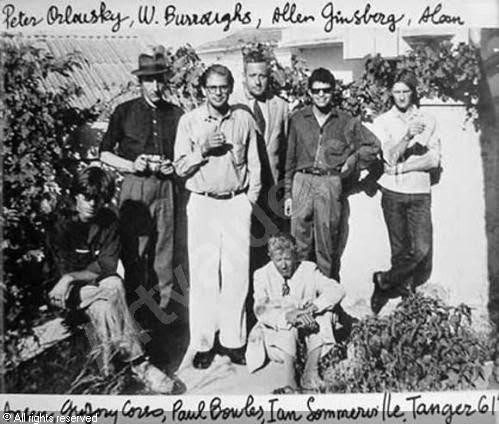
I didn’t get to see that band, unfortunately, but rather the 21st century version when, on three separate occasions, they played near me in CT, twice in New Haven, once in Hartford. The opportunity to hear Fripp play live should never be passed up. And so, for today’s song, I’ve chosen a live video of the Eighties Crimson performing “Sartori in Tangier” from the 1982 album Beat. I’ve always preferred that record to the more famous, because first of the new line-up, Discipline (1980). Beat takes its themes from “the Beat generation” writers—Kerouac and Ginsberg and Burroughs in particular—and 1982 was the time when I was most steeped in those writers, discovering most of their works in the early Eighties myself. So, there’s that.

About the title: Satori in Paris is a book by Kerouac, “satori” being a Buddhist idea: “awakening.” A key concept for the Beats as the standard-issue version of life is like being asleep and it takes some major epiphany to wake one up to the reality of being. Tangier was a notorious destination for the Beats, particularly Burroughs, and Ginsberg and Kerouac visited him there, in 1957, to help him get his manuscript of Naked Lunch into condition. The album prints the title as “Sartori in Tangier”—which is perhaps a misprint or perhaps a joke, as “sartori” might refer to choosing clothing appropriate to the region.

In any case, it’s an instrumental so I have nothing to say about its words, other than the title. On the video it’s great to watch Fripp play—though seated as usual, he actually moves around a bit. The sound he gets from his guitar is characteristic here. It’s that great, unmistakable treated sound of the guitar, using sustain in particular, to make that steady whine that sounds almost like shrieking, when he wants it to. Here it feels more ethereal, like a soul striving for the pure empyrean, with some Moroccan touches. Levin on Stick offers a great intro and interplay, and both Bruford and Belew are on drums. Bruford is probably my favorite of all the prog-rock drummers and that’s largely because of his ability to play so well with Fripp and his many time changes.

I still remember the article I first read on King Crimson in Circus magazine in 1973. I liked it because it made my mouth water for the album called In the Court of the Crimson King and intrigued me to hear In the Wake of Poseidon and Lizard and Islands. The new album, Larks’ Tongues, was the cause of the article but I wanted to hear the older albums first, and I did. I collected them all back then and I still find them intriguing, not only because Pete Sinfield wrote interesting, florid and memorable lyrics, but mainly because Robert Fripp’s idea of the guitar is so singular. His riffs on Bowie songs like “Heroes” and “Teenage Wildlife” are stand-outs to me, and, in general, his contribution is always notable.

Hats off to Mr. Fripp.