Showing posts with label Tarot Panels. Show all posts

Friday, February 18, 2022

THE TAROT TAPES, Side 2: XIX THE SUN

Ethos 2: XIX The Sun (2020) upper panel
The title of this one could be “waiting for the Sun God” in the sense that the Sun has associations with the Big One, the God of not only our Solar System but of the entire Universe. In other words, the primeval sense of the Sun as lording it over our world, controlling it—which was the case even when humans mistakenly believed that the Sun rotated around the Earth. The relation of the Earth to the Sun, however one positions them in the heavens, equates the Shining One with light, truth, godliness, and our planet of earth and water with a nature that might be able to be transcended but which seems doomed to just circle and spin for some indeterminate allotted time. Earth is existential, we might say. The Sun is too, of course, but we allow it to symbolize lots of things that aren’t if only because of the vast scale of its energy and the duration of its existence.

I know enough about Solar Myths to know that there’s good reason to write Christ into the mix, but I chose not to in my rendering for the panel. I went for deliberately pagan or classical, pre-Christian, and with a sense that the Sun God is a bit like Phoebus, a bit like Cupid, a brat we might say—you know, Phoebus Apollo killed the Python while still a baby and then became a seer. My feeling for the Sun God could be described as ambivalent, I guess, since the Sun, while it makes life possible on this planet, could also make life unbearable here, as it is—in my imagination anyway—in certain climes at certain times. I’m not a sun-worshipper, much, and so I wedded my Sun Child, rather enamored of looking at himself in a hand-mirror, with a desert wasteland, even as he sports with corn and sunflowers in his own little bubble. The “sun story” I got into as a kid, reading Greek myths, was of the son of Helios, Phaeton, who insisted his old man let him drive the sun chariot through the sky. Kid couldn’t handle the horses and the earth got badly scorched. Zeus had to knock the little jerk out of the sky with a lightning bolt.

Choosing songs for the panel’s tape side should be pretty simple. Search for all the songs with “sun” in the title and slap ‘em together in some semblance of order. Yup. But then, it’s the ordering of the examples that leap to mind that makes for our Sun saga. And two tracks don’t even have “sun” in the title, so the process may still be a bit associative . . .

Two songs on the side I’ve known since I was ten; my familiarity with most of the songs date from my teens, though there’s a key pair from my twenties and another pair from my forties, which is I guess a way of attesting that “the Sun” inspires a youthful disposition, or at least a cyclical view of nature acquired in youth—it comes up, it goes down; it’s summer, it’s winter, and so on. The listing is track # on the tape, title, artist, album it appeared on, date, composer, and, for the bio, the age (sometimes approximate) I was when I first heard the song, followed by the number of years, roughly, I’ve known the song as of this writing.

The point of the songs, often, is to ponder our relation to the Sun when we are most aware of its influence, whatever we may want it to mean. Here, in Ethos, it’s the sense of abundance, not of a Sun God who can do things to you—like Apollo often does—out of whim, but of a Good that just can’t help but shine and radiate and warm you up when you need it. As Nietzsche’s Zarathustra says, at the start of the Prologue, speaking to the Sun: “You great star, what would your happiness be had you not those for whom you shine?” He speaks to the Sun as, like him, overfull with wisdom and joy, spiritual goods which must be shared with the world. That sense of the Sun is needful, I’d say, for its part in the Ethos of the artist. Why make art at all if it’s not a question of sharing what talent dictates? The Sun, then, might be the god of that endeavor, the unchecked radiation that creates or makes vision possible. 

B. Ethos 2: XIX The Sun (May 2020)

B1 Waiting for the Sun—The Doors (Morrison Hotel, 1970; Jim Morrison) 18: 44 yrs
In the history of my listening, this song dates to the winter/spring of my first year after graduating high school. I was eighteen and working a dead-end, fast-food job. The spirit of this song—“at first flash of Eden we race down to the sea”—was one of those “consummation devoutly to be wished” situations. When it got warm, it would be possible to go to the beach. And one thing I associate with staying surfside is the prospect of getting up at dawn to watch the sun rise over the ocean. That, friends, is the basis of most of my poetic associations with the Sun. As Rimbaud says so well (even in translation): “It is recovered. What? Eternity, in the whirling light of the sun on the sea.” And, yes, it was in high school I learned he’d said that, thanks to Paul Schmidt’s recent translation. In my senior year, I became fascinated by The Doors though Jim Morrison had been dead seven years. Those first two Doors LPs seemed to promise something new in the possibility of rock poetry and I was all about that in those days (this was the era of Patti Smith’s first three LPs—which decidedly picked up on the myth of Morrison).

The third Doors LP is Waiting for the Sun, but with no title track. The song with that name appears somewhat belatedly on Morrison Hotel, their fifth studio LP and a much less stellar effort, though with some high points, this track being one. It’s the kind of song I easily transported myself into in those days, gripped by the idea that there should be these great liminal spaces, such as a beach at dawn, where transformation, if not transcendence, would be possible. I was deep into a book called The Transformative Vision and so this song kicks off my side on the Sun with a glimpse of . . . let’s call it situated symbolism. My situation at 18 was to believe in the power of the imagination as wielded by visionary poets, and there were a few such to be found, I believed, in contemporary songwriters. Which is why I’m inclined to compile tapes of songs as inspiration for paintings and to write about them.

And let’s not forget there’s always something dark about The Doors. They are not a feel-good band. “Waiting for you to come along / Waiting for you to tell me what went wrong.” That gesture towards the failed experiment of whatever all those newly released energies of the Sixties were supposed to mean was the take away for me in those days, all hepped up on Hunter Thompson and the Electric Kool-Aid Acid Test, A Season in Hell, and still chipping away at Gravity’s Rainbow. Suffice to say I want my Tarot side for The Sun to recall that promise of starting out but right at the outset I have to sound the belatedness of the entire endeavor. “Can you feel it, now that spring has come / That it’s time to live in the scattered sun?” That “scattered sun” said it well enough. Something not fully realized, piecemeal, cast to the wind. Pearls before swine?

B2 A Spoonful Weighs a Ton—The Flaming Lips (The Soft Bulletin, 1999; Wayne Coyne, Michael Ivins, Steven Drozd) 40: 22 yrs
Then we jump forward to one of the latest songs on the side, first heard live when my daughter, then starting college, and I sought out and heard the Flaming Lips on their tour for this LP. Actually we saw them first when Robyn Hitchcock opened for them, then sought them out on their own right and KDB got the record and then I heard it. The song is fit for inclusion on this side because of that great opening: “And though they were sad / They rescued everyone / They lifted up the sun / A spoonful weighs a ton.”

Following on The Doors’ “tell me what went wrong,” it’s not inappropriate to hear this, coming along at the turn of the century, as a kind of continuation of some of those energies unleashed by the bands of the Sixties, the ones that were still with me as ‘legacy’ handed on to my kid. The Flaming Lips, it seemed to me, had imbibed deeply of not a few of the same kinds of things that made their mark on my musical tastes and so this album was like the big pay-off. It had a Sixties-revisited feel but with a touch of post-punk prog—is how I imaged it. And that had great appeal for us, Dad and Daughter, generationally speaking. “The limits now were none,” “The doubters all were stunned.” Sure, why not. Total free license of the imagining, a Second Coming into consciousness (like when your kid goes off to art school because you didn’t, when you were her age).

When I was a kid in the Sixties it seemed that all of youth had access to a way of meaning that was lost on the elders. It was a flash of insight or spirit that could simply be the perennial gift of Youth or Sun, but which seemed caught up in so many things of that time, music not least. To me, the Lips here recall that “starting out” flame and, with its all-you-need-is Love gestures (“louder than a gun”) that have the peaceniks singing hosannahs, it’s like the same anew. Like the sun every morning, no? “A spoonful of sugar helps the medicine go down” we learned back there in Kiddom, but here a spoonful of sun sure do weigh a ton . . . like, as we’ll hear later on the LP (and in this series of tapes), it might be too heavy for even Superman to lift. But for now, no limits, doubters to the hindmost. The Sun is riz. We high priests & poets and musicking shamans figured out how to set it up there like a big special effect spectacle hanging over the birth of Lord Sunshine.

B3 Here Comes Sunshine—The Grateful Dead (Wake of the Flood, 1973; Jerry Garcia, Robert Hunter) 16: 46 yrs
And here he comes! The repeating motif on this side is that you wait for the sun, or lift it up maybe, and, it comes! It’s there! For real! End of night, darkness driven away again. And that’s what this song by the Dead makes me feel. It’s an early morning song, a just got up and got to make my way somewhere song, bleary and leery of what that might entail. But unbowed, nonchalant, as mellow about strict fate as only the Dead can be.

I remember with astounding sonic clarity putting this song on my turntable and listening as the sun lit up the church across the street and I watched out of the corner of my eye for the school bus I was a-waiting on the last day ever of my state-mandated education (June 1977), so glad to see it gone: “you just don’t have to go no more,” Jerry sings with the gleaming tingle of baptismal benediction. Go in peace, the mess is ended.

That line and the part about “good to know you got shoes to wear when you find the floor / why hold out for more” came to me as the mantras I needed since I had no job prospects, no employable skills or ever-ready credentials, and I’d had it with whatever the local suburbs unbroken of baleful New Castle could offer in the ways of culture, work, or vistas. But I did have shoes on my feet and I liked to walk, and so I’d saunter my way into some kind of inspiring frame of mind, if only the sun were kind. And here it comes, creeping up in that lyrical way this song has which always puts me in mind of the fact that there was a mix of LSD called “Sunshine” back in those days I was learning to recall fondly by proxy and the way that particular drug had of creeping up with tingling antennae stretched to receive was certainly part of the associative logic that binds together our first three oh so trippy bands. Have some “laughing water” while you’re at it. Justa giggling with those ticklish rays beamed on its grinning, fluid face.

B4 Silent Sunlight—Cat Stevens (Catch Bull at Four, 1972; Cat Stevens) 13: 49 yrs
This song goes further back. Cat Stevens was the romantic songwriter of the early Seventies when I was transitioning into early teens from adolescence. He had a great voice and a kind of spiritualized view of the times, as if a throwback to some pre-industrial era. I always thought of him as a medieval troubadour type, out of step with the modern world but still somehow a “pop star.” And that’s exactly the sort of possibility that inhabits the ethos of artistry, I’d say. You can be of it and apart, simultaneously.

The thematic tie-in of this song is that it speaks of the day beginning, the “silent sunlight” streaming in, and “the work I must now begin.” It’s a roll-up your sleeves and get to it song. But there’s also a lingering recall of the children who “wait to play”—like waiting for the sun, waiting to play is waiting for a kind of inspiration, as an artist might, but also for the permission or simply the right moment. To work, to play—to make them almost the same thing? Art. In any case that was my hope for art when I first heard that Siren Song pretty steadily during those years, when I was filling up notebooks with verse and trying to figure out how to use paints.

And this verse is as satisfying in its simplicity as a poem should be: “Sleepy horses, heave away / Lift your back to the golden hay / Don’t ever look behind at the work you’ve done / For your work has just begun / There’ll be the evening in the end / But till that time arrives / You can rest your eyes / And begin again.” Certainly I had no idea, then, that modern poetry was rarely as lyrical as that. What stayed with me was the injunction against the look back at the work. Keep going forward—every new day is a new beginning for whatever you’re trying to accomplish. What’s already been done is already gone.

Even now I can hear this song with some belief in that view, here in “the evening in the end.” True, looking back is often now a disbelief at how little was done—by me—and how much others accomplished, and not long after I first made this song’s acquaintance that sense of the enormous pastness of art and lit would start to become an issue. All the more reason to want to remember “When all things were tall / And our friends were small / And the world was new.”

B5 Here Comes the Sun—The Beatles (Abbey Road, 1969; George Harrison) 10: 52 yrs
The next song goes even further back in my trajectory: this song is from the the first full-length Beatles LP I heard, age 10, 1969. Abbey Road had that weird B Side of little songlets, but the lead-off song, Harrison’s, was the most hummable tune on the whole record, so genial and benign. It’s more Easy Listening than Rock, true, but no one then was going to tell The Beatles they couldn’t be mellow if they wanted to be, and this one—with that “sun, sun, sun, here it comes” choral bit—sounds like something for hippies to bond to. Sun Children, little darling.

The smiles returning to the faces, the ice melting—it’s not just a new day, it’s a new season. Spring, then summer, so not a song for all seasons but for the great anticipation of what it means when the sun comes back, the Sun God exerting his recurrent magic over the land. The song here takes its cue from the Cat in continuing with that feel of a long ago golden time. Sure, it’s childhood, for me, not even a teen yet, but it’s also that sense of a time when simple pleasures—the sun’s back, it’s warm again—were enough to make life worthwhile. “First flash of Eden,” and all that.

It was also something to realize—when I got a copy of the album in the later ‘70s—that there’s a synthesizer on this track, which aligned the song with those arrangements I loved so much in the prog years featuring acoustic and electronic instrumentation together. Like the stately piano on Cat Stevens’ track, the tinkly fingering on the guitar here ushers us into some kind of Sun Kingdom where all is golden and so, our next track . . .

B6 Golden Years—David Bowie (Station to Station, 1976; David Bowie) 16: 46 yrs
“Don’t let me hear you say life’s taking you nowhere, angel.” That opening line, the song’s syncopation, Bowie singing tracked with himself, that “run for the shadows” chorus. “Never look back, walk tall, act fine.” This song is—to borrow a phrase from the film The Missouri Breaks (also 1976)—“slicker than snot on a doorknob.” Hard to believe maybe that anyone thought 1976 and the next few years “golden years” but if you were a denizen of the discoing demimonde, you’d say Oh Yeah. Bowie’s stepping out, his pants pleated, his hair slicked back, his moves and his moue all moussed with liquid strains.

A relevant question here:  if you were Dylan and you’d done the run of records from 1965 to 1967 . . . then what? And Bowie had already roped us teen-types in with Ziggy and Aladdin and “Rebel, Rebel,” now what? Coke it up and cut a rug? Sheesh. Anyway, the song is Dave’s second bona fide U.S. radio hit in a row (“Fame” made #1; this one #10). He’s hitting the stride of sounding like the radio likes. But I’m with him on this one—though, at the time, I gave the Young Americans LP a skip. I’ll accept a blues belter going white soul, but folky hippy glam guys, no so much. But the sea change often throws up unexpected creatures and the LP Station to Station is like that. It’s a sound I go back to often in these days of posthumous Bowie.

So, celebrate the golden years, however you imagine them, whenever they may be. “Act fine”—it may be all an act but that’s what makes it golden, n’est pas? It’s your performance for the statuette. “In the back of a dream car twenty foot long,” like every just-so starlet, “I’m begging you save her little soul.” Well, yes, “nights are warm and the days are young” but how long can that last? About the time you have to run for the shadows is when maybe you suspect a deal with the devil (“opening doors and pulling some strings”)—and he’s up there waiting in our five panels for Ethos. “Lost that’s all.”

Halfway through the side and we’re remembering the request: “waiting for you to tell me what went wrong.” Or, what we did wrong?

B7 Look into the Sun—Jethro Tull (Stand Up, 1969; Ian Anderson) 18: 44 yrs
As the second half of the tape gets underway, we hit this little trade-off quartet: song from the Sixties (first heard as a teen) then song from the ‘80s, when I’m in my twenties. One-two, one-two. Makes for a a nice “step forward, step back” rhythm as we move along here: like saying we’ve gone from watching the sun rise to seeing it hit its stride, and now we know it’s bound to be on the wane. The songs themselves play into that dynamic in interesting ways as well, and none of them are “big songs” (in terms of radio play) for the artists involved.

This track from Jethro Tull’s 2nd LP was already a throwback when I got to know it, post-high school in the late ‘70s. For me, Tull as a big influence came to its fullest fruition in 1972 with the release of Thick as a Brick and the retrospective collection Living in the Past. Then, brought up to speed more or less (including a purchase of Benefit, the LP immediately preceding Aqualung), I was primed for A Passion Play (still my favorite), summer of ’73, then the War Child tour when I saw them live. After which their releases were less appealing and I’d moved on. Anyway, years later I picked up Stand Up with a sense of wanting to complete the collection (acknowledging that point when the new stuff isn’t as good as the old stuff … or just more of that Sixties fetishism which was looming large in my legend around then).

The song is an Ian Anderson love song (not too many of them in my Tull), and what’s more it’s an end of love song, which Dylan is great at (like “Don’t Think Twice, It’s Alright”) and so the tone of this has immediate appeal. But it’s on this side because of that “think of all the things you should’ve done” when you “look into the sun.” Of course, we were always told not to look directly at the sun and to do that means a certain risk, and here a willingness to face the truth (always risky). So it’s not what we did wrong . . . it’s what we didn’t do that we should’ve. We’re still on that theme, but we’re also basking in a sound—back when Ian was mellow with more of that stately troubadour vibe—and a feeling that whether she should’ve stayed with him or not (“remember who and what you nearly had” recalls another Beatles sun song, “I’ll Follow the Sun”—“you’ll know I was the one”), we shoulda stayed back there pre-teen in the world of the Beatles and a certain golden late post-war, pre-recession time.

The “golden years” are passing away from me at the ripe old age of 18 is what I’m getting at. But then—and this was the feeling the song gave me when I first heard it, around the same time as “Waiting for the Sun”—“summer always comes anyway.” Seasons change then change back. Is anything really over? So let’s set out again at dawn—as Rimbaud does at the close of his season in hell.

B8 I Remember the Sun—XTC (The Big Express, 1984; Colin Moulding) 25: 37 yrs
Now time for a retrospective glimpse of the sun. Fitting, since I acquired this song when I was back to living in my hometown not far from my parents’ house and the schools I attended, even the church, and all that pastness hovered in the background of the present. To think back to “days when we had enormous super powers” was easy to do, since the places where I’d play-acted as a superhero with my kid brothers were nearby. “When I remember days at school, most of all I remember the sun.” Whether that’s true or not, Colin Moulding made it so. I can recall, indeed, days in the last stretch of the schoolyear, May, early June, and walking home in the sun. And walking the streets barefoot as a child—“tarmac on the road feels soft”—yeah, and very, very hot.

So this is a song about the sun when we were kids, about that period of starting out that took place even earlier than the teens. This, from an album by these New Wave British guys pushing 30, played into where I was then as well. My kid still in the midst of her untrammeled childhood (a year before kindergarten) and all’s right with the world or at least it’s a time to revisit what childhood is like through the lens furnished by my own starchild.

The song has an odd, lurching sound, and effects that make it aurally interesting but also a bit off-putting, especially that weird climb into what are essential lyrics, but hard to get: “Sun that worked on overtime / Fueled our bodies, kindled fire in our minds”—yes, that “kindled” mind was already suggested by “I thought a page like it’s written in ink.” That was part of my childhood and early adolescence too, making things up, inventing, composing internally, and so, what the Sun is starting to become is a way of suggesting the Inner Light, the shining inside, the burning beacon of the Imagination. It pays to remember that, I want to say, want to believe—but “pays” how, exactly?

B9 Set the Controls for the Heart of the Sun—Pink Floyd (A Saucerful of Secrets, 1968; Roger Waters) 14: 48 yrs
I might say this song is the heart of this side. It’s not a particularly “sunny” song, but it fulfills on that idea of “the Sun” as being both a center of the personal universe, so to speak, and the celestial body that centers our solar system. The conflation of the two spaces—interstellar and inner—is the “trip” of this song.

Pink Floyd are one of the trippiest bands ever, having pioneered a form of rock that can indeed rock but which is more often spacey and eerie and introspective and even pastoral at times. Here, it’s at its eeriest and, the first time I heard this song (which was in the summer after the release of Dark Side of the Moon), it fascinated and hypnotized me. It’s not that long but it seems like it could go on forever—like how long would it take to reach (in Waters’ whisper) “the heart of the sun, the heart of the sun, the heart of the sun”?

The drum pattern and that little melody that sounds in some odd way primeval is what does it (like we stumbled onto a tribe of sun-worshippers). The overlay of electronic sounds is in keeping with the Floyd as masters of a certain kind of tech that, in those days, was often called futuristic, as in: that time when acoustic instruments played by people would be replaced by electronic instruments played by computers. And onstage during this song the band would walk off leaving Nick Mason, the drummer, to be the human playing with pre-set sound arrangements. Of course the drum pattern could be programmed too and free up everyone. Just “set the controls” and head backstage. There’s a nice irony to it but also a sense that we’re already in that future where gadgetry prevails and yet, this song is very humanistic: “love is the shadow which ripens the wine.” Well, I guess.

The point is that the song, with its man who raves and makes a question to heaven, is one of those “alone with the universe” situations and the last lines of the last verse sound that note I began this post with: “Whether the sun will fall in the evening / Will he remember the lesson of giving?” That lesson of the Sun as simply the heavenly body that can’t help but light our world, giving us all we need in the way of a livable environment, is the abundance I was talking about. And knowing that we have this “wheel of fortune” thing going where we have to turn away from that light and warmth along a definite track of time, so it “falls” in the evening and we plunge into darkness, is one of those “awareness of mortality” things that should keep us humble and human.

In that light, a journey to “the heart of the sun” (besides suicidal, a real flame-out that even Phaeton didn’t attempt) is a journey to where the sun never sets. Kennst du das Land?

B10 Invisible Sun—The Police (The Ghost in the Machine, 1981; Sting) 22: 40 yrs
And so, though we turn from the sun on our planetary journey, the sun continues on—invisible, as in this song, which did get some airplay (it was a single from the LP Ghost in the Machine elsewhere but not in the U.S.). The Police were pretty much an unavoidable radio staple in those days and so I rarely bothered to buy their records—you couldn’t help hearing them, but this album I got and maybe it was because this song wasn’t available otherwise. I’ve only just now seen the video for it, all centered on Belfast and the conditions there, and the song begins with a reference—the Armalite rifle—that is relevant to those scenes. I seem to recall the sense, hearing the song on the radio, that it had an occasion—a place with a definitely hostile military presence—but I don’t think I thought of it in terms of a specific locality.

As with many songs by The Clash that I was getting to know in the 1980-82 era, the mood of truculent endurance here was key. “They” were the ones with the guns and the numbers, “we” were the ones trying to get by and doing what we could to make things better for the innocent and the oppressed. And that—not a particular political underground—was the “invisible sun,” the local and anonymous and not widely publicized acts of kindness and collective hope. The song makes its case with a sense of sullen survival, with a couplet that’s one of its best: “I face the day with my head caved in / Looking like something that the cat brought in.” That resonated with a life on the margins, sure enough, along with the line that reached out of the radio and grabbed me: “I don’t ever want to play the part / of a statistic on a government chart.”

The invisible sun is unfelt in its effects? In any case, it can’t be measured by that always intrusive government that wants to know where you live and how much you make and how much energy you use and who your friends are and their known occupations. There’s a sense too that the sun that burns on, invisibly, giving us “hope when the whole day’s done” is, like the sun whose heart we want to reach in the Pink Floyd song, already within us, y’know, like Jesus’s claim about the kingdom of God.

B11 That Lucky Old Sun—Johnny Cash (American III: Solitary Man, 2000; Haven Gillespie, Beasley Smith) 41: 21 yrs
And that should count as a segue into this gospelly worksong that dates from 1949. I first heard it, I think, done live by Dylan in one of his acoustic sets in the 1990s. Johnny Cash, as with so many songs he recorded with Rick Rubin for the American label, takes it away and makes it his own. As far as this side goes, it just popped into my head, perhaps conjured up by the ’60s-’80s trade-off I had going: had to jump clear of the clockwork and land . . . way up there in the dawning 21st century. It’s a song that spoke to the times in the sense that I was just beginning my forties and so had “paid my dues” in a sense. Now wanting to “roll around heaven all day” rather than toil to get somewhere.

It's a view that sees the Sun as blessed, a kind of detached and blissful body on its appointed circuit. Rather than talk about its abundance and all it does for us down here on the ground, the singer sees it as “lucky” because it’s got “nothin’ to do.” It’s the way you feel about the weekend, maybe, when you’re in the middle of the week, or summer vacation when you’re a kid stuck in the doldrums of school, or a wage-slaver looking on at the retirees who have finally attained that “paradise” imagined as the cessation of striving. All of which is a way of saying that the song appears here as the notion of the Sun as above it all, out of the give-and-take and the ups and downs, stuck only in its circuit and lucky not to have to sweat about it.

Cash, in his late sixties when he recorded this, sings it with a somewhat mournful sound in his fervent wish, particularly the plaintive “lift me . . . to paradise,” which sounds like the prayer of a man who hopes, to borrow Dylan’s line, “to get to heaven before they close the door.” In any case, we believe in the hardship of the life and the glance upward to the Sun as the symbol of an extraterrestrial serenity and fixity. Amen.

B12 Sunrise—Uriah Heep (The Magician’s Birthday, 1972; Ken Hensley) 13: 49 yrs
Now, back to those teen years again, a time when “the Sun,” to me, was the bright light shed by the literary works I was reading, mostly on my own dime (as in: unassigned). It was so early in my setting out, I hadn’t yet reverted to the ’60s’ greats as the beacons to embody, but was still enamored of hard rock and, soon, prog. Uriah Heep had its place in both those scenes, and they even took their name from the villain in my favorite Dickens novel, which I’d already read.

The album of the Heep for me was Demons and Wizards (which will have its day soon enough, as we’re moving toward a Magician and the Devil), but this album, the follow-up, kicked off with this song and this song was almost as good as anything on the predecessor. “So from now till who knows when / My sword will be my pen.” Yeah! Just the thing for a teen poet to hear, at a considerable decibel level.

That comes late though: in the beginning it’s a love-lost song, where the sunrise shines on “another day without you.” So, yeah, pining for the great love, the one who makes it all ok, little darling, angel, remember who and what you nearly had, love to ripen the vine . . . and then the singer addresses the sun directly: “Bless my eyes / Catch my soul / Make me whole again.”

That puts the Sun in the guise of the Listener, the Mentor, the Great One who must shine on this endeavor, must countenance this effort to shine in a merely human way. So that the “and I’ll love you for all of my time” isn’t, finally, that lost lover with which we began, but the Sun itself. From now on out, singing its praises. The lucky orb, a crown as big as the circumference of the Sun.

B13 The Sun King—The Beatles (Abbey Road, 1969; John Lennon, Paul McCartney) 10: 52 yrs
But there’s still room left on the tape, just enough for this little mini-ditty from John Lennon, reprising the “here comes the sun” lyric from his bandmate George but with a twist: “here / comes / the sun … king.” The Sun King, of course, was Louis XIV of France, but I doubt that’s a meaningful reference, particularly. In any case, on this side, the song features as a coda—to reference the Sun as a King—and to recall, again, my childhood at the end of the Sixties, and the time spent with Beatles recordings as a kind of magic synthesis of the era itself. “Everybody’s happy, everybody’s laughing.” We’re still happy children on that Yellow Submarine, with beautiful overlapping voices and a feeling of dolce far niente, cheerily singing what sound like nonsense syllables but which actually bring together phrases from various languages to create a bit of Joycean polyglot. Questo obrigado, no?

Friday, December 31, 2021

THE TAROT TAPES, Side 1: 0 THE FOOL

Near the end of Fearful Symmetry, Northrop Frye’s book on William Blake (which I finished reading in December 2020, before beginning the second group of Tarot panels), I came upon this reflection:

“Blake … seems to be striving for an ‘alphabet of forms,’ a Tarot pack of pictorial visions which box the entire compass of the imagination in an orderly sequence. The alphabet itself, if we may do some imaginative guessing, may be a fossil of some such work of art, the Zodiacal signs another, and the Tarot pack (with which [Blake’s] Job series has been associated) a third.”

I got a kick out of that, certainly, because some such intuition was the basis of me picking up a book on Blake (and not just anyone’s, but Frye’s—the master of the “anagogic method”) and beginning some readings in Blake at the start of my consideration of the Tarot panels. Indeed, the idea of an “alphabet of forms,” or a series of pictorial visions, is the driving force behind the Tarot panels and the example of Blake as a poet, artist and visionary is at least provocative. My earliest reading of any of his verses was probably around 15, and I remember time spent with the Viking Portable Blake at 19. But there was little in-depth exposure to his work, mainly because of the alien mythography at work in his writings and art. I didn’t pursue the English Romantics in college, and in graduate school improved my familiarity with Wordsworth and Keats, but that was about it. There was a semester at Yale, in the 2000s, when I sat in on a seminar that took up Blake among the other Romantics and it was there I first saw an image that I’ve recalled in the fourth Tarot panel for Ethos, XV: The Devil. So let’s say there’s some debt to Blake somewhere in the deep background, but even more so in trying to imagine “illustrations” for the Tarot figures.

But that’s the panels, as an ongoing visual art project. Accompanying each panel is a cassette tape’s worth of songs, a 45-minute playlist that assembles itself in the process of transferring the tracks from vinyl or CD onto tape, but which may be prepared for by any number of list-making sessions to see which songs most readily suggest themselves as part of the tone, mood, or theme of the Card. And I should point out that I think of the Tarot as a complex system of playing cards, and I have done readings to see what a lay-out of cards “says.” For the purposes of the panels, though, which are not cards and not meant to be used as anything more than paintings, an “alphabet of forms” is apt enough since the cards, in my decision to break them up into four different groups, do “spell out” an associative logic. And associative logic is the key to how playlists form, aural illustrations of “the spirit” the panel is aiming for.

The first group is Ethos, which is to say, based in character and upbringing, in the kind of collective rationales for behavior that mark anyone’s Bildung, but which, in terms of artistry, can also create a dichotomy between the individual person (in this case, me) and the symbolic conditions of art . . . or the artistic realization of symbols. However you put it, Ethos keeps in mind that the person who is aiming at art is forming an ethos that differs to some degree—and maybe in kind—from other practices, such as those primarily concerned with getting along with others and performing the tasks of non-artistic activities. The onus of an artist’s Ethos, simply put, is self-realization, in no matter what forms that takes. So, for me, the five Cards grouped under Ethos are the five I recognize as the most germane to my sense of what an artist is.

Tape I

A. Ethos 1 (center panel): 0 The Fool (April-May 2020)

Track A1: “The Fool”—Camper van Beethoven (Our Beloved Revolutionary Sweetheart, 1988; David Lowery, Jonathan Segel, Greg Lisher, Victor Krummenacher, Chris Pedersen)
This instrumental track from my favorite Camper van Beethoven album could be said to be the “curtain’s up” on the entire tape, maybe the entire series of tapes. I don’t know why the song is called “The Fool,” but I’d be willing to bet it has something to do with the Tarot card, though it might also be a reference to a 60s psychedelic band of that name (elsewhere on the album is a cover of “O Death,” the Dock Boggs song also covered by a 60s psychedelic band, Kaleidoscope). The late ‘80s, twenty years on from the height of psychedelia, found more than a little inspiration in the artists of that earlier period.

Camper van Beethoven, with that joke name, are suitable to start things off on our Fool’s terrain, certainly, being a fairly whimsical and comical band, heroes of the “indie” or “alternative” world of college radio rock from the 1980s. The ‘80s, in my view, have much to answer for, but the good side of it all was the number of bands who were never in any danger of becoming monster artists of the inescapable mainstream airplay variety, but would always be a bit of caviar to the general. It was a time rife with subcultures, and why not tip my hand at the start, as part of the appeal of “The Fool” is that very willingness to pursue a quixotic goal, to be an adept of an unknown practice, to prefer the cult or coterie offering. The cards themselves, no matter how popular or ubiquitous, will always be a bit esoteric by the standards of world-wide religions and symbolic systems.

The track sounds like a movie theme, almost, or at least a soundtrack for a kind of carnivalesque sequence. Sort of eastern European, ‘80s gypsies feel. Brash, with a certain Old World charm that’s seductive in its own way. No fooling.

Track A2: “The Fool on the Hill”—The Beatles (Magical Mystery Tour, 1967; John Lennon, Paul McCartney)
Most of the songs on these playlists will date from the era long since designated as “classic rock,” and this song was already a classic when I finally got around to acquiring Beatles albums in the late 1970s. And yet I do remember when it was on the radio—there were several covers of it, as I recall, not least by Sergio Mendes and Brazil ’66—and on the Beatles cartoon TV show. It may well be my first cognizance of a use of “the Fool” in a way that seems properly capitalized. Not “a fool”—as in some stooge or dunce—on the hill, but “the Fool,” as, for instance, a character you could meet (and I did by around 1974) in King Lear. Of course, the phrase could also simply be pointing out a particular fool—the one on the hill as opposed to the one in the meadow, or next door, or in the White House (the sense of a political fool suggested perhaps by “the man of a thousand voices” whom no one hears, “they can tell what he wants to do.”)

In any case, as sung with his characteristic twee-ness by Paul McCartney, the song struck me—as a child and later—as oddly ruminative. You know, the mid-late ‘60s period was when McC was apt to come up with weird little ditties of dysfunction like “Eleanor Rigby” and “Penny Lane.” This song is somewhere in between, not as dolorous as Rigby nor as jaunty as Penny but detached. The contrast is between the Fool—who sees the sun going down and the world spinning ‘round—and the people who don’t like him. He doesn’t care because “he knows that they’re the fool.”

So at the outset we get what will be a theme to this side: the Fool who knows he’s considered a fool (as in idiotic or silly), but who takes that in stride because maybe he knows something “They” don’t know. The Beatles, with their madcap, antic natures—as a collective—captured well the nature of the Fool as someone who is wise in his own way. McCartney has claimed—so Wikipedia tells me—influence from The Fool (the band mentioned above which was also a design collective) and from the Maharishi Yogi, who may or may not have had a laugh on our nirvana-seeking Brit tunesmiths.

Track A3: “Fearless”—Pink Floyd (Meddle, 1971; David Gilmour, Roger Waters)
Now that the Beatles have provided us with both a fool and a hill, we will take it to the next step. Here someone, who may be seen as something of a fool by the crowd, is challenged to climb a hill—which he’ll do “in my own time.” Like: when I’m good and ready. The notion of climbing a hill becomes a theme, and there’s also an element of tempting fate or of relying on God, or of, God knows, trying to achieve some particular facet of selfhood or even to attain . . . the ultimate Self. Which, I just want to say at the outset, may in fact be a Supreme Fiction.

You can see how well Gilmour and Waters feed into our topic (and it would not surprise me to learn that they might have had some memory of “The Fool on the Hill” floating in the background when they wrote the song’s lyrics). From “Fearlessly, the idiot faced the crowd” to “And who’s the fool who wears the crown?” we know we’re in the world of trying to judge between “the idiot” who may be a wiseman, and the earthly authority who may in fact be a fool. And with that bit about “Go down in your own way,” how could I hear this song, when I got around to this album in 1974, gripped by my earliest reading of Thus Spoke Zarathustra, as not sharing some of the spirit of Nietzsche’s opening, where Zarathustra decides to go down from the mountain and back to the people? And the first thing he encounters is a crowd watching a tightrope walker, who falls to his death when a Fool comes onto the wire and leaps over him.

“Fearless” ends with the interpolation of “You’ll Never Walk Alone” as sung by a crowd at a football match in England. Apparently that song, which I associate with Jerry Lewis telethons, is often sung at such sites of collective outpourings of belonging. According to Wikipedia, the song, in 2020, was put at the service of tribute to the sacrifice and dedication of the frontline workers facing the COVID-19 pandemic. So, all the more appropriate for my Fool, painted in April/May 2020, while lockdowns were general. He’s walking off a cliff, though, so is, indeed, walking alone. Except that maybe, just maybe, we’re all going off the cliff with him.

Track A4: “Up the Hill Backwards”—David Bowie (Scary Monsters, 1980; David Bowie)
This song is not even one of the best tracks on this great album which I bought immediately upon its release in 1980 because of “Ashes to Ashes.” “Up the Hill” appears here because of that hill and because of its key line: “It’s got nothing to do with you, if one can grasp it.” Could be a reference to that plummeting Fool (“witnesses falling”), could be a reference to the hundreds of thousands of deaths due to COVID-19, or even to any eventual extinction that may be awaiting mankind, to say nothing of whatever shibboleths of social justice are currently on crusade. Quietism? Perhaps, but it’s more—in the context of our theme of a crowd misjudging a “fool”—about the fact that “I’m OK, you’re so-so.” All y’all.

In other words, it’s a wonderfully insouciant song, full of casual aplomb. And what we might call a survivor’s attitude. “While we sleep they go to work / We’re legally crippled, it’s the death of love.” Hard not to think of those who have to go struggle in Covidville while others get to be at home in their legally crippled privilege. Death of love—what do you call it when sacrifice goes awry? Or when love has to be proved by deaths? When you get to a certain age, the grim reaper is waiting in the wings, so why not ignore the struggle of others to stay alive and concentrate on what you might make of the time you’ve got?

Me, I’m just a painting fool for the time being, stirred by “the arrival of freedom and the possibilities it seems to offer.” For one thing, a shrug directed at all the things I’d otherwise be doing if not trapped at home. And climbing the hill “in my own way,” didn’t someone say? How about backwards? Here being a good place to pile up that detritus that Walter Benjamin imagines Klee’s Angel of History looking back at as he is blown into the future, which is bound to be an uphill course. Unless in fact it’s all downhill from here. As our plummeting Fool is no doubt about to find out, the hard way.

Track A5: “Po’ Boy”—Bob Dylan (“Love and Theft”, 2001; Bob Dylan)
I have to say that when I first thought of compiling mixtapes for the Tarot cards, I went through picking a Dylan song for each card, and I also played the same matching game with The Beatles. For probably obvious reasons, those two musical acts set much of the tone for what my record/CD collection became, and these playlists come from that collection. This “late period” Dylan track (the 21st century, for me, is “late,” as middle-age and after) continues the insouciance of “Up the Hill Backwards” but now things get positively jokey as Bob indulges in some one liners, a knock-knock joke, and conjures a Po’ Boy (not the sandwich but a kind of wise-guy rube).

That element of jokester/jester/comic gets picked up in some later songs on the side, and this is its first sounding. The Fool has to master a certain self-deprecation, playing for laughs. My list of favorite comics would include Groucho Marx, the troupe of Monty Python, Bill Murray, in many of his roles, but my sense of comic hijinks in song begins with The Smothers Brothers and Allen Sherman, both gifted with altering song lyrics for laughs, a knack I’ve indulged on occasion. Dylan here is riffing on that kind of thing, it seems to me. He could play the “poor boy” straight, as an underdog of the underclass, but instead he gives him the gift of absurdity, which is one of the great strengths to have in this world.

And that is what I’d say is the dominant sense of this side: a willingness to risk the absurd, to do things for no particular reason, to be a fool to one’s own vanity or ambition or desire or attachments, but also to laugh at one’s absurd effort to overcome such limitations, as though there is a Big Pay-Off waiting for the Fool on the hill, or the Fool climbing the hill, backwards and probably sticking his tongue out. Is the most foolish line in the song “things’ll be alright by and by”? You decide. “I already tol’ ya, won’t tell ya again.”

Track A6: “Ship of Fools”—John Cale (Fear, 1974; John Cale)
The Ship of Fools (Die Narrenschiff) by Sebastian Brant dates from the fifteenth century, in German; in an introduction to that work, in English, its translator, Edwin Zeydel, attributes to Brant the notion that “all sins are reducible to forms of folly.” But maybe it’s the sins that are expandable into acts of folly; which is to say “sin” could be a lesser idea than “folly” or greater. Zeydel, and Brant, go for sin as greater, but I wonder. It may be that the inclination to sin is, in itself, folly, making folly the force that drives the wheel, so to speak. Brant created a work in which a wide variety of follies are depicted, some of which—like avarice or gluttony—do get called ‘sins’ as well. In any case, the idea of a group of ne’er-do-wells aboard a ship bound for disaster—a ship of fools—sticks. So much so, that there are two songs on this side with that title.

In John Cale’s version, the ship of fools almost sounds like a collective of worthies—I think of Chaucer’s pilgrims on their trek to Canterbury. “The ship of fools was sent / to make sure we all got home for Christmas.” Not a bad thing, I take it. But the opening, with its weary request “take me off I’ve got to eat” and reference to “the same old story, the same old thing,” makes the ship seem not so much foolish as boring. And Cale’s tune is bright, with those tinkling sounds—a celeste?—that give the whole a stately air, full of a lighthearted dignity. And the goings-on are comic book style—“we picked up Dracula in Memphis / It was just about the break of day”; and there are ominous bits of detail: “a black book, a grappling hook, a hangman’s noose from a burnt-out tree—guess we must be getting close to Tombstone” (one of my favorite sequences in all of Cale’s oeuvre). The whole lyric feels like a fantasy of traveling through America, with a wish, for fisherman, that they “could sail from Tennessee to Arizona” (making the heartland not “flyover States” so much as “sail over”). In the end, Cale brings it all back home to his native Wales—in fact, his hometown, Garnant, gets a shout-out—and, in general, I think of this song as giving us a positive sense of the Ship of Fools.

And that’s important because the jokiness that came aboard with Dylan, and that “in my own way” theme, from Floyd, and the “they’re the fool” and “it’s got nothing to do with you” views, all come together now to give us a glimpse, maybe, of fools who are glad to be sailing away from the world where everyone else resides, whether content or contentious. And when we do get back “all the people seemed quite glad to see us.” Maybe that’s foolish on their part: to be glad to welcome a ship of fools. As the sixth song of twelve, Cale’s “Ship” ends the first half of the tape on an up note—the song’s mood, to me, feels like early spring, the season of Aries (and of All Fool’s Day), and is lively if also somewhat haunted by “something in the air that made us kind of weary.”

Track A7: “Running Up That Hill”—Kate Bush (Hounds of Love, 1985; Kate Bush)
With Kate Bush’s opening track from probably her greatest album we sound another take on “that hill.” Kate’s singer wants to be running up that hill “with no problems” and as the reward or punishment of a “deal with God.” The key idea here—since the singer is addressing a “you”—is that the deal with God would let the singer and the “you” swap places, so they could “exchange the experience.” Like, the only way to understand someone is to become that someone and vice versa. Like all those movies from the 1980s in which a parent and a child exchanged places. Presto: a pre-glimpse of maturity, and what it requires, and a reminder of immaturity, and why it works.

But in typical idiosyncratic fashion, I rarely listened to the song as a way of swapping viewpoints with some difficult personage in one’s life but rather a deal to swap places with God, thus making that climb wholly unimpeded by human foibles and concerns and failings. It would be a climbing that would be utterly transcendent, we might say. That is the aspect of the song that feeds into this tape because, while the Fool is on his way down, the eventual appearance of the Wheel of Fortune—way up ahead there in the 11th place of this schema—means he’ll also be on his way up, eventually. And the Fool, in shedding the limited perspectives of all those wise guys who think the things of the world are where it’s at, is transcendence writ small and humble and simply—as we’ll see with a few songs showing up soon—getting by by his wits.

Kate Bush’s song is propulsive and features a great rhythm track, something the 1980s were pretty good at, creating rhythm tracks which can sort of stand alone and be wedded to songs as one chooses. It’s a kind of autonomy, the rhythm that rules, and that’s important here because I feel certain that—whether as oneself or as God—the hill compels one to climb it, the propulsive rhythm of life will have it so, much as the great Wheel must spin and the earth must spin as it circles the Sun (which is coming up next). Much here lies with Kate’s repeated “if I only could / be running up that hill.” Like a Sisyphus fated to run up the hill forever and never have to come down when his big rock does. A running, climbing fool, and no mistake.

Track A8: “Fool’s Gold”—Graham Parker & the Rumour (Heat Treatment, 1976; Graham Parker)
But what’s such a fool after? Graham Parker, with his usual surly view of the mass of humanity, clues us in a bit: the search itself makes the fool a fool. He’s after “fool’s gold,” which can be read as any possibly fictive or chimerical goal, something others—more sensible—would decry. And here I have to say that I’m maybe not fool enough myself to share the vision fully. I can see the transcendent view—climbing forever—but not the notion that there is something—physical, tangible—that can answer the seeker with a definitive status of “found.” Thus my favorite part of Parker’s song is “people say heaven knows heaven knows heaven knows / see what comes I suppose.” Yeah, if it’s good enough it will be worth the search . . .  I suppose. “Well, well the event” as someone says rather testily in Lear.

As an expression both of the limit of judgment and an exasperation with explanatory comments, my mother was fond of saying “heaven knows” (and it appears in the title of one of my dad’s favorite movies, Heaven Knows, Mr. Allison), so that may be one reason that line resonates for me—with its repetitions—but it also falls into line with the notion of a “deal with God.” Meaning that there might be a perspective—from heaven’s view or God’s eye—that sees the search fulfilled. Like: you gained the goal, Fool, and just didn’t know it. But heaven knows. That’s a strong fulfillment, but it’s also quite possible that the search is the goal, in some Zen-like way, Grasshopper. Like climbing that hill, backwards, in your own time, the search is your fate and your folly, one and the same for any good fool.

Parker is a blustery singer and I like the way he handles this lyric, giving it his White Soul all. It starts quiet and ruminative but with heaps of passion surging again and again, and I always listen for him getting worked up in the fade, “and in the deep blue sea,” which is a nice segue to our next track, another “ship” on the sea, helmed by fools en route to disaster.

Track A9: “Ship of Fools”—The Grateful Dead (From the Mars Hotel, 1974; Jerry Garcia, Robert Hunter)
With this track—our second “Ship of Fools”—we can say that we’re entering the non-transcendent portion of the tape. The three tracks after the Dead are about jokers—not, perhaps, fools outright, but they do bring into question the interplay between fools—in the more spiritual sense we’ve been working up—and jesters, those who simply use levity to amuse or undermine or, maybe, enlighten. Lear’s Fool is a good case in point because he does want his jokes to “land” in such a way that Lear will perceive his own folly, but, because he’s a jester, he can allow that he’s just “fooling.” But before we get to our jesters, let’s give Robert Hunter’s lyrics their due.

This is one of those slow, mellow Garcia tunes, the kind that usually means he’s pondering big questions, trying to find a form for Hunter’s more searching lyrics. Here, the perspective is of a young man (thirty years upon his head . . . it’s when that Baby Boomer generation born in the early to mid ‘40s, hit their 30s, in the 1970s, a pretty dysfunctional time) who has had enough with the powers that be. The world, as conducted by these stalwarts, is a ship of fools, doomed. I’ve long aligned the song with the “non serviam” of Joyce’s Stephen Dedalus, particularly in those lines: “though I could not caution all, I still might warn a few / don’t lend your hand to raise no flag atop no ship of fools.” Here again we might see quietism more than activism—we’re being told what not to do, not what to do—but that caution suits the situation, perhaps. We’re not sinking yet, in 1974, so maybe it’s enough to NOT get caught up in the actions that are leading many fools to their flag-waving perdition.

And anyway the opening of the song is more aggressive: “I would slave to learn a way to sink your ship of fools.” That’s pretty emphatic, like—in “Candyman”—when usually docile Jerry muses that “if I had me a shotgun I would blow you straight to hell.” Sentiments like that are what give the lie to what is too often perceived as laid-back, hippie bliss-out as the dominant mood of the Dead. This song is not only bemused, it’s mournful and maybe ready to get serious. At any rate, the singer “cannot share your laughter.”

And that line can stand as the thin end of the wedge here. Since, in the fool/jester’s province, it’s all for laughs. Which is a way of saying, as Hamlet does, “why, what should a man do but be merry?” He asks that, of course, with all the sarcasm he can give voice to, being neither merry nor assured that there is any action—not even those a man might play—that is of any use . . . not even laughter. And if that’s so, we’re fucked.

So, before our ultimate demise, let’s have a few laughs with some jokers ready in the wings.

Track A10: “Man on the Moon”—R.E.M. (Automatic for the People, 1992; Bill Berry, Peter Buck, Mike Mills, Michael Stipe)
Michael Stipe’s lyrics for R.E.M.’s “Man on the Moon” directly reference comedian Andy Kaufman and a few of his comic routines—from “goofing on Elvis” to playing Twister live on national television with volunteers from the audience to the “breakfast mess” with pro-wrestler Fred Blassie—and the whole song has a kind of quizzical, quixotic vibe, signaled in that “IF you believed they put a man on the moon” chorus. The questioning of the moon-landing is one of those great “conspiracy theories based on media events” that leave us uncertain about what’s real and what’s not. And it’s in that space (“is it real or is it Memorex?”) that Kaufman’s humor lives: which is to say, thanks to media, we don’t know what’s real and so we’re all fools being fooled or primed to be.

Kaufman’s fooling may have had its transcendent side—at least I feel that his persona was “holy fool” enough to lend itself to that interpretation—and in the song he’s linked to figures such as Moses, Newton, and Darwin, the kind of fools who bring on a serious change in values. Which is a way of aligning them with Hunter’s spokesman in the preceding song; these are men who won’t lend their hand to lift no flag the fools are saluting. They have a different sense of things. Egypt, aka Cleopatra, “troubled by the horrible asp” is a bit of a non sequitur in that crowd, though I think we can allow that a victorious Egypt would’ve made for a different world than the one Rome bequeathed us.

The genius of the song is that such grand figures are still reduced to sound bytes, to what “we”—in the blips of our media brain—can call up about them. And, in that company, Andy—like a “truck stop instead of St. Peter’s”—is just a little ghost for the offering. “Mister Andy Kaufman’s gone wrestling”—which was a non-put-on-put-on of a sport that’s all put-on, for the sake of comedy and satire and something else, which might be ego-as-event. Like when Andy put his continued presence on Saturday Night Live to a vote and was voted off the show. It’s reality television, that great oxymoron of our times, and maybe that begins with a televised moon-landing, way back in 1969.

“Nothing up his sleeve,” of course, makes us think of magicians, and that type of potential charlatan is coming up soon—the third panel—but for now it’s enough to register the inclusive/exclusive nature of laughter—we’ve got to be in on the joke to get it—and the fact that belief is always at risk of “the joke’s on you.”

Track A11: “Dear Madam Barnum”—XTC (Nonsuch, 1992; Andy Partridge)
And with that said, let’s recall the man who famously said “there’s a sucker born every minute.” Surely, they come along much more quickly in these accelerated times, but, even so, P. T. Barnum knew whereof he spoke. And it’s fitting that Andy Partridge, while imagining himself in the role of circus clown, addresses himself to Madam Barnum, conceived as the mistress of the spectacle—a ringleader—he’s now about to depart.

“You tread the high wire between truth and lies” certainly gets at the aspects of performance, and fooling, that we saw with that Fool in the Zarathustra scene, but Partridge is also thinking of the truth and lies of romantic involvement. His fool is a fool for love who draws the line at being a cuckold “If I’m not the sole fool who pulls his trousers down / then, dear Madam Barnum, I resign as clown.” Clowns, of course, often get their trousers pulled down in performance, for laughs, but lovers pull their trousers down for other reasons and linking the two acts is a great notion of Partridge’s.

Here the clown quits the show. Let’s say it was causing him some psychic distress, playing for laughs, sure, until he realized the joke was on him. And that no self-respecting clown can endure. We could let it stand there as the end of the tape, a resigned fool resigning from his act. Cured! Or at least a fool no longer—at least not consciously. Lear’s Fool doesn’t get to leave, really. He gets a last line—“and I go to bed at noon”—and then is heard and seen no more. I’m inclined to link that statement to Zarathustra’s great noontide, but that’s merely a figment of tangential reading, at a time when fools were brave for risking mirth where others were solemn, not least in philosophical circles. And yet the possible incentives of mirth can’t be contained, like high tides at flood walls, and soon we’re laughing at ourselves for our own foolishness.

Track A12: “Happy Jack”—The Who (Happy Jack, 1966; Pete Townshend)
So why not one more track (because it fits on the span of the tape’s 45 minutes or so)? The Who’s “Happy Jack” is possibly the most quizzical track on the tape, its subject a person known as Happy Jack who gets persecuted, seemingly, for singing off-key and for generally not fitting in. “He lived in the sand at the Isle of Man” is one of those lines that might be literally true but also highly figurative. He’s a figure for the fool, to me, because his feeling happy is linked to the waters lapping—neither of which can be affected by the kids. Here, the kids are not “alright” but rather malevolent, as kids often are, and their targeting of Jack is just one of those “us against him”—or “them against me”—situations that fools are apt to find themselves in. 

The water lapping in the harmonies and the tide in Keith Moon’s drumming make for a wonderfully pungent aural world in this song, the kind that only The Who could bring to us with such unvarnished authority. I always think of the Who as the coolest Brit Invasion band, not madcaps like the Beatles, not surly and sexual like the Stones, just not easily made fools of, and Happy Jack, as a short, simple track, gives us a little anthem for the insouciant fool who maybe knows more than others, maybe less, and who may be the kind of figure Kurt Cobain expressed when he sang “I think I’m dumb, or maybe just happy.” Is God happy? I don't know but I like the line delivered by Karen Blixen's factotum in Out of Africa: “God is happy, Msabu. He plays with us.” No fool like an eternal fool. 

Wednesday, September 15, 2021

ARTSPACE OPEN SOURCE EXHIBITION, OCTOBER 2021

In the year since Artspace’s Open Studios 2020 (see my contribution here), I’ve continued my work on the Tarot panels and on the series called “renderings.” My work on this year's website can be found here (when the Artspace link goes live October 15).

First up, one of the latter. This painting, which I worked on in May and October 2020, is based on a photograph I took of my wife Mary and our newborn daughter in Philadelphia in summer 1981. Apart from its considerable personal meaning for me, as an image and as a souvenir of a particular time and place, I’ve always felt the image had a great potency. The protective abandon of the maternal figure, the way the child in sleep is still in the posture of nursing, but also looks as if she’s trying to “take in” the mother. The mother’s T-shirt and cutoffs certainly conjure fond memories for me, but are also great fun to paint, set against all the pillows and sheets, as are the flesh tones. It’s probably the first painting I’ve done where painting for the sake of painting is involved. I hope there will be more.

In this series there are three other works in progress that are too in flux for me to want to post their images. All three are intended as gifts anyway so I don’t mind keeping them under wraps for now.

And now, onto the Tarot panels.

Last year, I had finished the first 3 panels of the “Ethos” section. Now I can present them together with the last two to comprise what should be a quincunx of paintings, like this:

Individually, here they are:


“Ethos 1: O The Fool” (April-May, 2020): The image of The Fool is of a man stepping off a cliff because he’s not paying attention.

 “Ethos 2: XIX The Sun” (May-July, 2020): The Sun is depicted as a naked cherub looking at his own reflection, above a desert.

“Ethos 3: I The Magus” (June-September, 2020): On a stage which might also be a church, the Magus kneels on one knee, lifts a microphone and an illuminating finger.

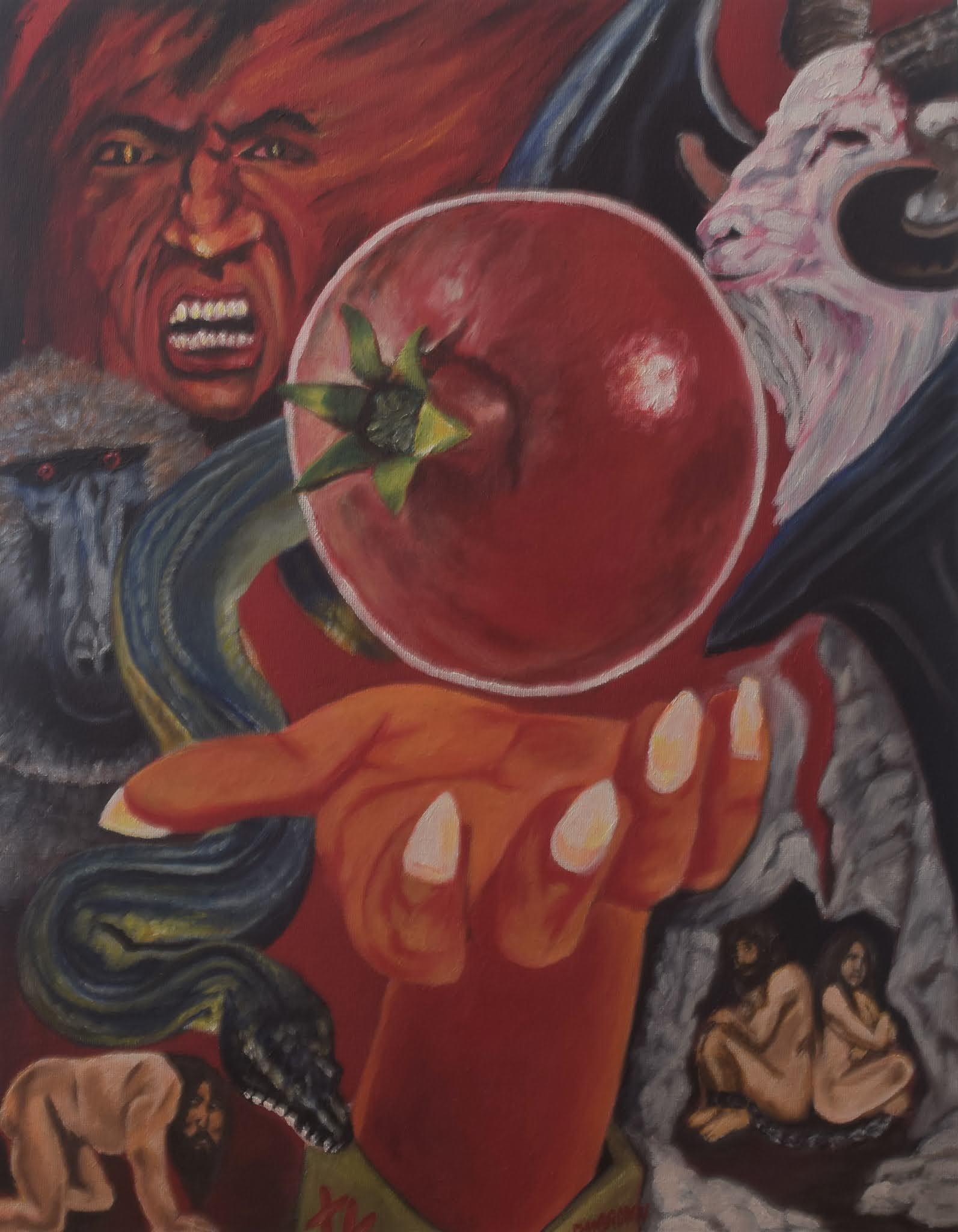
“Ethos 4: XV The Devil” (August-October, 2020): A collage of images for “the great deceiver,” including a pomegranate (as the fruit of temptation), a goat, a baboon, a serpent, a snarling face and images borrowed from William Blake.

“Ethos 5: IX The Hermit” (October-November, 2020): A single figure, derived from an Egyptian statue of a scribe, in an empty room, prepares to write his visions.

The latter painting was mostly painted last November. No matter how much I might like to be a hermit and withdraw from the world to paint and write and read and so forth, November, you may recall, was a particularly fraught time with the contested election and a host of unsettling events that culminated in the assault on the Capitol before the inauguration in January. It’s a fact anyway that I didn’t do much painting, if at all, after Thanksgiving weekend until the inauguration. That month I got started on Eros, the second segment in the Tarot series. And here are the first three. Again, these are meant to be seen as a group of five with VI The Lovers in the center, XVII The Star above, and III The Empress to the left of center; XIV Temperance, the panel below, is mostly completed but not yet signed or numbered, and VIII Strength, the righthand panel, was begun in August but hasn’t had much progress due to work on those three other “rendering” paintings.


“Eros 1: VI The Lovers” (January-March, 2021): Derived from an image for alchemical transformation, two winged figures, male and female, couple in a pond beneath a tree, a lyre nearby; the composition alludes to Chagall’s “Daphnis and Chloe.”

“Eros 2: XVII The Star” (March-June, 2021): A nude woman pours water from a vase into a pool in which she stands while gazing at the viewer, elements of her features and figure borrowed from friends, Dürer’s Eve, and a Waterhouse nymph.

“Eros 3: III The Empress” (April-July, 2021): A woman on a throne in nature, her figure and clothes derived from a statue of Parvati, the wife of Shiva and a Hindu goddess of fertility.

We're allowed nine images on the site, so that’s it for me, this year. Maybe around Christmas I’ll get those other three “Renderings” up. I’ve got quite a number of those planned, and should also be starting the panel for “X The Wheel of Fortune” which is the first “outcome” card—one at the halfway point, the other at the end. Thus I’m almost at the halfway point in the panels, but at least two to four months away.


Wednesday, June 30, 2021

SUMMER CITADEL

It’s summertime for real, right now. Here in the northeast US there are heat advisories and warnings and there is some noticeable discomfort if, like me, you live a life without air-conditioning—and work at home. But it’s the work that distracts from the heat—if you let it.

Today, making breakfast, I recalled the song by The Rolling Stones—from their 1967 psychedelic LP Their Satanic Majesties Request—called “Citadel.” Like many a psychedelic paean to the joys of the Inner Man, “Citadel” takes up an exotic theme (citadel as a castle with classical or biblical overtones because the word finds use in many such texts, whereas “castle” seems more deliberately medieval and European) as a metaphor for the “trip” mentality. The fantasy in the lyrics, initially, is of crusaders “armed with bibles,” then we get glimpses of flags and dollar bills (the U.S. market, of course), then “peasants” crawling (the fans, the press, etc.) to hear their numbers called, and finally the “woods of steel and glass” of a busy urban scene—all the things these citadel-dwellers are avoiding by staying in their indwelling universe, fixing a hole where the rain gets in, and all that. And always that child’s rhyme chorus: “Candy and Taffy, hope you both are well / Please come see me in the citadel,” where Candy—a playful plaything’s name at the time—gets stretched into confection by palling around with Taffy (these girls are sweet!) and both are invited to the citadel, where no doubt our singer reclines in utter decadence, plump grapes poised upon plump lips.*

Well! My sense of a working citadel is nothing like that! More like what I imagine Keef might be up to in the studio with Brian, layering all those sounds onto tape. For me, it’s layering colors and I’m concluding The Empress and a few days into Temperance. But the song was suggested by my subconscious (or something), due no doubt to a fleeting thought that painting while listening to my many mixtapes compiled in the summers (starting in 1978 and reaching to the present—I made the tape side for Temperance just last week) is about as withdrawn as I can be from the world at large.

Left to my own devices in the house of Eros on my painting tour of the 22 cards of the Major Arcana of the Tarot. The section Eros, as just became definite to me early in June before my visit to the shore in Maryland for two weeks, consists of: VI The Lovers (center), XVII The Star (above), III The Empress (left), XIV Temperance (below), XIII Strength (right). This configuration is pleasing as a departure from what I had considered the sequence to be, up to that point. I had thought I would be moving on to do The Emperor after The Empress. The change came about because, in searching for images to composite into the Emperor, I was struck by the pathos of the figure. And so that card will be the third panel in Pathos, corresponding to the place The Empress holds in Eros. And that’s fitting because The Empress represents the fully empowered female—mother, queen, the ruler of the roost, both sexual and maternal, all that. Whereas The Emperor—following the old idea that the son, come to manhood, is the king/father’s replacement—is a figure for decline, for the old that is passing away. Pathos, in other words.

In the four overlays, the center panels have been definite for some time: The Fool for Ethos, The Lovers for Eros, and Justice for Logos (all obvious to me). The first major change came in shifting The Wheel of Fortune from the center of Pathos (a good figure for all the changes that cause our sense of time passing toward the grave) to its place as the outcome of the first series, thus matching perfectly with The World (the idea of the eternal that supersedes that transient wheel) as the outcome of the second series. Which is a way of noting that Ethos (the Bildung) and Eros (the reign of desire) bring us to a sense of the Wheel (how all things do change and love fades and mentors die and nothing lasts) which must be endured through Pathos (the struggle to assert something that lasts at least a generation or two), aided by Logos (the idea of the eternal, as suggested by religion—for some—art, for others, and, well, at least by the systems of signs by which we make sense of the world as something to be made intelligible, for ever and ever anon). The new center figure for Pathos is The Hanged Man, a figure for the suffering body itself, and of “the sacrifice for the sake of”—wisdom (Odin), the sins of man (Christ) and so forth. So then, The Fool (my spirit guide, let’s say), The Lovers (my youthful ideal, late teens through twenties), The Hanged Man (upon the rood of time), Justice (you decide if he was wise). The circling we’re into now, around those lovers, takes in The Star—as a figure for the ingenue, the sweet thing (Candy and Taffy), but also all those forbidding maidens never manned, à la Cohen’s “Came So Far For Beauty”—The Empress (see above, here figured as an Empress of India who is in fact Indian), and, now, Temperance as the Angel who mixes duality into unity while also, like a horse of many colors, radiates all we project upon them (the Angel, being neither male nor female, is a perfect instance of the need for a “multi” pronoun as designation—particularly as, in a sense, any Angel is every angel, no?). Anyway, I’m having a wonderful time on this one just now.

But then, I have a wonderful time on each of them—the panels, that is—until I reach the limits of my ability and wish I could do something different. In any case, they are what they are, cartoon approximations of concepts that have to take the form of pictures since words don’t really convey what they are either. There are only tales told, rhymes rhymed, songs sung, and abstruse and recondite interpretations to approximate what these figures actually figure. The wonderful time, for me, is seeing what the paint does while I engage in that slippery pursuit of Image. A word I’ve always viewed with a certain awe as I understand it to be vision arrested by the mind—which some call “a vision” but which I’d rather call “an Image.” Keeping alive the relation to ‘imagine/imagination’ as well as recalling hoary old usages such as “made in his own image” and “the very image of a modern major general.” And maybe it’s just fanciful on my part to relate “Image” to “i mage, or I magus,” with “Magus,” card number I.

I guess this has gone on long enough. And what I really meant to talk about was the experience of listening to all those summer tapes. I arrange them by month—June, July, August—and, where possible, by the day I made them, rather than by year. So I’m not moving chronologically through the years in this trip through time, but through the months, after a fashion. June dropped away because I was away and I’m making it up as best I can. May found me listening through the series of May tapes my daughter Kajsa and I made. It became a tradition to make them at the end of each school year, beginning with the end of twelfth grade, and stretched into a few years after she graduated college. The summer tapes, though, make me tour through a variety of times. There is at least one summer tape for every year up through 1999 (when I turned 40). After that, tape-making for myself falls off, but, generally, a tape in summer and in fall continues for another decade give or take (I’ll have to tabulate them some time).

Are they all relevant to Eros? More or less, I’d say, though some are more tinged by Pathos than others, doubtless. And that’s fitting because we’re in the “bottom” of Eros, with one last turn to go. And I hope that I'll be through the circle—with at least a start on that Wheel—ere this summer is past.


*: note: In Andy Warhol's Popism, which I just finished reading, 7/3/22, Andy says that Candy is Candy Darling the person who Andy respects as the most successful drag queen he ever knew, and Taffy is one of Candy's drag friends, and that once, while the song was playing, Candy pointed out the lyrics to Andy as Mick inviting the girls to visit and mentions the hotel the Stones were staying in which becomes, by that reckoning, the citadel. According to Andy, though, Candy was a bit embarrassed because she could never tell the Stones apart and wasn't sure "which one is Mick."


Monday, September 21, 2020

Paintings, City Wide Open Studios, New Haven, October 2020

The following introduces the images I’m sharing in this year’s City-Wide Open Studios in New Haven, CT (here’s a link to the site at Artspace).

1. “Now & Then: Self Portrait with Photos” (January 1983, and August/September 2020; 24" x 30")


I'm feeling more Proustian than usual, thanks to this inter-temporal slam. Back in the winter of 1983, I was 23 and worked in security at the Pennsylvania Academy of the Fine Arts, and spent a lot of time hanging out with current and former students there, as well as a number of Philadelphia poets and artists. I painted a self-portrait that featured, on the right-hand side, my image in the bathroom mirror (the boards through the plaster showed renovation work that was halted when we moved in), and, on the left, a painting in black and white based on a photo of me in March, 1982, around the time of my daughter’s first birthday. In between were pasted three reproductions of a photo of me at 20 (my first winter in Philly) which I painted upon. The lower left showed a sunrise on the ocean when we stayed in Ocean City, MD, in June of 1981, and the upper left showed a view of Bar Harbor, ME, from Cadillac Mountain, from a visit in October the same year. The idea was to preserve me at that moment (the start of the end of the Philly era, as it turned out), set beside some images from the recent past that informed that period.

In 2020, the Kehler-Liddell Gallery in Westville put out a call for artists to contribute to a show called “I Am”: “How do you see yourself? How do others see you? What makes you, you? From selfies to personal branding to the complexities of identity politics, our carefully crafted personas are routinely broadcast to the world via the internet. The modern world revels in the revelation of a semblance of self, allowing us to conceal as much as we reveal. In this age of unprecedented exposure, how can an artist offer some fresh statement of self?” (Here’s a link to Brian Slattery’s coverage of the exhibit for the New Haven Independent.) I didn’t submit anything but the question made me think of my youthful self-portrait, which I wouldn’t have submitted as is because I was never quite satisfied with it. That got me thinking about painting-in a new, contemporary, twenty-first-century face.

Initially I thought I might use a very good photograph my wife Mary took of me for a class she was taking around 2017. But that already was a little dated. I turned 60 in 2019 and it made sense that the picture should be from the new decade in my life—the 60s!—and from the new decade we’ve begun—the Twenties! Shortly after my sixty-first birthday in August, with “Covid hair” in evidence, I took a selfie with my Surface and that’s what the new face on the left is based on. Further work was done on the “me” of 1983 as well, and the ocean (which was the part most fun to paint and which looks forward to a series of seascapes I hope to get started on soon).

While working on the painting, I played cassette tapes I still have from 1983 as well as an iTunes playlist featuring only LPs from 1980-83 that I owned at the time. Who says you can’t go home again?

In response to the K-L Gallery query: The activity of painting recalls someone I have been at various times in my life, and am trying to be again. For it’s not simply an action—painting—it’s an assertion of identity. One becomes the maker of this particular thing, and of another, and another . . . But there is no resting within that identity because it’s predicated on activity, an activity that changes with each new attempt. The task of painting what one sees becomes at once a reflection upon how perception changes day to day. There’s no enduring gaze, there are only the discrete moments of looking. Even a static image changes. And that fact, which used to defeat me and make me despair of ever “getting it right,” now keeps me in the game, given over to the effort to paint the way I see at the moment. And—here music contributes in subtle ways—the way I feel from moment to moment, or song to song. Part of the process of trial and error means relearning how to paint, or of learning how I paint now. “I Am” both painter and painted, and, in the painting, both 23 and 61.


2. “Baby Mommy” (September-December, 2019; 14" x 18")


The return to painting after a twenty-year lay-off started a year ago with this painting. The photograph shows my mother—who died in 2011 at age 82—at three or four, and so dates from around 1932. She is dressed for her portrait in a white, billowy dress adorned with embroidery across the shoulders and neckline, with puffy short sleeves and a cape, discernible off to her left side. Dress shoes—one is visible as she sits with one leg beneath her, the other foot is out of the frame. She leans forward slightly, eyes gazing at something, or simply intent upon not blinking. The face is a bit tense but also—I sense—greatly impressed at the fuss it must have taken to appear so perfect. Her hair is carefully combed, and she wears a bracelet on her right arm and a pendant around her neck. There she sits, Elaine May Taylor, third child and third daughter of Mr. and Mrs. James Patrick Taylor of Wilmington, Delaware, at her best. Understood even then, I suspect, as an icon of the ephemeral beauty of childhood.

The activity of painting involves what’s called “muscle memory”—indeed, that’s one of its great attractions, as some might feel for cooking or running or playing an instrument or any of dozens of physical activities. Which may include dancing or making love. And the latter is the act I find most akin to painting because it is a labor of love, this effort to render an image. Working from a photograph presents certain immediate frustrations—you can only see what the camera shows. And what the camera shows has been frozen in a lifelike but non-living image. To put life into it—my life—is the task, certainly. But, more importantly, the effort means putting my mother’s life into the image. Day after day I painted and watched her face change—watched as I changed her face—letting me glimpse my older brother, Tom, or Joan Walters, a cousin my age (who then died in April), or my mother’s father—recalling his resemblance to my younger brother, Jerry—or our sister Kathy, or even my daughter Kajsa, whose face I drew many times for a collage of images from photographs of her, newborn to age ten, back in the mid-90s. To find those other faces lurking in my mother’s child-face as I painted and repainted it was to see again our interrelations, while the face that emerged in the painting was not my mother as a child, or not only. The look in her eyes—in the eyes I fashioned for her—was a look I had seen, it was the stare not of the child in the photo, who would become my mother, but of my mother as I knew her. That double vision—was it only in my eyes, looking at what I had done, or was it there more tangibly? My deceased mother’s living gaze brought back to me as an object to be regarded, as a “thing” that had been, that had—in a sense—never gone away. The painting I created was not my mother as a little girl, but a little girl as my mother, a baby mommy.


3. “Not Yet Dad” (January-April, 2020; 14" x 18")


Here the idea was to do a quick study from a photograph of my father, Fred Earl Brown, 1927-1996. The picture was taken in a photo booth with my mother around the time, I believe, they became engaged in 1949. They married in August of that year and my dad turned 22 in October. I liked the way my father engaged the camera in this photo, ready to start his life with the woman at his side. He had been in the service as a Marine, but he was not yet a dad. Their first child would not be born until March 1952, when my father was 24. The fact that I was a dad before my 22nd birthday gave me a certain pleasurable feeling of priority over that young dude. The photo is black and white so I had considerable leeway in choosing colors, and the expectation that I would paint this one quickly soon faded away. I had thought, because my mother’s photo was such a fine studio affair, that it would be the more difficult to render, but the flash-bulb-lighting on my father was the kind of distortion that is foolish to render as is, in paint. So it took some time before I got a tonality and balance I could live with.

There’s the old canard of the poet Paul Valéry saying that, for amateurs, a poem is never finished, only abandoned. A comment I’ve often applied self-consciously, with an ironic smirk, to my own efforts. Valéry, a certain kind of perfectionist, wouldn’t undertake any work unless he knew what “the end” was, what it was he wanted to achieve and why. Well, we all can’t be Valéry, and many of us simply blunder along, trying things, eventually saying “I give up.” In fact, the only thing that made me stop work on this painting was the fact that I needed to move on, to begin the series that comprises the rest of the images in this inventory. And because any further work would only distort what I’d already achieved, and I didn’t want to find out where such distortion would take me. Not with this. The photograph, unprofessional as it is, has a charm I wanted to maintain and that has to do with walking a line between simply sentimental evocation—which I don’t at all disparage, at this point in my life, whatever I might’ve felt about such motivations as a younger man—and something more elusive. That “something” kept me involved because (whatever it is), it entails a search within myself for a reason to do anything so de trop, so superfluous, as making a thing. A photograph can be scanned, made into a digital facsimile, photoshopped, and shared. What can be the purpose of rendering that image as a separate object, if not the experience that occurs in the fashioning? And that’s the very thing—my skepticism says—not likely to be present to other eyes or at least not as a particular experience. The question of particularity—this particular image at this particular time—is apt to be meaningless to anyone but me. Even my siblings or my father’s grandchildren, familiar or not with this image of his youth, aren’t likely to relive their relation to him simply because I made this painting. And yet something like that is my goal: to live the hours spent making the image as a kind of homage—to my father’s past, to the beam in his eye, and to my past indebted to him and to whatever aspect of our connection still lives. While painting “Baby Mommy” I thought of my father once saying—watching me paint as a teenager still living at home—“I’m gonna have to chain you to the easel.” He meant, quite rightly, that I was very lazy about painting, even back then when I was doing Frank Frazetta copies for spending money, and I wasted a lot of time not making any effort and a lot of effort not putting in the time. So, on this one, I put in a lot of time.


The Tarot Panels

This is not the place to go into the history of my interest in the 22 cards called the “Major Arcana” in the Tarot deck. Suffice to say the curiosity dates from around 1980 and that I wrote a poem for each of the 22 cards between 1988 and 1992, which I gave a public reading of while in grad school at Princeton. A few efforts to publish them as a chapbook went nowhere and my interest drifted to other things. When I moved to Hamden in 2016, I hoped the extra room would give me a place to paint and one of the ideas was to do an “illustrated Arcana” in some fashion. When the COVID lockdown occurred in March, I got immersed in texts and notes to see how I’d approach that. Developing a logic I’ll maybe go into on some other post, I broke up the 22 cards into four groups of five, with two leftover, one as transition and the other as outcome. The four groups were titled—following on ideas about literary interpretation I spent some post-doc years developing—“Ethos,” “Pathos,” “Eros,” “Logos.” I considered doing a very big painting for each group with the two extras as stand-alone images. But that didn’t feel right. And I don’t really want to work so big in my spare room home studio anyway. The two paintings of my parents both happened to be 14” x 18” and that seemed a good size for the Tarot panels. Panels because canvas stretched on board to feel and look a bit more like playing cards. So it should be possible to hang all five on a wall at once, and to even rotate them through the seasons and so forth…

Initially, my plan to join the City-Wide Open Studios was to garner a wall to hang the first group of five on—“Ethos”—which should be in a quincunx with #1 in the center, #2 above, #3 to the left, #4 below, #5 to the right. My hope was to do one a month and have all five done by September. It didn’t happen and COVID meant no wall anyway. So, here are the three I consider “done” as of now. #4, “XV The Devil” is begun and #5, “IX The Hermit,” may be by the end of October? In any case, I’ll add them as they come along.


4. Tarot Panel 1: “0 The Fool” (April-May, 2020; 14" x 18")


The standard image—borrowed from the Golden Dawn Tarot pack developed by A.E. Waite and Pamela Colman Smith—is of an aesthete-looking guy stepping off a cliff while brandishing a flower and carrying a knapsack. I didn’t ponder too long over this card because I’ve drawn a couple different adaptations of it, in different contexts, over the years. The main change was to depart from motley for the Fool—I liked the association with the Fool in King Lear, one of my favorite Shakespeare characters in one of my favorite Shakespeare plays. But this time I wanted a contemporary fool, and the act of checking his phone while stepping into the abyss struck me as irresistible. His clothes came from a google search of hip threads of the times, while the figure’s stance came from Rodin’s statue “John the Baptist preaching.” I needed a naturalistic space, I felt, so the fact of his imminent plunge would be clear. I selected the Cliffs of Moher in Ireland, well-known as “the Cliffs of Insanity” in The Princess Bride. And the Fool’s features are meant to recall those of the young Hermann Hesse (around the time he wrote Knulp, a novella about a free-spirit who wanders about without any ties to person or place) whose works helped me, as a teen, get into Nietzsche’s Thus Spoke Zarathustra, which I associate with the spirit of The Fool, in its more philosophical inspirations. (For more synopsis, via a song playlist, go here.)

5. Tarot Panel 2: “XIX The Sun” (May-September, 2020; 14" x 18")


Unlike the Fool, which has a story of sorts, the Sun is mostly just a symbol, or else it’s the heavenly body itself. To paint a picture of the sun is not an easy thing to do, and what should its foreground or background be? All along I knew—drawing again on the Waite-Smith deck—that there would be a young nude male in the image. He should be an embodiment of the Sun. A Sun-child. The Sun god. The search went out for cherubs and cupids and a number were found that might suffice. In the end I came to rely, mostly, on the figure of Cupid that stands, mini-me style, on a first-century statue of Augustus Caesar from Prima Porta. Except that my Cupid-Sun figure would be holding a glass up to see his own countenance. To get the look on his face was a long bout of trial and error—at one point I had a face that was quite lyrical and dreamy, then a self-satisfied look that reminded me of the young Marlon Brando, and a couple others. The face that finally emerged owes something to an image of a Renaissance putti a facebook friend happened to post. The idea is that The Sun is personified as a nude man-child looking raptly at himself in a kind of “sun bubble” that flourishes with sunflowers and corn, to symbolize summer in my part of the world, while below all is desolate sunbaked wasteland, recalling two famous poetic lines: “a gaze blank and pitiless as the sun” (from Yeats’ “The Second Coming”) and “boundless and bare / The lone and level sands stretch far away” (from Shelley’s “Ozymandias”). (For more synopsis, via a song playlist, go here.)

6. Tarot Panel 3: “I The Magus” (July-September, 2020; 14" x 18")


The figure of the Magus, or Magician, should be potent. Initially, my conception of the figure I wanted to portray drew on Jimi Hendrix, a magician of the guitar whose playing first held me rapt around age 10 (when Hendrix was still alive). Some subsequent thought made me think of merging Hendrix with Prince, a musical figure from my own generation to whom he could be compared in creating a unique niche in rock music as a black artist. The image would be a charismatic performer, maybe with a guitar maybe not, kneeling on a stage singing into a microphone, his clothes a flamboyant mash-up of Jimi and Prince. For further inspiration I compiled a tape alternating songs by the two performers. Then came the protests for the ruthless murder of George Floyd in Minneapolis (Prince’s hometown) and my Magus would have to be seen taking a knee. He would hold his microphone aloft to invite the voices of the crowd, his raised finger showering sparks—perhaps incendiary, perhaps illuminating. His hat I borrowed from a photo of Lamont Steptoe, a black poet-friend of mine from Philadelphia, while the rainbow sash recalls Hendrix’s Rainbow Bridge and the alchemy of colors in “Bold as Love,” as well as the rainbow of LGBTQ awareness. The plaque in the background copies an ancient Egyptian relief of the god Thoth, a kind of analogue to the Greek god Hermes, known for his magical knowledge and for having given humanity writing, and often associated with The Magus card. The Ankh symbol on the hat I used to wear on a chain around my neck, in high school, and is generally interpreted as a symbol for eternal life.