With no Friday night double features at WHC I have to fend for myself. I’m trying to adjust, reading more, resuming old habits like the "4 films for 4 nights" deal at Best Video that got me through my daughter’s high school years, but there’s still something missing. Which means I’ve come to realize how much I began to rely on pre-selected movies and the big screen. To see a movie on the big screen, without WHC, means ... seeing a movie made in 2008, yeah, or going to NYC to see something at Film Forum or Anthology. I even did that, saw two Godard movies, but I think I’m just not cinéiste enough for that. Pilgrimages to the Big City to see Classic Movies seems a bit of an indulgence. So what I’m faced with, bereft of WHC, is a process often referred to as “dumbing down.” And that’s because watching movies on DVD is primarily for entertainment purposes, so I have a hard time working up the attention span for the kinds of movies WHC would show. Godard being a good case in point: I made those trips to NYC expressly to see those movies largely because of the fact that they’re dead on the little screen. Or, to put it more tellingly, as send-ups of le cinéma they must be viewed au cinéma.
So far the only 2008 movies I’ve seen in the theater were 1) The Spiderwick Chronicles, a kid’s movie I saw with kids, one of whom got more than a little scared (he was scared of the big CGI thing; I was scared of Nick Nolte). 2) Iron Man, which answers that deep need, introjected at the age I first learned to read, to see comicbook heroes on the big screen.
The film, the first made by Marvel Comics own production company, sets a standard that perhaps the other Marvel Comics-to-movie franchises will follow, which is to say: it’s essentially like reading the comic book. The Spiderman series has moments that comply with that formula (particularly in the first one) but the problem they’ve encountered is extremely ham-fisted writers creating the "romantic interest." In the comics, you could skip those panels if, like me, you were about eight years old and girls were basically somebody else’s problem (and women, with like breasts and stuff, were kind of embarrassing). But in the film, you have to sit through Kirsten Dunst’s earnest efforts to inhabit a vision of Mary Jane that has nothing to do with the snappy, sassy, guy’s gal that Marvel created. It’s woesomely bad, in other words. Iron Man fares better with Gwyneth Paltrow as the gal Friday that even guy’s guys (who had moms too) realize that even heroes might need, and if she’s got to pine, at least let her pine prettily (and snappily). That’s pretty much it. Robert Downey Jr. is a man who, whatever his failings may be, understands that the point of being on screen is to be entertaining. And he does that well. And Jeff Bridges is sleazy and nasty and uses one helluva voice.
Will I see Ed Norton assay Bruce Banner? Who knows, as a kid I easily tired of The Hulk’s “me Hulk, you human” antics so it’s not like I’m eager for the treat. It’s typical of American tastes in general (which I seem to be always on the outs with, even when I dumb down to the easily consumable popular stuff) that there will be two films of the musclebound numbskull before even one bona fide effort to give us Cap Am . . . or Thor. Do Thor right, I dare ya, I double dare ya. The after-the-credits ending of Iron Man gives us a glimpse of Samuel L. Jackson as Nick Fury (which is just a fun idea), and supposedly we will eventually get The Avengers, in some incarnation that might include Cap and Thor, and of course Iron Man, so, we’ll see.
But this, like the amazing quality of toy action figures since the ‘90s at least, is all more than a bit “too little too late” for this wizened ol’ superhero fancier. I can take heart that my grandkids will have it better, I suppose. But will they really? I remember how wondrous it was to walk into a news stand selling comic books -- there was a store in Wilmington that had all the comics in slots filling an entire wall. I wouldn’t trade the rapt wonder of standing in front of that wall for the first time with much, certainly not with sitting in a movie house to see whatever version of those heroes Hollywood, in its infinite effort to pursue the ersatz, makes available to the ticket-buying millions.
3) Son of Rambow, a Brit movie about kids making movies which should have been better than it was -- it went for treacly when it could’ve gone for sharp (when’s the last time we had a true child visionary, other than that kid that sees dead people?), and 4) Then She Found Me -- one of those female midlife crisis movies, via Helen Hunt, boasting a surprisingly effective Bette Midler (boasting the kind of “work done” that Hunt obviously eschews) and a good dramatic outburst from Colin Firth as a harried single dad, and which, in the end, makes the viewer want to go out and adopt a Chinese baby girl . . . anyway.
What else? I saw Amy Heckerling’s female midlife crisis movie, I Could Never Be Your Woman (2008), which must’ve gone straight to DVD (IMDB says yes -- no theatrical release in the U.S.), but which made me laugh harder than I have at a film in quite some time. Heckerling, who memorably skewered the CA Valley Girl way of life (while making it seem sweetly quaint, no easy feat), in Clueless (1995) while riffing on Jane Austen (if that ain’t walkin’ the walk in terms of “chick flics” what is?), delivers a similar wallop to the moms of the teen shopamatics that inhabited Clueless -- the credits sequence shows footage of face-lifts. Oh yes, this film has bite. Maybe a bit too much -- at times it comes off as a little shrill and frustrated (though Tracey Ullman as a phantasmal Mother Nature playing superego to Michelle Pfeiffer’s aging TV sitcom producer hits the right note with most of her diatribes). The film does aim at the Baby Boomers as the most indulgent of all generations thus far, but also suggests, bravely for such a less-than-brave new world, that growing old gracefully means being willing to hand it over to the new generation . . . and maybe thinking about being responsible for whether or not there’s a world worth handing over. Which is to say -- something I was thinking about, watching all these kiddie entertainments -- that we pretty much do what we do hoping to interest our kiddies in the world we’ve made, but that sooner or later one has to ask why they keep buying into it. Gullible little jerks.
When I was just a little boy
I threw away all of my action toys
while I became obsessed with Operation
With hearts and minds and certain glands
you gotta learn to keep a steady hand
and thus began my morbid fascination
–Andrew Bird, “Dark Matter” (2007)
Saturday, May 31, 2008
Tuesday, May 27, 2008
IN PRAISE OF POLLACK
Film director and producer and actor Sydney Pollack died yesterday, a shame. Pollack always struck me as the director as Everyman, or as “the Everyman director.” His films aren’t arty in the auteur manner, nor are they resolutely of a signature style or theme -- as so much of Scorsese and Altman are. Nor are they, generally, mawkish like Spielberg or preachy and overbearing like Oliver Stone. They are just solidly made films, good solid entertainments -- what used to be called without too much condescension, “middle-brow.”
I mainly associate Pollack with two things: first, several films starring Robert Redford that helped make the blonde, boyishly rugged actor the male icon of my youth -- Jeremiah Johnson (1972), Three Days of the Condor (1975), Out of Africa (1985). For the latter, Pollack won Best Director and the film Best Picture -- which means, I suppose, it's mainstream and middle-of-the-road and all that, but if you consider for a moment that trajectory you see the kind of maverick heroism that Redford portrayed in Pollack’s films.
In Johnson, about a young ex-soldier who becomes a mountain man -- and finally the stuff of myth -- Redford and Pollack worked together to create an ode to the wonderful territories in Montana that are protected from commercial incursions, or which, in some places, were in the personal possession of Redford himself. In other words, Redford gets to play the founding spirit of a back-to-nature individualism that isn’t meant to create a movement or a trend, but is meant to evoke the sacredness of place -- symbolized by Johnson’s hard-won acceptance by the local tribes. In Condor, Redford is a bookish fellow who becomes unwittingly the little guy who must kill and outsmart his way (shades of Jimmy Stewart crossed with Charles Bronson) to the leader of a covert group within the CIA -- a group determined to work out scenarios for how to seize oil without doing blunderous things like invading foreign countries. It’s a timely film, we might say, but in those heady post-Watergate days it stood strong on the idea that revealing a cover-up was tantamount to a victory for the good guys. Then, in Africa, teamed with the incomparable Meryl Streep at her most incomparable, Redford was Denis Finch-Hatton (Pollack didn’t even try to make his old buddy assay a Brit accent, while Streep flaunted her Danish one), a big game hunter, amateur flyer, and general man of adventure even as the post-WWI world shrank the sense of adventure even in the African wilderness.
It’s significant that I talk about these films as plots and characters rather than as Pollack vehicles because, when you get down to it, Pollack’s films are mainly about plots and characters, not about the art of filmmaking. The greatness of Africa is in its ability to manifest old Hollywood-style epic sweep -- those opening shots of the train crossing the veldt with John Barry’s magical score evoking any favorite armchair journey via movie magic (as well as his own score to Born Free (1966), another paean to Africa), and the great “seeing the world through God’s eye” trip in the two-seater airplane -- for the era of mid-Reaganesque conservativism and revisionism. In other words: literate, gorgeously filmed, winning 7 Oscars, the film was the mainstream vindication of Pollack’s version of the loner hero -- heir to Gable and Wayne and Tracy and so on, not the mercurial and volatile Brando and Co. -- and of the lasting filmic value of on-location landscape that, I have to admit, one overlooks at times in one’s appreciation of the sets and artifice of the film experience (but important to note more than ever now that CGI can just paint-in whatever it wants).
Two: the other thing I praise Pollack for is his presence on-screen. Not exactly an actor in the sense of one who can portray any number of characters or types, Pollack enacted very memorably in two very different films two very different versions of the same kind of man’s man character: in Woody Allen’s Husbands and Wives (1992), Pollack was memorable as the guy who amicably splits up with Judy Davis only to flounder vulnerably and comically through jealousy and the bathos of his new arrangement with a younger and rather New-Agey aerobics instructor; and in Stanley Kubrick’s Eyes Wide Shut (1999), as Victor Ziegler, Pollack is memorable for the authoritative gravitas -- and even an endearingly humble humanity in a NY bigwig -- he brings to the role of the friend and client who has to set Tom Cruise’s Dr. Bill Harford right about a few shady matters. It’s largely due to Pollack’s grasp of the man-to-man tone that we accept Ziegler’s version of things, so gruff and steady and affectionate is his delivery.
Pollack’s death is a loss because at once a quality that we can think of as a fatherly presence behind big budget movie making is gone. Which is to say that such a loss is indicative of the coming time when the Baby Boomers become “the elders” of our culture. God help us -- and bless Sydney Pollack.
I mainly associate Pollack with two things: first, several films starring Robert Redford that helped make the blonde, boyishly rugged actor the male icon of my youth -- Jeremiah Johnson (1972), Three Days of the Condor (1975), Out of Africa (1985). For the latter, Pollack won Best Director and the film Best Picture -- which means, I suppose, it's mainstream and middle-of-the-road and all that, but if you consider for a moment that trajectory you see the kind of maverick heroism that Redford portrayed in Pollack’s films.
In Johnson, about a young ex-soldier who becomes a mountain man -- and finally the stuff of myth -- Redford and Pollack worked together to create an ode to the wonderful territories in Montana that are protected from commercial incursions, or which, in some places, were in the personal possession of Redford himself. In other words, Redford gets to play the founding spirit of a back-to-nature individualism that isn’t meant to create a movement or a trend, but is meant to evoke the sacredness of place -- symbolized by Johnson’s hard-won acceptance by the local tribes. In Condor, Redford is a bookish fellow who becomes unwittingly the little guy who must kill and outsmart his way (shades of Jimmy Stewart crossed with Charles Bronson) to the leader of a covert group within the CIA -- a group determined to work out scenarios for how to seize oil without doing blunderous things like invading foreign countries. It’s a timely film, we might say, but in those heady post-Watergate days it stood strong on the idea that revealing a cover-up was tantamount to a victory for the good guys. Then, in Africa, teamed with the incomparable Meryl Streep at her most incomparable, Redford was Denis Finch-Hatton (Pollack didn’t even try to make his old buddy assay a Brit accent, while Streep flaunted her Danish one), a big game hunter, amateur flyer, and general man of adventure even as the post-WWI world shrank the sense of adventure even in the African wilderness.
It’s significant that I talk about these films as plots and characters rather than as Pollack vehicles because, when you get down to it, Pollack’s films are mainly about plots and characters, not about the art of filmmaking. The greatness of Africa is in its ability to manifest old Hollywood-style epic sweep -- those opening shots of the train crossing the veldt with John Barry’s magical score evoking any favorite armchair journey via movie magic (as well as his own score to Born Free (1966), another paean to Africa), and the great “seeing the world through God’s eye” trip in the two-seater airplane -- for the era of mid-Reaganesque conservativism and revisionism. In other words: literate, gorgeously filmed, winning 7 Oscars, the film was the mainstream vindication of Pollack’s version of the loner hero -- heir to Gable and Wayne and Tracy and so on, not the mercurial and volatile Brando and Co. -- and of the lasting filmic value of on-location landscape that, I have to admit, one overlooks at times in one’s appreciation of the sets and artifice of the film experience (but important to note more than ever now that CGI can just paint-in whatever it wants).
Two: the other thing I praise Pollack for is his presence on-screen. Not exactly an actor in the sense of one who can portray any number of characters or types, Pollack enacted very memorably in two very different films two very different versions of the same kind of man’s man character: in Woody Allen’s Husbands and Wives (1992), Pollack was memorable as the guy who amicably splits up with Judy Davis only to flounder vulnerably and comically through jealousy and the bathos of his new arrangement with a younger and rather New-Agey aerobics instructor; and in Stanley Kubrick’s Eyes Wide Shut (1999), as Victor Ziegler, Pollack is memorable for the authoritative gravitas -- and even an endearingly humble humanity in a NY bigwig -- he brings to the role of the friend and client who has to set Tom Cruise’s Dr. Bill Harford right about a few shady matters. It’s largely due to Pollack’s grasp of the man-to-man tone that we accept Ziegler’s version of things, so gruff and steady and affectionate is his delivery.
Pollack’s death is a loss because at once a quality that we can think of as a fatherly presence behind big budget movie making is gone. Which is to say that such a loss is indicative of the coming time when the Baby Boomers become “the elders” of our culture. God help us -- and bless Sydney Pollack.
Wednesday, May 21, 2008
THE CDS: The Allman Brothers Band
The town in Delaware I come from is just north of the Mason-Dixon line, but the bulk of the state is below it. And I associate the white-boys blues of this Southern clan with what is not so affectionately known, by us Nawthunuhs, as "slower Delaware," which is where my dad's folks were from. In other words, much as I might like to deny it, I have to admit there's some of this music in my blood. I don't mean I'd like to deny the Allmans per se, I just mean that when I do find myself caught up in their music, I'm aware that it's due to what Hunter S. Thompson would call "an atavistic fondness" for the blues as they emerged from the racial crucible of the Deep South. So one day in Cutler's in New Haven I saw a used copy of The Allman Brothers Band Greatest Hits and picked it up, the only CD I have by them.What resonates with me from those days when Duane Allman, one of the best, walked the earth is not only the stirrings of '70s Classic Rock, which is what this music lives on as, but something more rooted, some kind of fabled domain that might only be, yet again, the glimpse of the child I was when I could float away on "Melissa" or "Blue Sky" as pure distillations of the summer in suburbs that could still fitfully recall their past lives as farmland. I mention those two songs, from 1972's Eat a Peach, as probably the earliest Allman tracks that I can recall hearing, along with the zippy instrumental "Jessica" from Brothers and Sisters (1973)-- all songs of the mellow Allmans as fronted by Dickie Betts.
Granted, everyone knew "One Way Out" because it was a gem of the doin' what you shouldn't, hearty partying era and the radio loved it. Same with "Ain't Wastin' Time No More" and "Midnight Rider," but I can't say that either had made complete inroads into my psyche -- radio play just being too haphazard. It wasn't till I started hanging out with my older brother Tom in those end of high school days in the late '70s that the kind of immersion occurred that leaves me forever chilled by Betts' frenetic slide on "Ain't Wastin'" and convinced by the desperado pose of Gregg's vocals on "Rider."
It was also then that the darker, meaner Duane-driven Allmans crept into my cranium as evidenced on the two stand-out tracks from the band's eponymous debut album in 1969: "Dreams" and "Whipping Post." On these two tracks Duane's playing is revelatory, as in, revealing untold riches in the instrument. The songs were written by Gregg who bellows the words with his trademark wounded hoarse cry of longtime suffering that made all us suburban white boys believers, for a spell, in Suthrun blues and its mystique -- "Lord help me, baby, or this will surely be the end of me" ("Dreams"). "Post" partakes of that world of the blues in which love is the cruellest obsession imaginable -- misogynist, yes, but . . . though the woman is heartless ("now she's with one of my goodtime buddies, and they're drinkin' in some crosstown bar"), the singer knows it's his own weakness that's to blame. Which "weakness" becomes -- in the apotheosis that Duane's guitar creates in the final climax -- almost Christ-like in the sense that being "tied to the whipping post" is being nailed to the cross of what Joyce calls one's own "cruelfiction," crucified, as it were, by a desire, a passion that just won't stop.
Then there's "In Memory of Elizabeth Reed" which is so stately and elegant, with a cool that becomes hot in the solo, that at times it could almost be Santana, which is to say that guitar gods were the main game c. 1970. To be young then was, for my money, to have a sense of music as the province of virtuoso musicianship -- as it was for my mother when she hearkens back to the days when Benny Goodman was alive and playing. Here's to Duane's fabled fingers, to Dickie's dexterous digits!
I drown myself in sorrow
When I look at what you've done
But nothing seems to change
The bad times stay the same
And I can't go on
--Gregg Allman, "Whipping Post" (1969)
Friday, May 16, 2008
IN PURSUIT OF READING
Now that the semester is officially over (I turned in my grades yesterday), I’m reading again. I say “again” because during the semester, it seems, one is rarely able to read, really. Of course, there is a lot of reading going on: the assignments you ask the students to read, the assignments you ask the students to write -- since I was tutoring for Daily Themes, that meant about 45 brief pieces of prose, 250-300 words each, a week, as well as many responses and drafts from freshman comp. The reading of student work is a particular kind of reading: it’s reading that can’t be in any sense passive, to simply take in information or follow an argument or be entertained. The reading has to be active, directed, pointed because you will have to comment, have to offer -- in that term we use from electronics, for some reason -- feedback. Feedback that, in this case, isn’t just noise in the signal, distortion caused by resistance, but is supposed to be constructive and helpful and meaningful.
It’s involving, certainly, such reading. But it also makes me begin to feel rather harried after awhile -- particularly as I am by nature not the kind of reader who feels a great need to respond to much of what I read. I generally just let writing wash over me, allowing it to trickle in and pool wherever it can in my ragged cranium. That’s the kind of reading I thrive on, but it’s a kind of reading that is, I realize more and more, all too rare in this vale of tears.
That’s because when one is in college one reads for a purpose. Bear in mind, I spent my formative years (when most are being formed by the college of their choice or of their fate, as the case may be) reading whatever and however I damn well pleased. Not for me the “syllabus experience” of reading, so that, when I finally encountered such, I noted at once the change it made in my reading practice. Of course, I’d always read pen in hand, marking the text, making marginal comments, sometimes making notes separately -- I always imagined, next to whatever published work I might myself contribute, a vast array of books read and marked by me, the raw material as it were of my great endeavor with the printed word. I was proud to leave traces for my later self or for my descendants or (flattering myself) for researchers who would be curious to see what I drew attention to by marking. Eventually such thoughts became beside the point because I marked things for useful purpose, to find quickly what I’d noted, passages which, in college, became the basis for papers and exam crammings. But what I discovered about syllabi reading was how liberating it was: you needn’t concern yourself with the choice of the next book to read -- it was already decreed! You just had to go down the list. And you know how I love lists...
Granted, I’d made myself all kinds of lists of things to read over the years. In fact, I sometimes chose courses -- as I’m sure some of us do -- not based on who was teaching it, or who else was taking it, but on how many texts on the syllabus were also on my lists. This was less the case in Graduate School where, in a sense, there’s no point in taking any classes. The point is to read everything. Syllabi help, in the early going. And then it was that I did take classes because of who was teaching it -- Cornel West, for instance (did I really need to read David Hume for a whole semester?) -- and of who was taking it as well: because part of the grad school experience is what happens in the seminar room and you want your companions to be ones that keep it interesting. I sometimes fondly recall the days of “passing notes,” as it were, by stating what one got out of -- or by hearing what a particular someone else got out of -- a passage. For some this might be an undergrad experience, but I was still perhaps too much an autodidact in college to be much impressed by the explications at hand. But I’m sure I’m not the only student to be fixated on his own ideas and what the professor says, indifferent to any other voices in the room.
It’s after graduate school, then, while in some sense “a professional reader” -- or “a professorial reader,” or, at least, a Ph.D’d reader -- that the trouble begins. Not, as I was just saying, the kind of reading you do for class: a syllabus (mine!), the stuff the students (a list themselves) write. Easy. But the other kind of reading -- for myself -- becomes a difficulty.
The professional approach would be easiest: you choose books by their proximity to your field or by their author’s proximity to yourself. So, friends (and maybe enemies -- always keep them closer than friends, as Don Corleone advises) in your area first, then everyone else, rank ordered by some whim, or by reviews, word-of-mouth, press, catchy title, etc. But that kind of reading -- to the freewheeling reader I once was -- feels like a trap. Head filled with visions of a kind of Herculean Sisyphus (he cleans out the Augean stables by reading everything published this year only to see them fill up again next year), I tend to want to believe that, having attained my “degree of comfort” (ha!), I should be able to read as I damn well please, knowing full well that such an assertion means something fateful: that I don’t damn well want to read what gets published in my field, and therefore I’m not really a professional, because that’s tantamount to being a “company man” who wants to keep company with the profession’s practitioners. True, my assertion of readerly autonomy assumes the same cry of the student beleaguered by syllabi: "one day I’ll read what I want to read, when I get out of college!" is the cry of the professional reader: "one day I’ll read what I want to read, when I retire!" Me, I read what I wanted to read before college and, it seems, before I retire, so I find it very hard to defer. Deferring was what being a student was about, but what, really, is being “a master” about?
Change that to “a professor”: one who professes . . . what, exactly? All I’m here professing is that I like to read what I feel like reading, write what I feel like writing. Clearly there can be no monetary value to either act. They are momentary acts expressive of desire, such as choosing to watch TV or not, or choosing to eat out or stay home and cook. It matters not to a single other person what I in my solitary readerly desire elect to do. And it’s only that sense of “ought” that comes from those who do what they want and get paid for it -- the success stories -- or those who insist that what you want should be what is best -- the ethicists -- that makes one feel a need to make a case. The only happiness, it’s said, is doing what virtue dictates, the only happy life is being free to do what is good. And by such standard, then, the only criteria for “what to read” is that it be good to read and, thus, makes me happy to read it. Such a standard then permits one to be, at once, a critic with a stake in the matter (regardless of expertise) because if something one reads isn’t good, and doesn’t make one happier for having read it, then we can say that its virtues are lacking, a fact that it is good of the critic to point out, lest others waste their time with a less-than-good object.
The position I’ve just outlined is, I think, my mature statement of my case as a reader. But I have to say that it is what I intuitively (nodding to Emerson here) followed when as a youth I read what I felt I needed to read, or wanted to read (since it came to the same thing). The difference that my education makes is that it makes me more willing to exercise the critical spirit -- why such-and-such a work is a waste of time -- more deliberately. But, by the same token, the only reason I’m more likely to do that is because I’ve read many more things that dissatisfy than I would have as a young man. Then I would simply look at a few pages and decide to read it or not, with complete indifference to reputation, word-of-mouth, inclusion on syllabi or on the bookshelves of influential minds, and so forth. Now, I suppose, late as it may be in my own life and in the history of the world, I feel more of a need to be “engaged” by “the times.”
But there’s another point too that I don’t want to neglect: the choice of reading material then and now had mainly to do not with a need for information -- as when wanting to understand, for instance, ancient Greek architecture, or to know something of a great writer’s life, or to have a grasp of historical chronology and, to some extent, causality -- but with a need for (to use that other electronics term) “input.” Let words wash over one as a great electromagnetic wave of streaming strings of electrons and protons and let some of them agitate the ones in your brain, happily (but virtuously?) bouncing around on their own little electrical circuits. But to what purpose? As I knew “then” and still dream “now”: why, writing, of course. One only achieves writing by acquiring writing: by reading, in other words. So, what have I been reading? Well, that’s another story...
Comicbooks, roadmaps, the Bible, pornography
Anything you want to read
Go out and sit in a field some time
--Paul Westerberg, "Knockin' on Mine" (1993)
It’s involving, certainly, such reading. But it also makes me begin to feel rather harried after awhile -- particularly as I am by nature not the kind of reader who feels a great need to respond to much of what I read. I generally just let writing wash over me, allowing it to trickle in and pool wherever it can in my ragged cranium. That’s the kind of reading I thrive on, but it’s a kind of reading that is, I realize more and more, all too rare in this vale of tears.
That’s because when one is in college one reads for a purpose. Bear in mind, I spent my formative years (when most are being formed by the college of their choice or of their fate, as the case may be) reading whatever and however I damn well pleased. Not for me the “syllabus experience” of reading, so that, when I finally encountered such, I noted at once the change it made in my reading practice. Of course, I’d always read pen in hand, marking the text, making marginal comments, sometimes making notes separately -- I always imagined, next to whatever published work I might myself contribute, a vast array of books read and marked by me, the raw material as it were of my great endeavor with the printed word. I was proud to leave traces for my later self or for my descendants or (flattering myself) for researchers who would be curious to see what I drew attention to by marking. Eventually such thoughts became beside the point because I marked things for useful purpose, to find quickly what I’d noted, passages which, in college, became the basis for papers and exam crammings. But what I discovered about syllabi reading was how liberating it was: you needn’t concern yourself with the choice of the next book to read -- it was already decreed! You just had to go down the list. And you know how I love lists...
Granted, I’d made myself all kinds of lists of things to read over the years. In fact, I sometimes chose courses -- as I’m sure some of us do -- not based on who was teaching it, or who else was taking it, but on how many texts on the syllabus were also on my lists. This was less the case in Graduate School where, in a sense, there’s no point in taking any classes. The point is to read everything. Syllabi help, in the early going. And then it was that I did take classes because of who was teaching it -- Cornel West, for instance (did I really need to read David Hume for a whole semester?) -- and of who was taking it as well: because part of the grad school experience is what happens in the seminar room and you want your companions to be ones that keep it interesting. I sometimes fondly recall the days of “passing notes,” as it were, by stating what one got out of -- or by hearing what a particular someone else got out of -- a passage. For some this might be an undergrad experience, but I was still perhaps too much an autodidact in college to be much impressed by the explications at hand. But I’m sure I’m not the only student to be fixated on his own ideas and what the professor says, indifferent to any other voices in the room.
It’s after graduate school, then, while in some sense “a professional reader” -- or “a professorial reader,” or, at least, a Ph.D’d reader -- that the trouble begins. Not, as I was just saying, the kind of reading you do for class: a syllabus (mine!), the stuff the students (a list themselves) write. Easy. But the other kind of reading -- for myself -- becomes a difficulty.
The professional approach would be easiest: you choose books by their proximity to your field or by their author’s proximity to yourself. So, friends (and maybe enemies -- always keep them closer than friends, as Don Corleone advises) in your area first, then everyone else, rank ordered by some whim, or by reviews, word-of-mouth, press, catchy title, etc. But that kind of reading -- to the freewheeling reader I once was -- feels like a trap. Head filled with visions of a kind of Herculean Sisyphus (he cleans out the Augean stables by reading everything published this year only to see them fill up again next year), I tend to want to believe that, having attained my “degree of comfort” (ha!), I should be able to read as I damn well please, knowing full well that such an assertion means something fateful: that I don’t damn well want to read what gets published in my field, and therefore I’m not really a professional, because that’s tantamount to being a “company man” who wants to keep company with the profession’s practitioners. True, my assertion of readerly autonomy assumes the same cry of the student beleaguered by syllabi: "one day I’ll read what I want to read, when I get out of college!" is the cry of the professional reader: "one day I’ll read what I want to read, when I retire!" Me, I read what I wanted to read before college and, it seems, before I retire, so I find it very hard to defer. Deferring was what being a student was about, but what, really, is being “a master” about?
Change that to “a professor”: one who professes . . . what, exactly? All I’m here professing is that I like to read what I feel like reading, write what I feel like writing. Clearly there can be no monetary value to either act. They are momentary acts expressive of desire, such as choosing to watch TV or not, or choosing to eat out or stay home and cook. It matters not to a single other person what I in my solitary readerly desire elect to do. And it’s only that sense of “ought” that comes from those who do what they want and get paid for it -- the success stories -- or those who insist that what you want should be what is best -- the ethicists -- that makes one feel a need to make a case. The only happiness, it’s said, is doing what virtue dictates, the only happy life is being free to do what is good. And by such standard, then, the only criteria for “what to read” is that it be good to read and, thus, makes me happy to read it. Such a standard then permits one to be, at once, a critic with a stake in the matter (regardless of expertise) because if something one reads isn’t good, and doesn’t make one happier for having read it, then we can say that its virtues are lacking, a fact that it is good of the critic to point out, lest others waste their time with a less-than-good object.
The position I’ve just outlined is, I think, my mature statement of my case as a reader. But I have to say that it is what I intuitively (nodding to Emerson here) followed when as a youth I read what I felt I needed to read, or wanted to read (since it came to the same thing). The difference that my education makes is that it makes me more willing to exercise the critical spirit -- why such-and-such a work is a waste of time -- more deliberately. But, by the same token, the only reason I’m more likely to do that is because I’ve read many more things that dissatisfy than I would have as a young man. Then I would simply look at a few pages and decide to read it or not, with complete indifference to reputation, word-of-mouth, inclusion on syllabi or on the bookshelves of influential minds, and so forth. Now, I suppose, late as it may be in my own life and in the history of the world, I feel more of a need to be “engaged” by “the times.”
But there’s another point too that I don’t want to neglect: the choice of reading material then and now had mainly to do not with a need for information -- as when wanting to understand, for instance, ancient Greek architecture, or to know something of a great writer’s life, or to have a grasp of historical chronology and, to some extent, causality -- but with a need for (to use that other electronics term) “input.” Let words wash over one as a great electromagnetic wave of streaming strings of electrons and protons and let some of them agitate the ones in your brain, happily (but virtuously?) bouncing around on their own little electrical circuits. But to what purpose? As I knew “then” and still dream “now”: why, writing, of course. One only achieves writing by acquiring writing: by reading, in other words. So, what have I been reading? Well, that’s another story...
Comicbooks, roadmaps, the Bible, pornography
Anything you want to read
Go out and sit in a field some time
--Paul Westerberg, "Knockin' on Mine" (1993)
Tuesday, May 13, 2008
LA LURE DE LA PEINTURE
Back in February I attended a talk at the Yale University Art Gallery about acquisition of Old Masters Drawings, then drank and ate at the reception, then toured the Old Masters Drawings on display; the exhibit was impressive, but not as impressive as I’d hoped, so I went up to the museum’s collection of paintings from Impressionism to the present and looked at paintings in a way that I hadn’t in far too long. Someday maybe I’ll go into more detail about my ruminations on the rather excellent little collection of modern art in the Yale museum, but for now I simply want to say that -- as I cruised around the gallery with three glasses of wine in me -- I realized that there are few things I enjoy more in this world than looking at great paintings. I tend to forget this because, of course, one is so seldom looking at great paintings. You have to seek the things out and, even if you do, you won’t necessarily find them. There are great paintings to be found in most good museums, but from the late 20th century to the present fewer and fewer of them are produced. I say all this by way of introduction to a few comments about a recent visit to the Metropolitan Museum of Art in NYC where two great shows of paintings were on display last weekend: one showcasing Gustave Courbet, the other Nicolas Poussin.
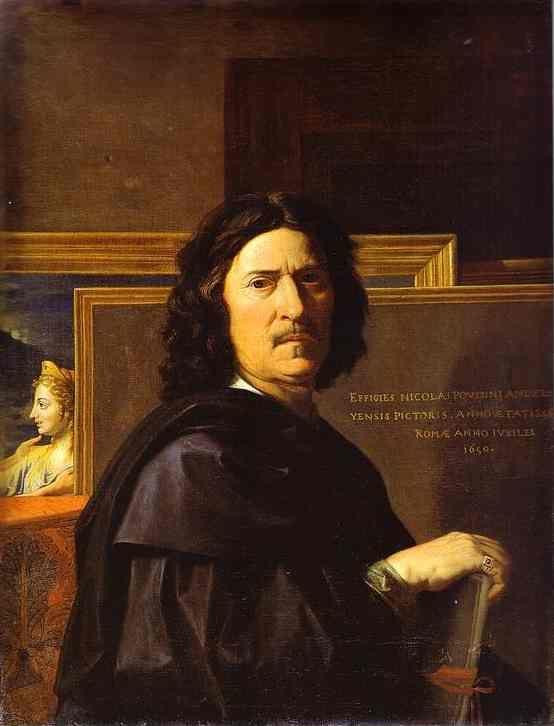
Back in high school I kept a book out of the Wilmington Library for quite some time: it featured a single self-portrait by what I understood to be every major European painter from Raphael to Picasso. So effective was this single book that I was able, on the basis of having studied these images, to identify the painter of many paintings on sight simply by recalling the styles of painting on view in those self-portraits. Of course some artists are more given to self-portraiture than others, and doubtless (as I later learned) there were some very great painters who never painted one. But the book was a worthy introduction to a host of great painters and I mention it because on Saturday I finally stood in the presence of two paintings I remember encountering in that book: Courbet’s painting called “The Meeting” but generally known by the mocking title the press of the day gave it: “Bonjour, Monsieur Courbet”; and Poussin’s self-portrait which the note next to the painting said has been interpreted as an allegory of friendship. In Courbet’s case there were many other self-portraits on display; Courbet -- like Rembrandt before him and like Van Gogh after him -- got a lot of mileage out of the genre, but unlike those two greats he wasn’t so much interested in exploring the changes that time perpetrated upon his visage as he was in creating “roles” for himself. Courbet was, in so many ways, the inventor of the modern artist as we generally think of the type (sort of the way that Byron is the inventor of the romantic poet), and this is nowhere more evident than in the theatricality of his self-portraits, which at times are only indirectly self-portraits because they are actually “genre studies” for which he simply used himself as the model. Rembrandt and Van Gogh share the interest in delineating themselves as a subject, though only sometimes -- as in that wonderful Rembrandt self-portrait at the Frick -- is the concept of “artist” illustrated by pose and demeanor. Courbet, on the other hand, is always illustrating that the concept of “artist” simply is a pose and a demeanor.
Then there’s Poussin. I should say that when I told my daughter that I definitely wanted to see the Courbet show I termed him “the first truly great French painter.” Foolish of me. How could I have forgotten Poussin? And there he was to rebuke me for my presumption. It’s true, of course, that I really believe that most significant artistic events before the 20th century took place in the 19th century, but that’s only because so much from that time is meaningful for what modernism is and becomes. I don’t mean to say that the Renaissance and the Baroque and the neo-Classical era are lesser. Of course not. Shakespeare, Rembrandt, Vermeer, Velazquez, Cervantes mean as much to me as anything does, but, still, the 19th century is the first century that resonates for me as a standard of living and production that makes sense, in the modern sense of “sense,” I suppose.
All the more reason to take in the Poussin exhibit because his is a style of painting that, in its grandeur, in its allegorical trappings, in its Italian Renaissance stylings of pose and color, in its historical landscapes as a genre that tells stories and presents symbolic mythologies, is inimical to what that version of modernism so dominant from the 1850s to the 1930s would develop, and yet somehow speaks directly to an era in which the aesthetic of the graphic novel -- the unfolding of narrative in pictorial space -- has come to seem uniquely of our time. But there’s also the fact that modernism, as the dominant aesthetic that defines the artistic expectations of the 20th-century-born viewer, makes us see what might not really be there: the way that Poussin’s self-portrait, for all its impeccable neo-Classicism (which Courbet was not above attempting to mimic when it suited him), “recalls,” say, Max Ernst’s Louloup paintings -- not in terms of handling of the paint, of course, but in the determinate relation to something called “painting” as the basis for specular identification and for the multiplication of “grounds” or spaces of image.
Poussin’s iconography usually involves: natural landscape, classical buildings, mythological figures, playful compositional use of line and color to involve the eye in that unique act of reading that is “following” a painting. So used to cameras controlling our attention, giving us “a shot” for a duration at the whims of an editing presence, we can luxuriate in letting our eyes take in a canvas in whatever incremental way we choose. And that’s even more the case, for me, in looking at Courbet -- seldom, in his case, am I concerned with reading some narrative or symbolic meaning. And this is why we know we’re looking at the major practitioner to emerge in that space between Rembrandt and early Cézanne: we’re looking at how paint makes the painting of rocks, water, nude female flesh, snow, sea become the entire point. We look to see the ingenuity of depiction, to see that Courbet is capable of making his own whatever subject he chooses. And because we know where the history of painting is going, we can’t help looking at how his paintings dispense with the pieties of compositional space and refinement of contour in favor of what sheer stylistic vigor (and one hell of a palette knife) makes happen before our very eyes.
Back in high school I kept a book out of the Wilmington Library for quite some time: it featured a single self-portrait by what I understood to be every major European painter from Raphael to Picasso. So effective was this single book that I was able, on the basis of having studied these images, to identify the painter of many paintings on sight simply by recalling the styles of painting on view in those self-portraits. Of course some artists are more given to self-portraiture than others, and doubtless (as I later learned) there were some very great painters who never painted one. But the book was a worthy introduction to a host of great painters and I mention it because on Saturday I finally stood in the presence of two paintings I remember encountering in that book: Courbet’s painting called “The Meeting” but generally known by the mocking title the press of the day gave it: “Bonjour, Monsieur Courbet”; and Poussin’s self-portrait which the note next to the painting said has been interpreted as an allegory of friendship. In Courbet’s case there were many other self-portraits on display; Courbet -- like Rembrandt before him and like Van Gogh after him -- got a lot of mileage out of the genre, but unlike those two greats he wasn’t so much interested in exploring the changes that time perpetrated upon his visage as he was in creating “roles” for himself. Courbet was, in so many ways, the inventor of the modern artist as we generally think of the type (sort of the way that Byron is the inventor of the romantic poet), and this is nowhere more evident than in the theatricality of his self-portraits, which at times are only indirectly self-portraits because they are actually “genre studies” for which he simply used himself as the model. Rembrandt and Van Gogh share the interest in delineating themselves as a subject, though only sometimes -- as in that wonderful Rembrandt self-portrait at the Frick -- is the concept of “artist” illustrated by pose and demeanor. Courbet, on the other hand, is always illustrating that the concept of “artist” simply is a pose and a demeanor.
Then there’s Poussin. I should say that when I told my daughter that I definitely wanted to see the Courbet show I termed him “the first truly great French painter.” Foolish of me. How could I have forgotten Poussin? And there he was to rebuke me for my presumption. It’s true, of course, that I really believe that most significant artistic events before the 20th century took place in the 19th century, but that’s only because so much from that time is meaningful for what modernism is and becomes. I don’t mean to say that the Renaissance and the Baroque and the neo-Classical era are lesser. Of course not. Shakespeare, Rembrandt, Vermeer, Velazquez, Cervantes mean as much to me as anything does, but, still, the 19th century is the first century that resonates for me as a standard of living and production that makes sense, in the modern sense of “sense,” I suppose.
All the more reason to take in the Poussin exhibit because his is a style of painting that, in its grandeur, in its allegorical trappings, in its Italian Renaissance stylings of pose and color, in its historical landscapes as a genre that tells stories and presents symbolic mythologies, is inimical to what that version of modernism so dominant from the 1850s to the 1930s would develop, and yet somehow speaks directly to an era in which the aesthetic of the graphic novel -- the unfolding of narrative in pictorial space -- has come to seem uniquely of our time. But there’s also the fact that modernism, as the dominant aesthetic that defines the artistic expectations of the 20th-century-born viewer, makes us see what might not really be there: the way that Poussin’s self-portrait, for all its impeccable neo-Classicism (which Courbet was not above attempting to mimic when it suited him), “recalls,” say, Max Ernst’s Louloup paintings -- not in terms of handling of the paint, of course, but in the determinate relation to something called “painting” as the basis for specular identification and for the multiplication of “grounds” or spaces of image.
Poussin’s iconography usually involves: natural landscape, classical buildings, mythological figures, playful compositional use of line and color to involve the eye in that unique act of reading that is “following” a painting. So used to cameras controlling our attention, giving us “a shot” for a duration at the whims of an editing presence, we can luxuriate in letting our eyes take in a canvas in whatever incremental way we choose. And that’s even more the case, for me, in looking at Courbet -- seldom, in his case, am I concerned with reading some narrative or symbolic meaning. And this is why we know we’re looking at the major practitioner to emerge in that space between Rembrandt and early Cézanne: we’re looking at how paint makes the painting of rocks, water, nude female flesh, snow, sea become the entire point. We look to see the ingenuity of depiction, to see that Courbet is capable of making his own whatever subject he chooses. And because we know where the history of painting is going, we can’t help looking at how his paintings dispense with the pieties of compositional space and refinement of contour in favor of what sheer stylistic vigor (and one hell of a palette knife) makes happen before our very eyes.
Friday, May 9, 2008
RANDOM THINGS
My friend Andrew Shields tagged me in his blog: this means I am to write six random things about myself. The rules of the tagging, which Andrew posted, indicate that I should also tag people's blogs and get them to follow suit. It's like a blog chain letter or something. But I'll have to break the chain because I don't really have a list of bloggers to link to. And yet I'll try to keep with the spirit of the thing and post "six random things"... which reminds me of the lyrics to "My Favorite Things." These are a few of my randomest things?
1. May 8th was Thomas Pynchon's 71st birthday. I began reading Gravity's Rainbow (1973) in 1976 because a friend/teacher told me about it in 12th grade; I didn't finish my first reading of it until 1980. I started working on a ms. on Pynchon last spring/summer but haven't completed the GR chapter yet.
2. I have lived in four states in a sequence that happens to follow the order in which the states were admitted to the union: Delaware ("the 1st state") 20 years, Pennsylvania 4 years, New Jersey 5 years, Connecticut 14 years (almost), though between PA and NJ, I lived in DE again for 6 years.
3. The books in my personal library and the CDs I own are arranged in chronological order.
4. The cars I have driven are: 1 Honda Civic hatchback, 3 Honda Accord sedans, 1 Toyota Corolla. My favorite was the gray Honda Accord '87 which I drove a lot while commuting to college and throughout grad school and which died in '94 in CT after being backed into in a parking lot.
5. My earliest occupational dream was to draw comicbook heroes for Marvel Comics.
6. The first rock concert I ever attended was Jethro Tull at the Spectrum in Philadelphia in the winter of 1975 when I was in 10th grade.
1. May 8th was Thomas Pynchon's 71st birthday. I began reading Gravity's Rainbow (1973) in 1976 because a friend/teacher told me about it in 12th grade; I didn't finish my first reading of it until 1980. I started working on a ms. on Pynchon last spring/summer but haven't completed the GR chapter yet.
2. I have lived in four states in a sequence that happens to follow the order in which the states were admitted to the union: Delaware ("the 1st state") 20 years, Pennsylvania 4 years, New Jersey 5 years, Connecticut 14 years (almost), though between PA and NJ, I lived in DE again for 6 years.
3. The books in my personal library and the CDs I own are arranged in chronological order.
4. The cars I have driven are: 1 Honda Civic hatchback, 3 Honda Accord sedans, 1 Toyota Corolla. My favorite was the gray Honda Accord '87 which I drove a lot while commuting to college and throughout grad school and which died in '94 in CT after being backed into in a parking lot.
5. My earliest occupational dream was to draw comicbook heroes for Marvel Comics.
6. The first rock concert I ever attended was Jethro Tull at the Spectrum in Philadelphia in the winter of 1975 when I was in 10th grade.
Monday, May 5, 2008
WORLD WAR II REVISITED
World War II has been the setting of so many films, it seems dangerous terrain for a filmmaker attempting anything new. We could say that perhaps about any genre that has had a long life and that continues to interest, but in the case of WWII films the early versions seemed to determine expectations about the boys -- from all over this great country (“hey Iowa, have you met Brooklyn here?”) -- and the hardships they faced (“Captain, the men haven’t had a decent meal in two months”) and the untimely deaths they met (“he was right here a minute ago, talking to me about his girl back home, and now he’s–”), to say nothing of the cliché of the tough-as-nails commander who either sees the error of his ways only at the cost of his platoon, or proves to his men they can take more than they ever believed they could; then there’s the sensitive leader, the gutsy malcontent, the oddly detached and therefore somewhat spiritual enlisted man, maybe a blood-thirsty eager killer or two, the romantic with the girl back home, the brainy kid who just wants to be one of the guys, the determined suck-up and rah-rah, the ethnic folk hero type, the cowardly leader, etc., etc. Not even the Western has as many stereotypes and stock characters, and not even the Western is as emphatically a man’s world, guys only affair.
So, you sense my skepticism toward the idea of a great WWII film? Or, put another way, a “great” WWII film would have all those familiar elements of the genre but somehow “transcend” them with something new. I don’t know that Terrence Malick’s The Thin Red Line (1998), which was screened at the WHC last Monday, manages to do that, but at least it tries and sometimes succeeds. One reason it succeeds as much as it does is because of casting and acting. In war pictures like this one, there are a lot of characters, a lot of little stories, and you’ve got to have actors -- what used to be called “character actors” -- able to pull off their given bit in the whole. The cast on-hand for TRL is impressive and they’re able to push these familiar GI Joes into somewhat new terrain. As the most dramatic untimely death, Woody Harrelson is riveting, as the irascible Lt. Col. Tall, Nick Nolte is full-bore Nolte -- perhaps his greatest scenery-chewing role ever; as the sensitive Capt. Staros, Elias Koteas acquits himself well, and as the spiritual, detached Pvt. Witt, James Caviezel has the face of an impassive idol, and Sean Penn, as the gutsy malcontent, 1st Sgt. Welsh, simply has a face -- rugged, good-looking but not too, expressive, wry, inward -- that belongs here, that could’ve made a career of this genre in an earlier era.
The other reason the film succeeds is cinematography: John Toll’s swooping runs with the men through high grass and up hills, the feel of the bombardment as a chaos of movement and noise, the perspective shots of characters at key moments, the judicious use of slow motion (not overused as it so often is in action movies), as for instance the almost dreamlike scene when the GIs finally overtake the Japanese camp, and the pervading sense of natural beauty and mystery even in conjunction with such violence and horror.
What I’m not quite sure succeeds is the overarching meaning of the film. As the most harrowing WWII movie I’ve ever seen, TRL deserves its place in a film-buff Hall of Fame, but as a movie with its own logic and meaning -- a film set in WWII rather than a film “about” WWII -- it’s less clear what we’re dealing with. The pacing is epic, the intro in the Solomon Islands, where “the gentle savages” live their childlike lives in what looks a natural Eden, are a bit tendentious in opposition to the war scenes, as though we should all wish to “go AWOL” from the 20th century and go back to our noble savage roots in nature, and the relationships among the men, such as they are, don’t really resonate. Most characters seem a bit monadic, in their own worlds of struggle and strife and death, so that the scenes which matter most are the truly intense exchanges: Nolte bawling out Koteas; Nolte getting sensitive himself and revealing his motives, in a bid for bonding, with John Cusack; Caviezel offering consolation to Harrelson during his death throes; the brief and somewhat enigmatic exchanges between Penn and Caviezel. These things stay with one after the film is over, but even more does the control of the action -- the narrating presence, as it were -- impress one with its determined command and its idiosyncratic emphases. Malick is an oddly self-possessed filmmaker and he has given us an oddly compelling account of the battle of Guadalcanal that seems leavened with a kind of grandiose, spacey clarity -- and if that phrase sounds a bit like an oxymoron, that’s as it should be because the film is a bit overwhelming, and I can’t recall the last film I saw that I’d say that about.
So, you sense my skepticism toward the idea of a great WWII film? Or, put another way, a “great” WWII film would have all those familiar elements of the genre but somehow “transcend” them with something new. I don’t know that Terrence Malick’s The Thin Red Line (1998), which was screened at the WHC last Monday, manages to do that, but at least it tries and sometimes succeeds. One reason it succeeds as much as it does is because of casting and acting. In war pictures like this one, there are a lot of characters, a lot of little stories, and you’ve got to have actors -- what used to be called “character actors” -- able to pull off their given bit in the whole. The cast on-hand for TRL is impressive and they’re able to push these familiar GI Joes into somewhat new terrain. As the most dramatic untimely death, Woody Harrelson is riveting, as the irascible Lt. Col. Tall, Nick Nolte is full-bore Nolte -- perhaps his greatest scenery-chewing role ever; as the sensitive Capt. Staros, Elias Koteas acquits himself well, and as the spiritual, detached Pvt. Witt, James Caviezel has the face of an impassive idol, and Sean Penn, as the gutsy malcontent, 1st Sgt. Welsh, simply has a face -- rugged, good-looking but not too, expressive, wry, inward -- that belongs here, that could’ve made a career of this genre in an earlier era.
The other reason the film succeeds is cinematography: John Toll’s swooping runs with the men through high grass and up hills, the feel of the bombardment as a chaos of movement and noise, the perspective shots of characters at key moments, the judicious use of slow motion (not overused as it so often is in action movies), as for instance the almost dreamlike scene when the GIs finally overtake the Japanese camp, and the pervading sense of natural beauty and mystery even in conjunction with such violence and horror.
What I’m not quite sure succeeds is the overarching meaning of the film. As the most harrowing WWII movie I’ve ever seen, TRL deserves its place in a film-buff Hall of Fame, but as a movie with its own logic and meaning -- a film set in WWII rather than a film “about” WWII -- it’s less clear what we’re dealing with. The pacing is epic, the intro in the Solomon Islands, where “the gentle savages” live their childlike lives in what looks a natural Eden, are a bit tendentious in opposition to the war scenes, as though we should all wish to “go AWOL” from the 20th century and go back to our noble savage roots in nature, and the relationships among the men, such as they are, don’t really resonate. Most characters seem a bit monadic, in their own worlds of struggle and strife and death, so that the scenes which matter most are the truly intense exchanges: Nolte bawling out Koteas; Nolte getting sensitive himself and revealing his motives, in a bid for bonding, with John Cusack; Caviezel offering consolation to Harrelson during his death throes; the brief and somewhat enigmatic exchanges between Penn and Caviezel. These things stay with one after the film is over, but even more does the control of the action -- the narrating presence, as it were -- impress one with its determined command and its idiosyncratic emphases. Malick is an oddly self-possessed filmmaker and he has given us an oddly compelling account of the battle of Guadalcanal that seems leavened with a kind of grandiose, spacey clarity -- and if that phrase sounds a bit like an oxymoron, that’s as it should be because the film is a bit overwhelming, and I can’t recall the last film I saw that I’d say that about.
Subscribe to:
Posts (Atom)