Friday, October 31, 2014

DB's Song of the Day (day 304): "HALLOWEEN" (1981) Siouxsie and the Banshees


Everyone, I’m sure, has some idea of when Halloween became “something” to them, if it ever did. On the one hand, I think of it as part of childhood and the fun of dressing up. Then there were a few times I attended the Halloween party at the PA Academy of the Fine Arts, those being the only time I partied at Halloween as an adult. So, in a sense, Halloween as the time to get freaky and make a statement has passed me by.

Though not entirely, as Halloween, like Christmas, has always been a child’s holiday. Halloween is all about the early awareness that there are things that frighten you and things that frighten adults too. The world is a scary place, and yet there’s a certain odd power that comes along with that, whether through accepting one’s fears or making a sort of make believe out of them. Then too, horror movies and tales of terror always have a certain corniness to them too, which comes with realizing that one’s own imaginings can be much worse that what can be depicted or described.  It’s comforting in a way. And there’s also a collective sense in which we all support each other’s fears. It’s like “haunted hayrides” and funhouses—scariness, in all its morbid particularity, derives from folk consciousness, and I suppose the creepy stories I like best have a strong element of that. That sense of dread that comes from a place that seems accursed, since time immemorial, or of some “condition” in a family line that will out.

Halloween, as a child’s holiday, is a way of communing with your own kids as they navigate those realms—the dark and the light, the living and the dead . . . and the undead. With my kid, the thrill of, as it were, celebrating the dark side came along early. It became a holiday with traditions—of films, songs, stories, memories. And one of the songs of Halloween is today’s song, which happened to have been released the year my daughter was born. I got the album Juju a few years later.

At that time I knew the album of Siouxsie and the Banshees’ singles, Once Upon a Time (1981), and a handy little compendium of goth-pop it was. Siouxsie, compared to a band like Blondie, was New Wave with a vengeance. They had a distinct look, in Siouxsie’s make up and hair styles and punk-goth couture (though now we'd just say she looks like she walked out of a Tim Burton movie), and she had a voice that was very cool and also a bit frenzied. Where Blondie made you recall girl groups of the Sixties revisited, Siouxsie made you realize that there hadn’t been any glam bands with a female singer.

It was too late to be “glam” for real, but bands like The Banshees and Bauhaus and The Cure revisited those days and remade them, made them darker, inhabiting the place where the neurotic become erotic, the psychotic sexy and chaotic. There was often a trope of supreme maladjustment, of a kind of distress that went well beyond any definite context. It was apolitical in the sense that there was no implied means to alter things for the better. Psych-rock, you might call it, where everything—your folks, your friends, your job, your fun, your lives, your deaths—causes states bordering on breakdown, creates a general malaise that inspires a certain kind of acting out and dressing up and playing the game of signs.

Without going into the semiotics of subcultures, let’s just say that the outlook of Siouxsie et al. made them prime for a song celebrating Halloween—“trick or treat, the bitter and the sweet.” An easy enough rhyme, but one that supports what I’m saying about the holiday itself. It is both bitter and sweet, fun and threatening. The song comes at you with a sound of guitars like a swarm of wasps in your ear, an assault. And the voice, claiming it “murmur[s] like a gho-o-o-ost,” is a bit on edge, riding an energy that, you imagine, could propel you to some gathering where there will be ghastly reminders of things you’d rather not think about—“I wear my memories like a shroud.” “I try to speak but words collapse, echoing.” See what I mean, we’re always on the verge of breakdown and yet the music sustains us.

With that bit about “the ice-blue nursery” I can’t help thinking of one of my favorite Halloween movies, The Haunting (1965), directed by Robert Wise from a novel by Shirley “The Lottery” Jackson. Back there in my own memories is a viewing of it with my big sister when we were kids and it seemed everyone was asleep and we sat watching the late, late show, scared out of our wits but at the same time, not. I mean, even then we knew it was just a movie, and it even had commercials to give you a breather, but still. It left images in your mind that made a dark hallway suddenly seem the most malevolent thing in the world, a closet might have a life of its own.


“Of a childish murder of hidden luster and she cries”—who knows exactly what that means, but it sounds traumatic. Siouxsie’s “ohs” do a lot of the work in creating the haunted sense of the song, whether of someone unnerved or unnerving, or both. Reminding us that those who are certain they are in the presence of spirits or demons can be much more frightening than any celluloid horror. The mind, we say, plays tricks, and that’s no treat. 

The carefree days are distant now

Happy Halloween!


Thursday, October 30, 2014

DB's Song of the Day (day 303): "THE HIGHWAYMAN" (1965) Phil Ochs


’Twas the night before Halloween and what should be stirring but the ghost of the Highwayman.

The poem by Alfred Noyes—who, I just learned, taught at Princeton and taught the works of Joyce, among other things—was one of the earliest poems I remember hearing, along with poems by Poe and Frost. Noyes’ “The Highwayman,” first published in 1958, became one of those “textbook” poems—How is the road like a ribbon? How does the poem’s rhythm imitate the sound of the horses’ hoofs?—but it also was a very gripping narrative told in what we today generally call “cinematic” terms. Which means it has a very telling way with details, with “close-ups”—as on Bess’ finger on that trigger, and that lace at the throat of the fallen anti-hero. And, yes, he is an antihero. We know he’s a criminal but we still want him to keep his rendezvous with Bess, the landlord’s daughter, the landlord’s black-eyed daughter. What’s more, though Noyes is British and his setting is Britain, I, as a kid, always assumed it was an American poem (keeping company with Poe and Frost) and so, “King George’s men” were the enemy anyway. I took it to be a pre-Revolutionary War setting and so, even though the Highwayman is no Paul Revere, still, we aren’t on the sides of those sniggering, jesting, uncouth, sexist soldiers.

Several years after encountering the poem in school, I encountered Phil Ochs’ recording of the poem, which he set to music. Now, Ochs was truly a “protest” or topical singer in the era of the folksong critique of the powers that be, much more than Dylan was. For Ochs, it was a calling he was quite serious about. But, for that very reason, I didn’t listen to him much. Unlike Dylan’s electric screeds about the Great Society, Ochs was still in that romantic brigade that Dylan distanced himself from with “My Back Pages,” in 1964. “Romantic” in the sense of thinking that singing songs was going to rally the forces of change. Sure, it must’ve been great in those heady days when “We Shall Overcome” seemed to be working but . . . seems to have taken a tremendously long time, hasn’t it? Ochs could be sardonic and that helped keep him from seeming overly earnest but in the late Seventies when I was discovering all this stuff I wasn’t much in the mood for listening to someone fighting those battles on disk. Ochs had died in 1975, and that was that.

Except for his song of “The Highwayman.” That still moved me. Mostly because of how courtly his song is, and what’s more, if you examine the actual poem and then listen to his song, you’ll see that all his edits are quite judicious. His song improves the poem. And he does it by leaving out extraneous bits—like that ostler who betrays the Highwayman out of jealousy of Bess’s love for him, and the extra verses to exploit Bess’s predicament. In Ochs’ version it’s enough to see her trussed up there and know that she’s listening for her lover to come and then hears him before they do and ends her life to warn him, or, as the great line has it: “and warned him with her death.”

And Ochs’ delivery gets the most out of what is my favorite verse in the whole thing: “Back he spurred like a madman, shrieking a curse to the sky / With the white road smoking behind him and his rapier brandished high / Blood red were his spurs in the golden noon, wine-red his velvet coat / When they shot him down on the highway / Down like a dog on the highway / And he lay in his blood on the highway, with a bunch of lace at his throat.”  As poem, that’s pretty good. As sung, it’s devastatingly good. Here he is singing it on TV.

Noyes also repeats two verses at the end—after “still on a winter’s night, they say”—so that we get the Highwayman riding up to the inn, and we get Bess still plaiting that dark red loveknot into her long black hair. Ochs only gives us the first. The forlorn and bereft and betrayed Highwayman riding up to that inn forever. That’s the way revenant stories really work. The idea that they “live happily ever after” in a ghostly world that mirrors their in-life love is a bit too precious. Ochs’ version tells us that the force that drove the Highwayman back—to certain death—is what keeps his ghost alive. And that’s in the promise, that he will come by moonlight “though hell should bar the way.” So, return he must, as if she may be there, though she’s not.

About that sacrifice: it makes you a bit uneasy, those sniggering soldiers, kissing her, taunting her, placing that rifle beneath her breast, which we suppose is soft and white and vulnerable. We feel for her, of course, and Noyes makes her do what she can to save him though it costs her her life, and of course, it’s all for naught, in the sense that he will come back and be killed. “Not till the dawn had he heard it and his face grew gray to hear / How Bess the landlord’s daughter / The landlord’s black-eyed daughter / Had watched for her love in the moonlight and died in the darkness there.”  That, I suppose, is why Noyes wants them both to be present at the close in a tradition of ghostly love that survives death. The colder version, though, makes it a Halloween tale, of a wraithlike haunting in search of a beauty snuffed out too soon.

Yup, safe to say this was my intro to the romantic “go no more a-roving” vein of British poetry, though Noyes is aiming to be more Tennysonian than Byronian, I’d say. In any case, Ochs does that tradition proud, resurrecting it, like those “romantic facts of musketeers foundationed deep somehow,” that Dylan speaks of, as a romantic vision of the eternal outlaw, riding, riding, riding, to go with the romantic dissident marching, marching, marching in protest. If this post were simply in tribute to Ochs, I would've posted about his song “Changes,” probably his best lyric, and also very romantic, but this is for what we used to call “Mischief Night,” and in my memory/imagination of that night, the wind is always “a torrent of darkness among the gusty trees” and the moon “a ghostly galleon tossed upon cloudy seas.”


Wednesday, October 29, 2014

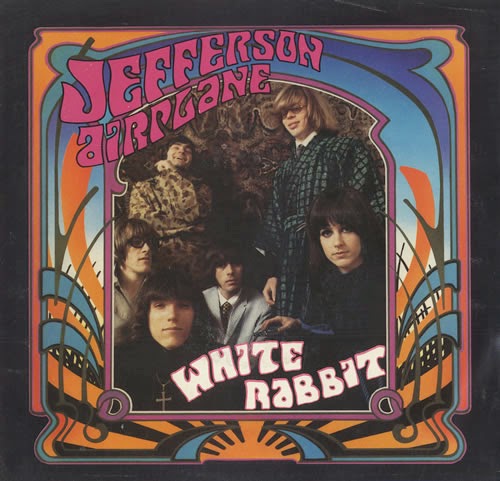
DB's Song of the Day (day 302): "WHITE RABBIT" (1967) Jefferson Airplane


Tomorrow is the birthday of Grace Slick, who sang lead on a number of my favorite Jefferson Airplane songs, particularly today’s song, which she wrote. I’m also very partial to “Somebody to Love” and “Lather.” In fact, I considered posting about the latter since it’s less well known, but, it being Halloween time and all, “White Rabbit” fills the bill better. We could say it’s all about tricks and treats.

The trick is the way the song quickly escalates into a heart-pounding shot of adrenalin. The treat is all the pills Alice is popping in the song—to get bigger and smaller, just like in Alice in Wonderland, though, of course, we know that’s not what’s really going on.  “And the ones that Mother gives you don’t do anything at all.” Well, they don’t have psychotropic properties, but one imagines that they might be birth control pills, so they definitely do something. Which reminds me not only of the Stones’ “Mother’s Little Helper”—those speed pills the average housewife is popping for weight issues and depression and that general feeling of lassitude, doctor—but also Elvis Costello’s line (in “You Little Fool”): “mother just gives her some pills to choose / and says go use / your imagination.”

So, yeah, mom and pills might lead to whatever we imagine. But let’s get back to our Alice, shape-shifting like a sonuvabitch. It’s all part of growing up in the high and happy days before things like LSD were outlawed, to say nothing of psilocybin mushrooms. The Airplane were a pretty trippy band and this song was sort of the theme song for mental exploration, set to an insinuating bolero-style lead-in that gets faster and faster till it seems the beginning of the song is ages past and it ends with a crescendoed slogan essentially (but I always wanted something a bit more revelatory for Slick to wail at the end): “Remember what the Dormouse said / Feed your head.”  I suppose “feed your head” is being attributed to the Dormouse, so, yeah, who wouldn’t take the advice of a talking furry critter?  We’ve all been colonized by Disney, ain’t we? They even have an animated version of Alice in Wonderland.

And let’s hear it for that “hookah-smoking caterpillar.” In fact, Lewis Carroll gives us this dude, a nod to, shall we say, the dreamy poppy that came to general knowledge via the Raj. And India—its drugs and its spiritual exercises—would be a hit with the kids of the TV generation . . . the Vietnam generation . . . the dropout generation . . . the Mod generation. All that. The Airplane, wittingly or not, created the go-to song for kids to get freaky in the rec-room. The phrase “go ask Alice” was even filched for one of those TV movies of the Seventies, maybe it was a book first, about a girl who gets strung out on drugs and comes to grief. A warning to you all not to become a wigged-out waif with a habit to support. I'm pretty sure we had to read it in middle school and it got me interested in today's song, and that got me interested in those bygone glory days of the Acid Generation. With all due respect for the dangers involved. And it’s true that Slick’s song does pack a certain malevolent energy. It’s when those distortions start kicking in—you feel the rising wave of the “bad trip” about to overwhelm the protagonist: When logic and proportion have fallen sloppy dead / And the White Knight’s talking backwards / And the Red Queen’s off with her head.  Well, when all that comes to pass, you’re tripping, girl! That's what you get for chasing rabbits down the rabbit hole.

But of course things even trippier happen in Carroll’s story. Which is a way of saying that one of the key factors of the psychotropic experience was how it opened not only what Huxley called “the doors of perception” (you see and hear and feel differently) but also the doors of imagination. Things you’d stored away, like details from childhood, could become re-animated with peculiar vividness, as though a part of your mind you had “outgrown” was fully available to you again. Some, like Timothy Leary, went further and claimed you could experience memories that were genetic, going back to ancestors, even to the primal soup of being. Well, sure, why not? Feed your head, Tim.

I will always associate this song with the scene in Hunter Thompson’s Fear and Loathing in Las Vegas when Dr. Gonzo’s attorney, tripping on a whole blotter of acid in the tub, insists that the Doc chuck the tape player—playing “White Rabbit”—into the bath water as the song peaks. That part, as the attorney says, when the rabbit bites its own fucking head off (or words to that effect). Dr. Duke can’t bring himself to do so, and throws a grapefruit in instead, though it seems to achieve the same effect of causing the attorney to scream and thrash in some kind of death-trip ecstasy. And that’s part of Thompson’s brilliance in that book: seeing that much of what passed for the contagious drug-wisdom of the era was a death-trip. Seeking in hallucinogens and meditation and sexual be-ins an annihilation of the self. Getting back to the primal soup to which you once belonged. Which is why HST was so fond of Dr. Johnson’s statement as his epigram: “He who makes a beast of himself gets rid of the pain of being a man.”

So, sure, feed your head, but let’s keep it in perspective. It is your head. And always will be, world without end.

When the men on your chessboard get up and tell you where to go